Saturday, February 16, 2013

Angel Killer Caught!

It is only rarely that I am able to provide substantial follow-up for the countless bovine news that I share here, mostly because people are fleetingly interested in the goings-on in the cattle world, even if they condescend to report it. That is why I am grateful to the Bridgeport's Connecticut Post for staying on top of the slaying of Angel the Cow. Back in January, Angel and her Holstein companion were attacked in a drive by that left the Holstein hurt and Angel so badly wounded that she was euthanized. Now, it seems, the culprits have been caught:

State Police have arrested two men and are looking for a third in connection with the shooting of two cows at a North Stonington farm.

Troopers charged 18-year-old Max Urso of North Stonington on Tuesday with cruelty to animals and other crimes. Twenty-year-old Henry Williamson of Stonington was charged with hindering prosecution and making a false statement to authorities.

State police say they're also seeking 23-year-old Todd Caswell of North Stonington on animal cruelty and other charges.

According to Connecticut General Assembly website, it is "an unclassified felony to maliciously and intentionally maim, mutilate, torture, wound, or kill an animal" punishable by five years in prison, a $5,000 fine, or both.

If they'll keep reporting on it, I'll keep sharing updates.

Wednesday, February 13, 2013

Dorothy Day, the Nurse

When World War I rolled around, Dorothy Day struggled with the same dilemma that so many pacifists struggle with: how much service is too much service? Is non-combat service of any kind in the military permissible? Perhaps only non-combat service outside of war zones or in traditionally charitable roles like medical facilities? Must pacifists be removed from the military altogether? Can they be in non-military service that directly abets the making of war? And on and on the questions go. They seem less urgent now that the draft seems like only a remote possibility politically, and in Day's age she was aided (as she would be today) by the fact that she was a woman. Nevertheless, she felt compelled in a time of crisis to render aid to the countless people suffering directly or indirectly from the war effort but needed an ethically defensible means to do it. Her solution was to become a nurse at a municipal hospital in New York.

Never one for self-aggrandizement, her reflections on her time as a nurse admit her frustrations, her disgust, and her doubts about the work she was doing. Most importantly, she adopted the attitude that the care she was giving was not primarily an act of giving but an act of learning in which she came away the recipient of more than she had offered:

From the first, in addition to bed-making and care of the ward, we were given nursing to do, straight nursing, which delights every woman’s heart…My first patient was an old Canadian woman, ninety-four years old. Granny objected to being bathed, saying that she had bathed the day before and that at her time of life she did not see why she had to be pestered with soap and water the way she was. Argument was useless, so she began to fight with the nurses, clawing at them and screaming and sitting in the middle of her bed like a whimpering monkey.

“Let us help you,” one of the other nurses said soothingly. “Can’t you see that we want to take care of you because we love you?”

“Love be damned,” the little old lady cried, “I want my wig.” And she began to cry and whimper again…

“She has been crying for her wig since she came in,” the other nurse said. “We let her have her teeth, but she wants her wig. I don’t see why they don’t let her have it.”

…She had sympathy and understanding and realized that the little old lady needed more than soap and water and clean bed linen. She needed more than to be loved. She wanted to be respected as a person, and for that she needed to have her wishes respected. She needed such appurtenances as her wig. I remember we compromised with a cap and so pleased her.

The result was a better understanding of service, one that neatly parallels Paul's message in Romans:

One thing I was sure of, and that was that these fellow workers and I were performing an act of worship. I felt that it was necessary for man to worship, that he was most truly himself when engaged in the act.

Tuesday, February 12, 2013

An Unexpected Benediction

Go with God, Pope Benedict.

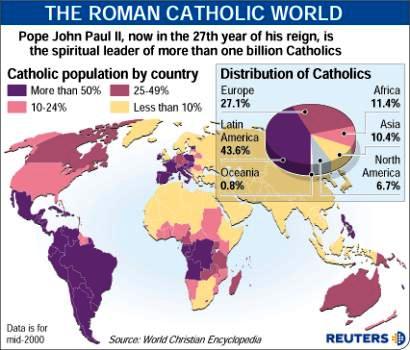
This is undoubtedly the biggest religious news in a long time, and, much to my unceasing shame, I can think of nothing substantial to contribute to the discussion. I can only reiterate the commonsense observation that has been made at least since the death of John Paul II, namely that the papacy no longer reflects the largest and most vibrant Catholic constituencies.
It seems that the primary discussion in the wake of Benedict's announcement has been whether or not the papacy will remain Germanic or return to Italian dominance. Never mind that Europe represents a radical minority of stereotypically nominal Catholics in the global picture.

As to the frequent and melodramatically dire warning that the election of a "third world" pope might bring about a conservative backlash that could undermine Vatican II, of course it could. But this reflects precisely the same problem as minority domination of the papacy: the guiding vision of a liberalizing strand of Catholicism which predominates in the West is foisted upon the majority of Catholics who may or may not share that vision. The papacy ought to reflect the Catholic Church, both through continuity with its honored traditions and through representation of the needs of the parishioners.

(Of course, in truth, my biggest hope is that whoever is elected will be someone willing to work closely for the bettering of relations between the papacy and the patriarchate in Constantinople. Fingers crossed.)

Saturday, February 9, 2013

This is the House that Chris Built

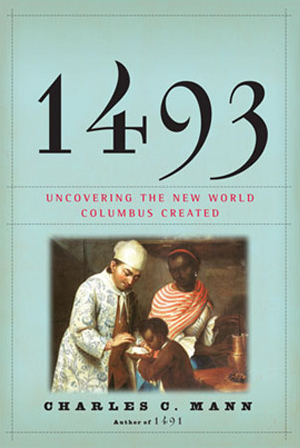
I did not enjoy reading 1493. I fully expected that I would, given my recent foray into environmental history, but it turns out that the very act of gaining knowledge in advance sapped the joy from the reading. Mann, it seemed, had little to offer me that I hadn't already seen argued with more force and clarity elsewhere. In fact, I found the reading so dreary, so basic and redundant, that I had entirely discarded my original intention to review it here. This past week, however, the book came up in a discussion of those who were either new to the field of environmental history or who were outside the field of history altogether. Their unabashed enthusiasm about the work led me to reconsider Mann’s purpose and thus to reevaluate the book’s value.

Charles Mann hardly needs my recommendation. His earlier book, 1491, was a bestseller. That work explored the Americas prior to the arrival of Columbus. This latest work, 1493: Uncovering the New World Columbus Created, is sometimes, though inadequately, cast as a sequel. In fact, what Mann sets out to do is to update and make accessible the pioneering work of Alfred Crosby first expressed in books like The Colombian Exchange and Ecological Imperialism. The basic premise is that in inaugurating the modern age of truly global intercourse Columbus did not discover a new world so much as create one. The rapid, primarily unintentional, transport of organisms big and small, the change in the way the land was used, and massive demographic shifts made the world of today what it is, making 1493 the beginning of our present age.

This conceptualization of the world is, unsurprisingly, necessarily flawed. Global intercourse no more started with Columbus than electricity started with Thomas Edison. The first voyage of Columbus makes for a convenient watershed moment, and Columbus himself is an important if exaggerated figure. Nevertheless, a view of history in grand, sweeping moments of dramatic change pervades the book, even as it is at odds with the way professional historians generally conceive of historical change.

Beyond this, however, Mann does a phenomenal job both of engaging serious scholarship in environmental history and, in spite of not being under the strictures of academic ethics, citing precisely from whom he derives the ideas he synthesizes. Those familiar with the field will notice the strong hand not only of Alfred Crosby but William Cronon, John McNeil, and countless others. Of course, if those names are familiar to you, as they are to me, then you may find nothing to intrigue you in Mann. For the vast majority of the reading public, however, for whom the Colombian exchange is still little more than the uneven trade of smallpox for syphilis, Mann opens up a whole new world of just how dramatically the transition to large scale global commerce has altered the world. Extended sections on potatoes, rubber, and mosquitoes introduce the reader to the all-too-often unwritten changes that the Americas brought to the world. A host of lesser actors appear: earthworms, honey bees, pigs, malaria, sweet potatoes, and more. All, Mann successfully and correctly argues, typically had a much larger impact on the course of human history than did the human agents conventional history is preoccupied with.

So in the end, it is impossible to fault Mann’s work for what it is: a synthesis of historical scholarship intended for a general audience not familiar with the material. The reader who knows this can find in Mann an unusually useful tool, infinitely more accessible than the standard work by historians and even more dramatically superior in its scholarship when compared to the pop histories of journalists, not to mention talk show hosts. It is a long book, prohibitive for those unaccustomed to anything more intense than a blog post (not, of course, to disparage that medium), but Mann’s style will generally appeal to avid readers making the heft bearable. Time and inclination permitting, 1493 is an excellent place to get your foot in the door of the cutting edge of one of the youngest subdisciplines in historical research.

Wednesday, February 6, 2013

Dorothy Day, the Child

Unsurprisingly, Dorothy Day began life as a child. Equally unsurprisingly, when she looked back on her childhood she found both profound truths and glimpses of her future self. This is perhaps a great act of anachronism--one which would be by no means unique to her--in which we project back onto a past of infinite possibilities the notion of fate which comes from hindsight and the wisdom which comes from distance. Even if that is true, even if to the smallest degree, it does not thereby negate the value of this self-reflection, this turning to the past to explain the present and to extract from its eventualities eternal truths. After all, Christ pointed often to children for just such a reason, either to validate this human instinct or because he knew that through it we might more easily grasp that which he taught us. It was to those like "little children" that truth had been revealed, not the wise, whom Jesus must rebuke and remind that out of the mouths of babes came true praise. To the those who would become children, the kingdom of heaven belongs. So when Day looks back on her childhood in search of kernels of truth, she may indulge a human impulse but she also practices a Christian virtue.

What she finds is both the seeds of simple faith and the onset of our most basic sins:

We did not search for God when we were children. We took Him for granted. We were at some time taught to say our evening prayers, “Now I lay me,” and “Bless my father and mother.” This done, we prayed no more unless a thunderstorm made us hide our heads under the covers and propitiate the Deity by promising to be good.

Very early we had a sense of right and wrong, good and evil. My conscience was very active. There were ethical concepts and religious concepts. To steal cucumbers from Miss Lynch’s garden on Cropsey Avenue was wrong. It was also wrong to take money from my mother, without her knowledge, for a soda. What a sense of property rights we had as children! Mine and yours! It begins in us as infants. “This is mine.” When we are very young just taking makes it mine. Possession is nine points of the law. As infants squabbling in the nursery we were strong in that possessive sense. In the nursery might made right. We had not reached the age of reason. But at the age of four I knew it was wrong to steal.

She also remember with what innocence and clarity she first learned about poverty and became disillusioned with the way it is approached in supposedly Christian society. Her words are both a testament to the obviousness of our shortcomings and to the wisdom and impressionability of our youth:

Children look at things very directly and simply. I did not see anyone taking off his coat and giving it to the poor. I didn’t see anyone having a banquet and calling in the lame, the halt and the blind. And those who were doing it, like the Salvation Army, did not appeal to me. I wanted, though I did not know it then, a synthesis. I wanted life and I wanted the abundant life. I wanted it for others too. I did not want just the few, the missionary-minded people like the Salvation Army, to be kind to the poor, as the poor. I wanted everyone to be kind. I wanted every home to be open to the lame, the halt and the blind, the way it had been after the San Francisco earthquake. Only then did people really live, really love their brothers. In such love was the abundant life and I did not have the slightest idea how to find it.

Sunday, February 3, 2013

God Rigs the Super Bowl!

This is apparently a revelation to CNN, which has reported with some amusement:

Well, according to a new poll, 27% of Americans believe that God "plays a role in determining which team wins" sporting events. That means about 80 million Americans believe that God will help one of the teams in this Sunday's Super Bowl.

That number actually strikes me as very low. I might be surprised to find that many Americans think God cares about who wins sporting events, but the belief that God is determinative in everything which happens in the world is a venerable old Christian doctrine, particularly in America. Hopefully, that is what people have in mind when they say that God is going to pick the Super Bowl winner. Of course, I could get behind the statement that "it's clear that God likes certain teams more than others. And God's favorite -- and I know many will hate to hear this -- is clearly the New York Yankees."

Friday, February 1, 2013

This House Believes Religion Has No Place in the 21st Century

The title was the proposition debated yesterday at the Cambridge Union Society debate which included former archbishop Rowan Williams and current archatheist Richard Dawkins. The audience, perhaps contrary to expectations, overwhelming rejected the proposition (324-138). Most of the headlines in the aftermath have triumphantly declare that Williams beat Dawkins in the debate, with the not so subtle implication that Christianity has triumphed over atheism. There is a sense in which that is true, but before Christians become too jubilant over what would be a largely symbolic victory anyway, it is important to remember exactly what has won the approbation of the student audience:

Some students voiced that Dawkins was in fact "the least intriguing speaker" at the debate. One second year student told TCS: "He did not address the motion. His points focused only on debating whether religion is true, and ignored the question of whether it has a place in modern society."

The student, in critiquing Dawkins, drove right to the heart of why this victory should be, if anything, disappointing for Christians. This was not a debate about the truth claims of any particular religion, least of all Christianity. Consigned to the too often unread body of the text are the humanist, the philosopher, the neo-con, and the Muslim who also weighed in on the proposition. The issue, as the profession of one of the objectors will demonstrate, was not whether or not Christianity is true or even more simply whether or not God exists but whether or not religion, in the abstract, can function for social cohesion. Christianity is no longer the subject of debate. Neither God in heaven nor Christ incarnate are propositions worth debating. Faith has been dissolved into social utility, and in that respect Christians who are delighted by the Cambridge verdict are rejoicing in their own obsolescence.


Williams won and Dawkins lost because the latter didn't realize that the question he cared so deeply about was no longer a topic of any interest. Had the proposition been "This House Believes in a Deity," statistics suggest the vote would have been very much the same, roughly three quarters voting against. In other words, Dawkins lost because he didn't realize he had already won.