Showing posts with label Holy Spirit. Show all posts

Sunday, June 12, 2011

Feast of Pentecost

There are few moments so critical in Scripture as Pentecost, when the period of waiting following Christ's ascension was resolved in the glorious outpouring of the Holy Spirit. It is, in the hearts of many Christians, a kind of birthday for the church, and that is a fair way to look at it because the promise of renewal which was made possible through the Son saw actualization in the Spirit. In other words, what was conceived in Christ came to life in the Spirit.

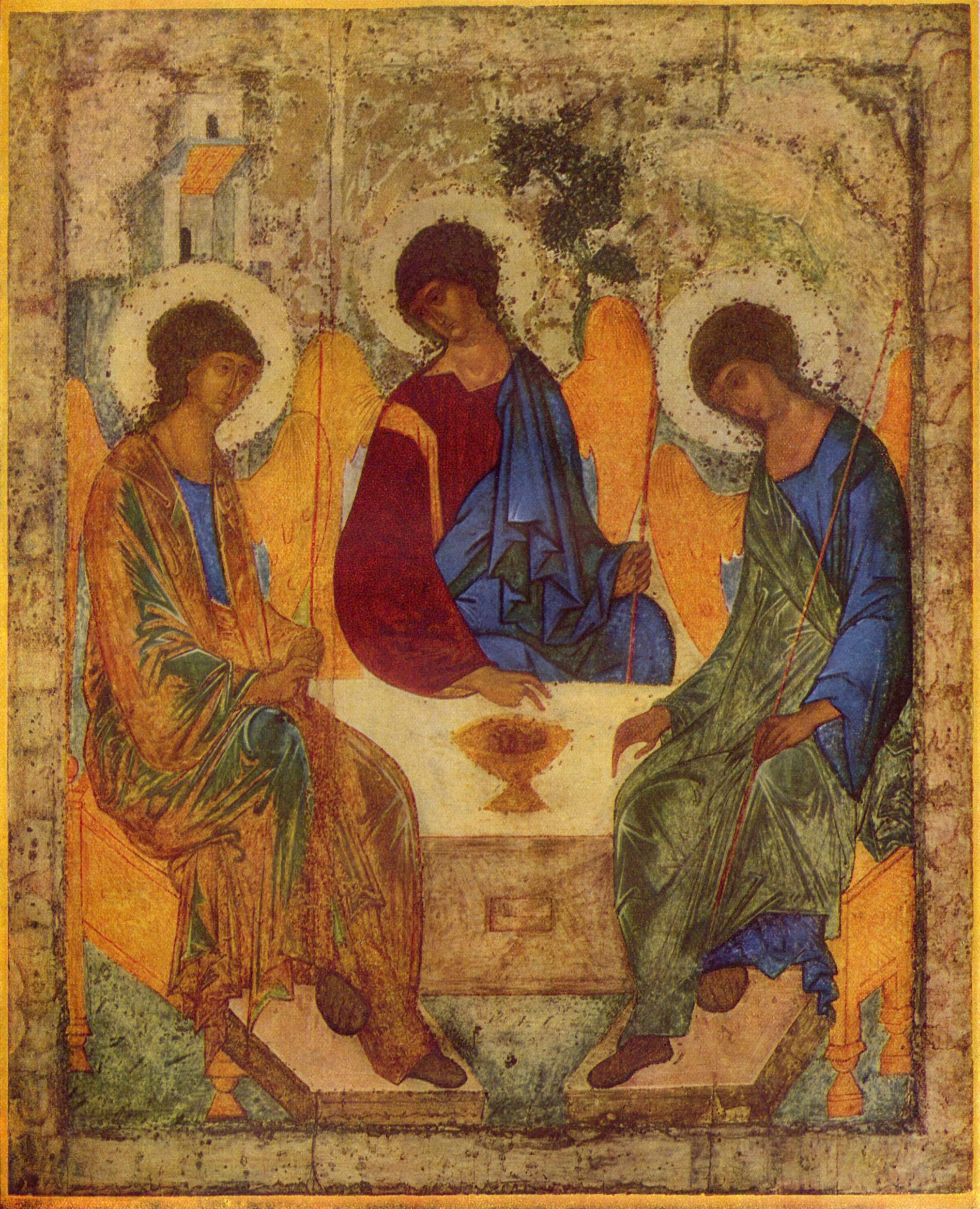
Pentecost has also been a time when traditionally the church has emphasized and defended the doctrine of the Trinity and the coequal place of the Spirit in it. The icon of the Holy Trinity comes to the forefront of Orthodox worship and Roman Catholics are encouraged to say the novena to the Holy Spirit. The prayers are quite beautiful and they stress the real place of the Spirit as part of the divine Godhead:

" Come, O blessed Spirit of Holy Fear, penetrate my inmost heart, that I may set Thee, my Lord and God, before my face forever; help me to shun all things that can offend Thee, and make me worthy to appear before the pure eyes of Thy Divine Majesty in heaven, where Thou livest and reignest in the unity of the ever Blessed Trinity, God world without end. Amen


Gregory Naziansus, in the fourth century, articulated and defended the divinity of the Holy Spirit with such acuity and vigor that he earned himself the epithet "the Theologian." It is unsurprising that his oration on the occasion of Pentecost in 381 is a vehicle for expressing this doctrine. In Constantinople, where the sermon was preached, what would be the second ecumenical council was in session. Gregory and his thought on the Spirit would be instrumental in its final decision which is properly lauded as the definitive victory for the doctrine of the Trinity in Christianity. The following selection from this oration is intended to be more inspirational than doctrinal, but it is important to remember that these truths about the Spirit that are taken for granted or neglected in modern Christianity were under constant assault in Gregory's day. What he preached was the profound mystery of the Godhead against all foreign and dangerous doctrine which would strip the Christian religion of perhaps its most foundational and normative doctrine.

Gregory the Theologian, "On Pentecost,"

Honour the Day of the Spirit; restrain your tongue if you can a little. It is the time to speak of other tongues—reverence them or fear them, when you see that they are of fire...He wrought first in the heavenly and angelic powers, and such as are first after God and around God. For from no other source flows their perfection and their brightness, and the difficulty or impossibility of moving them to sin, but from the Holy Ghost. And next, in the Patriarchs and Prophets, of whom the former saw Visions of God, or knew Him, and the latter also foreknew the future, having their master part moulded by the Spirit, and being associated with events that were yet future as if present, for such is the power of the Spirit. And next in the Disciples of Christ (for I omit to mention Christ Himself, in Whom He dwelt, not as energizing, but as accompanying His Equal), and that in three ways, as they were able to receive Him, and on three occasions; before Christ was glorified by the Passion, and after He was glorified by the Resurrection; and after His Ascension, or Restoration, or whatever we ought to call it, to Heaven. Now the first of these manifests Him—the healing of the sick and casting out of evil spirits, which could not be apart from the Spirit; and so does that breathing upon them after the Resurrection, which was clearly a divine inspiration; and so too the present distribution of the fiery tongues, which we are now commemorating. But the first manifested Him indistinctly, the second more expressly, this present one more perfectly, since He is no longer present only in energy, but as we may say, substantially, associating with us, and dwelling in us. For it was fitting that as the Son had lived with us in bodily form—so the Spirit too should appear in bodily form; and that after Christ had returned to His own place, He should have come down to us—Coming because He is the Lord; Sent, because He is not a rival God. For such words no less manifest the Unanimity than they mark the separate Individuality...

But as the old Confusion of tongues was laudable, when men who were of one language in wickedness and impiety, even as some now venture to be, were building the Tower; for by the confusion of their language the unity of their intention was broken up, and their undertaking destroyed; so much more worthy of praise is the present miraculous one. For being poured from One Spirit upon many men, it brings them again into harmony.

Tuesday, June 7, 2011

Have Prophecies Ceased: The "Perfect" Canon

Previously, the flow of Paul’s argument in 1 Corinthians 13 was examined with the aim of better understanding the context of the promise that the miraculous spiritual gifts on which the Corinthians prided themselves would one day cease. The stress of the passage is on the superiority of love and its permanence in relation to things transient. Because of this, the Corinthians ought to have love as their highest aim, not spiritual gifts.

This interpretation makes way for a better study of when precisely Paul expects prophecy and tongues-speaking to end. When this is hinges almost entirely on the interpretation of “the perfect” (το τελειον) in verse ten. There are at least four options which have gained some currency in contemporary debate:


  1. "The perfect" is the full revelation of doctrine which is represented by the completion of the New Testament, either through the finishing of the individual writings or through the final process of canon.

  2. "The perfect" is love, so that when the church truly learns to love it will no longer have need for spiritual gifts.

  3. "The perfect" is maturity, variously understood. Spiritual gifts are "childish ways" which are abandoned when the church outgrows the need for them.

  4. "The perfect" is the second coming of Christ at which time spiritual gifts will become obsolete.


Of these, only the first and fourth really demand extensive attention. While the second option provides a nice symmetry by tying the cessation back into love (though Paul himself never indicates that love will be the cause of prophecies ceasing), it gives no practicable hermeneutic for understanding the history of spiritual gifts. Has the church as a whole learned to love and that is why there is no longer tongues-speaking? When was that moment? Or have churches in the Pentecostal movement not yet learned to love? Had Paul, who exercised spiritual gifts like healing, not yet learned to love? The third option presents similar problems. What is maturity and when, if it has yet, did the church achieve it? What are we to make of the fact that some churches still ostensibly exercise spiritual gifts while others do not?

The most notable stance among those typically termed cessationists (though I should hope, as I said in my previous post, that all Christians are cessationists in an ultimate sense) is that the New Testament has brought an end to the exercise of spiritual gifts. It should come as a surprise to no one that B. B. Warfield classically articulated this position in 1918 coinciding with the rise of Pentecostalism. Rick Oster has noted that this particular cessationist position has been kept alive “more by polemical necessity than exegetical soundness” (321). It is often presented as the last bastion of biblical authority against the unbridled charismata of the holy-rolling, snake-handling hoard of senseless babblers. I will address that misconception later, but evidences for this view (which from now on I will, with some irony, refer to as “scriptural cessationism”) merit attention.

To their cause, the scriptural cessationist can muster Ephesians 4:11-16 and Hebrew 2:1-4. These verses demonstrate that God granted the gifts of the Spirit primarily as evidences and assurances of sound teaching. The reasoning then is that when an unquestionable doctrinal authority came, the necessity for spiritual gifts disappeared and with it the gifts themselves. The Ephesians passage is particularly noteworthy because it not only gives doctrinal security as the reason for spiritual gifts but also uses the same language of love and maturity that also appears in 1 Cor. 13. These are the texts in question:

11And he gave the apostles, the prophets, the evangelists, the shepherds and teachers, 12 to equip the saints for the work of ministry, for building up the body of Christ, 13until we all attain to the unity of the faith and of the knowledge of the Son of God, to mature manhood, to the measure of the stature of the fullness of Christ, 14so that we may no longer be children, tossed to and fro by the waves and carried about by every wind of doctrine, by human cunning, by craftiness in deceitful schemes. 15Rather, speaking the truth in love, we are to grow up in every way into him who is the head, into Christ, 16 from whom the whole body, joined and held together by every joint with which it is equipped, when each part is working properly, makes the body grow so that it builds itself up in love.


1Therefore we must pay much closer attention to what we have heard, lest we drift away from it. 2For since the message declared by angels proved to be reliable, and every transgression or disobedience received a just retribution, 3 how shall we escape if we neglect such a great salvation? It was declared at first by the Lord, and it was attested to us by those who heard, 4 while God also bore witness by signs and wonders and various miracles and by gifts of the Holy Spirit distributed according to his will.


The problem arises, however, that if we accept the reasoning by which these ideas support the view of scriptural cessationism then we are forced to admit that God’s in His providence has been a profound failure. Here is what I mean. If it is granted that the purpose of spiritual gifts was to prevent doctrinal error, and if it is granted that the Bible is the perfect tool for preventing doctrinal error such that it supersedes and brings an end to spiritual gifts, then why does doctrinal error abound? Paul and the author of Hebrews seem to be very clearly stating that the miraculous gifts of God worked as a sign to indicate divine approval and to guide the church in doctrinal purity. Most Christians will argue that the church was purer and more perfectly unified in the first century than the twenty first century. Why is this the case if the Bible, which guides us now, is so superior to spiritual gifts, which guided the church then? There have been more divisions in the past two hundred years than in perhaps the entire history of the church previous, and these divisions occur with the most startling frequency among those churches which hold to a “Bible only” creed. The Bible, it must be admitted, is a terrible source for assuring doctrinal purity. For every possible teaching there is a biblical hermeneutic to justify it. The Corinthians, for all their various and multiple ethical shortcomings, seemed to have a fairly firm grasp on the basic teachings of Christianity--with one notable exception.

More importantly, I think this view grossly misunderstands the relationship which existed between spiritual gifts and Scripture through the long history of God’s people. It incorrectly assumes that one is superior to the other or even that the two are antagonistic. It must be remembered, however, that miraculous gifts and holy, authoritative texts coexisted harmoniously for centuries among God’s people, even as Paul was writing. The Jews, for example, had an authoritative text early in their history in the form of the Law (if we assume, for a moment, an early date for substantial parts of the Torah). During the golden age of Israel’s prophets, miraculous signs and divine prophecies did not contradict or transcend the written code. They illumined it for a people who had allowed their own priorities to cloud God’s intentions. (Interestingly, in the case of the core of the Old Testament, the authoritative text preceded the golden age of prophecy.) The same basic dynamic is at work with the prophets and healers of the New Testament, including Jesus who explained the truth of the Scriptures and verified his exposition with miraculous signs.

The Semitic model for handling Scripture seems to be not that it replaced prophecy but that it was prophecy placed in the interpretive hands of the prophets. It cannot be forgotten that Moses is the first and greatest prophet of Israel, and it was his life and writings that became the canon for the Israelite people. His teaching was forever authoritatively interpreted and applied by the prophets of God. The same is the case with Jesus, who was the first and greatest teacher of the New Covenant (and more, of course) who entrusted his life and teaching not to scholars but to prophets and healers who would preach it with power (which, incidentally, likely means something more that speaking loudly and pounding a Bible against a pulpit). Paul, it should be imagined given his tirade against human wisdom in 1 Cor. 2, also was not expecting to entrust his teachings to academics and masters of Baconian induction. His writings which became our Scriptures are the property of a universal priesthood of believers quickened to life by the Spirit of God. Scripture in the Biblical model does not supersede prophecy but invites it as the true model for interpretation. Now, that invites us to examine what precisely spiritual gifts, and particularly prophecy, are, but that is a subject which will be taken up in good time.

So, to recap, the Bible does not adequately fill the stated role of spiritual gifts which was to ensure doctrinal certainty. Moreover, the relationship between Scripture and spiritual gifts proposed by scriptural cessationism is itself unscriptural and misunderstands the role of prophecy in the history of God’s people. It would seem that Oster may be right in his evaluation of scriptural cessationism. But wait, there’s more.

Wayne A. Grudem rightly notes that scriptural cessationism fundamentally undermines the force of the argument Paul is trying to make in 1 Cor. 13. Paul’s purpose is to show that love endures even beyond the cessation of spiritual gifts. This is hardly an impressive feat if, as scriptural cessationists believe, the end of miraculous spiritual gifts came less than a generation after Paul’s death with the writing of the last of the canonical documents. Certainly Paul is a better rhetorician than that. If I may be deliberately hyperbolic (because I am not nearly as subtle as Paul was), he might just have readily as argued, “Love never ends; it is even going to be around after dinner tonight.” Or, since some things never change, “Love never ends; it lasts longer than most politicians’ marriages.” If Paul’s point is to highlight the great permanence of love against the transience of everything else (including faith and hope) he would certainly not have picked as his counterpoint a moment in time that he could have very well lived to see had he not died a martyr.

The real damning criticism of scriptural cessationism, the final nail in the coffin, is simply that the Bible is not self-aware. It’s nature as an unconscious anthology forbids it. No matter how hard we squint, no matter how contortionist our hermeneutics are, no matter if we pray, hope, wish, and write a letter to Santa, the fact of the matter remains that the biblical authors are not aware of the future canon. Paul is writing a letter to Corinth; he did not submit it to Eerdmans to be published as part of an authoritative collection. Gordon Fee has put it thus: “It [i.e. biblical cessationism] is an impossible view, of course, since Paul himself could not have articulated it. What neither Paul himself nor the Corinthians could have understood can possibly be the meaning of the text.” (645) It needs to be assumed in reading any New Testament epistle that the audience for whom it was intended could understand the meaning that was intended. Paul and the Corinthians had no concept of a process that would be completed three centuries later, ergo Paul was not referencing that process.

It would seem that the motivation for the scriptural cessationist view is more polemical than exegetical after all. It found popularity with the rise of Pentecostalism and is slowly falling out of favor as the fear of Penecostalism subsides. Commentaries, even those by very conservative scholars, are increasingly abandoning this view. This leaves only the last of the four major views left standing. Why precisely it may be correct and how it can be defended without necessitating Pentecostalism will require further explanation.

Monday, June 6, 2011

Have Prophecies Ceased: Exposition of 1 Cor. 13

I recently promised someone a face-to-face on the subject of cessationism but was unfortunately unable to follow through on that promise. It is my hope that a series of posts in this venue will suffice as an alternative.

Cessationism, the belief that the miraculous gifts of the Spirit have ceased since the times described in the New Testament, is biblically justified almost exclusively with reference to 1 Corinthians 13:

1If I speak in the tongues of men and of angels, but have not love, I am a noisy gong or a clanging cymbal. 2And if I have prophetic powers, and understand all mysteries and all knowledge, and if I have all faith, so as to remove mountains, but have not love, I am nothing. 3 If I give away all I have, and if I deliver up my body to be burned, but have not love, I gain nothing.

4 Love is patient and kind; love does not envy or boast; it is not arrogant 5or rude. It does not insist on its own way; it is not irritable or resentful; 6it does not rejoice at wrongdoing, but rejoices with the truth. 7 Love bears all things, believes all things, hopes all things, endures all things.

8Love never ends. As for prophecies, they will pass away; as for tongues, they will cease; as for knowledge, it will pass away. 9For we know in part and we prophesy in part, 10but when the perfect comes, the partial will pass away. 11When I was a child, I spoke like a child, I thought like a child, I reasoned like a child. When I became a man, I gave up childish ways. 12For now we see in a mirror dimly, but then face to face. Now I know in part; then I shall know fully, even as I have been fully known.

13So now faith, hope, and love abide, these three; but the greatest of these is love.


I quote the full chapter rather than just verses 8-10 because the context is so very critical. The verses on the cessation of spiritual gifts are too frequently treated in isolation, which allows for a radically broad interpretation of what “the perfect” is. Christians, and even non-Christians, are largely familiar both with Paul’s definition of love (i.e. “Love is patient…”) and the triumvirate of Christian virtues (i.e. “So now faith, hope, and love abide…”). In the wake of Pentecostalism, Protestants--particularly those groups with a penchant for controversy--are equally familiar with the promise that speaking in tongues will cease. What seems to be entirely forgotten is that the prediction of cessation is sandwiched neatly in between Paul’s two most memorable statements about love. The verse about tongues-speaking and prophecy are not out of place. It is intimately related to Paul’s argument here, and the true meaning of these verses about cessation are wrapped up in precisely what that argument is.

Paul is writing in 1 Corinthians to a church that is perhaps more troubled than any other represented at length in the New Testament. In Corinth, they prefer human names to the name of Christ (Chapter 1), they prefer wisdom to divine folly (Chapter 2), they prefer libertinism to holiness (Chapter 5), they prefer “justice” to forgiveness (Chapter 6), and in this chapter Paul is dealing with their preference for spiritual gifts over the fruits of the Sprit (if I may subtly propose an intertextual relationship between 1 Cor. 13 and Gal. 5). The purpose in this chapter is neither merely to define love in a list of primary Christian virtues nor to stamp an expiration date on spiritual gifts. Paul’s aim is to show the superiority of love to spiritual gifts.

Paul achieves this aim in three broad strokes that roughly correspond to the paragraph divisions that we see in our modern English translations. First, Paul insists that love is what constitutes the value of the Christian life. Spiritual gifts, knowledge, charity, and even faith (which, incidentally, ought to qualify any valid understanding of sola fide) without love as their primary content and motive are all worthless.

Next, Paul gives an exposition of how love appears when it is manifest. The qualities which are listed are not so subtle jabs at the way the Corinthians have been treating one another. In fact, let’s break it down to see just how Paul’s description of love links back in to Paul’s earlier teachings in the same book:


In all this it becomes quite clear that the point Paul is trying to get at is that love is characterized by behaviors and dispositions quite contrary to what the Corinthians are presently practicing. Notably, he once again elevates love even above both faith and hope by saying that love both believes (the verb is “πιστευει”) and hopes all things.

Finally, Paul concludes that--though all things are contingent on love, even faith and hope--love is contingent on nothing, not even time. “Love never ends,” and with this phrase Paul introduces the part of his argument that includes the reference to cessation. The spiritual gifts which the Corinthians are delighting in and allowing to disrupt their services, these things are ultimately transient. There was a time when they began; there will be a time when they end. Love, however, is without end. Ben Witherington has noted that even here love supersedes faith and hope, which both become obsolete eventually. In the final analysis, faith becomes sight and hope is fulfilled. Love only ever increases into eternity.

In the final rendering then, Paul is concerned first and foremost with the perfect nature of love in contrast not only to spiritual gifts, but to the knowledge that the Corinthians professed to have and to the childish behaviors that they have been exhibiting. When Paul speaks of the cessation of miraculous gifts, it is not as a passing statement of fact meant simply to inform the church at Corinth that their prophecies had a "best by" date on them. It was to illustrate that even these great gifts which they had would one day pass away, but love never would. Love, therefore, is the proper object of pursuit, the proper quality for boasting and pride (except that love does not boast and is not proud). There is nothing to glory in except love which is an all-sufficient and eternal glory.

Though I believe this analysis will be fruitful in time, the above does not really immediately solve the problem of precisely when spiritual gifts like prophecy and tongues-speaking will cease. The only thing that seems self-evident to me is that every Christian ought to be in some sense a cessationist. There will be a time when prophecies cease. The only thing left to decide is exactly when that time is.

Monday, September 27, 2010

Personal vs. Person

In general, in reading Stanley Grenz's Theology for the Community of God I have very often been unimpressed and only rarely disappointed. I did find one rather predictable occasion of unnerving theology, however, in his explanation of the personhood of the Holy Spirit. Grenz is part of that venerable tradition of Western theologians whose reductionist pneumatology equates the Holy Spirit to the bond of love between the Father and the Son. This is, so far as I'm concerned, an essentially binitarian view of God where the two person of Father and Son constitute God with the Spirit as an unintended consequence of their relationship. David Bentley Hart is more generous when dealing with the tradition in general. He writes:

There is a long, predominantly Western tradition of speaking of the Spirit as the vinculum caritatis between Father and Son, which - if taken to mean that in the divine life the indiscerptibility of love and knowledge is such that God's generation and procession enfold one another, the Spirit acting as the bond of love between Father and Son, the Son as the bond of knowledge between the Father and Spirit, the Father being the source of both - is a good and even necessary term. But it can also be misleading, in various ways: as Orthodox theologians occasionally worry, it can give the appearance that the Spirit is not irreducibly "personal" as Father and Son.


Correctly understood, however, it does none of this; and it depicts the Spirit as not simply the love of Father and Son, but also everlastingly the differentiation of that love, the third term, the outward, "straying," prodigal second intonation of that love.


Whatever the merit may be of Hart's evaluation of the tradition in general (and stricken as I am by intellectual hero worship, I doubt I could ever flatly disagree with him), Grenz's pneumatology seems to fall far short of Hart's "correctly understood" application of the tradition. Instead, Grenz sums his position up thus:

The personhood of the Spirit arises from the personal character of God as well. The love that binds the Father and the Son is the essence of the one God, for "God is love." God is also personal. Therefore his essential nature - love - is likewise personal. This essence is also the third person of the Trinity, the Holy Spirit, who as the "concretization" of that essential divine character must be person.


I would like here to point out merely the most obvious flaw with this line of reasoning: simply because something is person does not mean that it is a person. The adjective "personal" in general usage - and, it would appear to me, in the above usage - means that object of the adjective involves persons. The love of the Father and the Son is personal because it involves the hypostases Father and Son. The love in my marriage is arguably personal on the same grounds, that it involves two (and hopefully only two) persons. By Grenz's logic, this makes the love in my marriage a person in its own right. Grenz argues, and I certainly agree, that God is personal, but it is because he is "constituted" of persons. I likewise agree that his love is personal, but again it is personal because it is "shared" among persons. None of this demands that the love is itself a person distinct from the persons who share the personal love.

In short, simply calling something personal does not logically demonstrate that it is a person. PC owners everywhere can sleep easy tonight.

Friday, August 6, 2010

Rational or Spiritual Creatures?

We must believe that the Bible was addressed to rational creatures, and designed by God to be understood for their profit. When we open the Bible under the impression that it is a book of mysteries, understood only by a few learned ministers, we are at once discouraged from reading and investigating its contents. But believing it was written for our learning and profit, and therefore addressed to our understanding, we are encouraged to read and diligently search its sacred pages. - Barton Stone


I think Stone may have more closely approximated the truth if he had begun this thought with "We must believe that the Bible was addressed to spiritual creatures, and designed by God to be understood for their profit." The text of Scripture gives no indication that its contents are primarily rational, not in the way that Stone indicates, and it certainly gives just the opposite impression of divine truth. In 1 Corinthians 2:13:16, Paul writes:

This is what we speak, not in words taught us by human wisdom but in words taught by the Spirit, expressing spiritual truths in spiritual words. The man without the Spirit does not accept the things that come from the Spirit of God, for they are foolishness to him, and he cannot understand them, because they are spiritually discerned. The spiritual man makes judgments about all things, but he himself is not subject to any man's judgment: "For who has known the mind of the Lord that he may instruct him?" But we have the mind of Christ.


Paul explicitly denies that human wisdom can grasp the truth about God. He contrasts human discernment with a "spiritual discernment" that is rooted in our redeemed, indwelled state. Spiritual truth is expressed in spiritual words, words that presumably do not accord with human modes of thinking. For this reason the unspiritual man is incapable of accepting or even adequately grasping truth about God. It is, to him, foolishness.

Paul explains, so far as I can tell, that this is because of the radical otherness of God. Who can know the mind of God from which spiritual truth flows? It seems self-evident to Paul that humanity is incapable of knowing God apart from His spiritually discerned truths. Normal human methods, what he terms "human wisdom" earlier in the chapter and what Stone would call rationality, are inadequate because God ineffably transcends our standard modes of thinking. Only through the transformative work of the Spirit, conforming our minds to "the mind of Christ" can we begin to grasp God. Only when we teach ourselves to "think" as God "thinks" is truth made known.

It is amusing to me that if the first sentence of Stone's quote is corrected in the way I suggested, the remainder of the quote seems to follow Paul's thinking quite nicely. It becomes a critique of hyper-rationalism and the belief that the truth of the Bible rests in the hands of an intellectual elite rather than, as I think Paul would assert, in the hands of a spiritual elite. Read it again:

We must believe that the Bible was addressed to spiritual creatures, and designed by God to be understood for their profit. When we open the Bible under the impression that it is a book of mysteries, understood only by a few learned ministers, we are at once discouraged from reading and investigating its contents. But believing it was written for our learning and profit, and therefore addressed to our understanding, we are encouraged to read and diligently search its sacred pages. - Barton Stone, with revisions