Showing posts with label Holy Days. Show all posts

Tuesday, May 21, 2013

Feast of Franz

Today we take a break from our regularly scheduled wisdom from the Christian Standard in order to observe the feast day of Franz Jägerstätter. Not on your calendar? Perhaps it should be. Jägerstätter was a German Catholic who refused to take up arms during World War II. He offered himself for non-combatant service, but the Nazis cared even less for conscientious objection during the nationalistic global wars than Americans did. Instead of allowing him to work as a military paramedic, the Nazis sentenced him to execution by guillotine. On the day of his death, he penned these words:

If I must write... with my hands in chains, I find that much better than if my will were in chains. Neither prison nor chains nor sentence of death can rob a man of the Faith and his free will. God gives so much strength that it is possible to bear any suffering.

His story would remain largely untold, until academics uncovered him and offered him to the world. In 2007, the Roman Catholic Church recognized him formally as a martyr and beatified him, making May 21st his feast day. Jägerstätter is a reminder both of the unconquerable power of the human will invigorated by the divine and of our certain ignorance of the countless stories of brave, pious fortitude that might inspire us if only we knew the half of them.

Sunday, May 5, 2013

Rejoicing on Pascha

Hallelujah! Christ is risen!

I love Easter. I love it more when the Christian community, East and West, by delightful coincidence happens to be celebrating it on the same day, but on years like this, when they don't, I do my best to look at the silver lining: I get twice as many resurrected Christs. My intent had been to share another passage from John of Sinai today, but he has nothing very pleasant to say about Easter.

The gluttonous monk...counts the days to Easter, and for days in advance he gets the food ready. The slave of his belly ponders the menu with which to celebrate the feast. The servant of God, however, thinks of the graces that may enrich him.

Joy and consolation descend on the perfect when they reach the state of complete detachment. The warrior monk enjoys the heat of battle, but the slave of passion revels in the celebrations of Easter. In his heart, the glutton dreams only of food and provisions whereas all who have the gift of mourning think only of judgment and of punishment.

Well, I'm not a warrior monk, and I left my mourning on Great and Holy Saturday where it belongs. I suppose there is a reason why John of Sinai is standard Lenten reading for the Orthodox and not standard Easter reading. Though I admit the possibility that this is duplicitous of me, and I'm sure John of Sinai would accuse me of just that, but I'd like to think that I can think both of the physical feast and of the spiritual feast afforded by the resurrection. In fact, I rather like to believe that the two are related. With sacramental flavor, the feasts of holy days are intended to make tangible to our bodies and minds--more accustomed and attuned to the immediacy of physical stimuli than spiritual ones--the great joy which we have received from God. Today being the remembrance of that consummate joy of Christian existence, I intend to make that as holistic an experience as possible, letting my body partake of the joy of my heart, and vice versa. I can only hope that God consecrates that effort rather, and I don't run headlong into gluttony and dissipation.

On that note, happy Easter everyone (even those of you who thought Easter was more than a month ago).

Saturday, May 4, 2013

Mourning on Great and Holy Saturday

Today Jesus is in the tomb and the Orthodox Christians around the world are mourning the savior. But this mourning cannot help but anticipate it relief, as the Paschal feast is within sight and the Lord is eager to spring from the tomb, resurrected, triumphant, and regnant forever. It is because of this that John of Sinai can speak of sorrow the way that he does.

Groans and sadness cry out to the Lord, trembling tears intercede for us, and the tears shed out of all-holy love show that our prayer has been accepted...Hold fast to the blessed and joyful sorrow...and do not cease laboring for it until it lefts you high above the things of the world to present you, a cleansed offering, to Christ.

Friday, May 3, 2013

Contemplating Death on Great and Holy Friday

Today Christians in the Orthodox world are recalling the crucifixion of Christ, perhaps the most famous death in human history and, if our testimony is to be believed, the most important one as well. Christ death is itself a victory over death, which has a rightful claim on all humanity except the undefiled Christ. With his death, Jesus has sapped death of all its finality, taken from death its sting. It is a truth which warrants endless rejoicing, but just as the victory over death was not complete until the resurrection and our freedom over death not complete until the eschatological future, so today is not a day for the ruminating on victory but for contemplating death. John of Sinai believes that the remembrance of death is a necessary product of our sins, but he also insists that it is a spiritual virtue if rightly practiced.

As thought comes before speech, so the remembrance of death and sin comes before weeping and mourning...To be reminded of death each day is to die each day; to remember one's departure from life is to provoke tears by the hour...Just as bread is the most necessary of all foods, so the thought of death is the most essential of all works. The remembrance of death brings labors and meditations, or rather, the sweetness of dishonor to those living in community...Just as some declare that the abyss is infinite, for they call it the bottomless pit, so the thought of death is limitless and brings with it chastity and activity.

Someone has said that you cannot pass a day devoutly unless you think of it as your last.

Remembering that humanity must still die keeps our sins in the forefront of our mind standing in judgment of our behavior now so that they will not stand so before the Lord in the last days. Considering our own deaths also reminds us of the inadequacy of them when compared to the atoning death of Christ, for "the day is not long enough to allow you to repay in full its debts to the Lord."

Thursday, May 2, 2013

Learning Humility on Great and Holy Thursday

After a couple excellent years of sharing the date of Easter (Pascha) and one year of reasonably close proximity, the holiest day in Christianity is once again being celebrated at completely different times by Catholics and Protestants, on the one hand, and the Orthodox, on the other. While for most Americans, Maundy Thursday is just a distant March memory (if it's remember at all), but today is Great and Holy Thursday in the Orthodox Church, the day when, like their Western counterparts, the Orthodox remember the washing of the disciples feet and the last supper on the night when Jesus was betrayed. Both these events--the radical servanthood of Jesus and the betrayal of the Christ for material gain--ought to inspire in us an enduring sense of humility. Humility, unfortunately, has a bitter taste to Christians, being one of those virtues which we know we ought to have but we never really aspire for because its no fun and (unsurprisingly) garners us little praise. John of Sinai, standard reading for the Orthodox during the Lenten season, views humility differently.

As soon as the cluster of holy humility begins to flower within us, we come, after hard work, to hate all earthly praise and glory. WE rid ourselves of rage and fury; and the more this queen of virtues spreads within our souls through spiritual growth, the more we begin to regard all our good deeds as of no consequence, in fact as loathsome...We have risked so far a few words of a philosophical kind regarding the blossoming and the growth of this everblooming fruit. But those of you who are close to the Lord Himself must find out from Him what the perfect reward is of this holy virtue, since there is no way of measuring the sheer abundance of such blessed wealth, nor words nor could word convey its quality.

Humility, after all, is only the rejection of false blessings in favor of real blessings, divine blessing of eternal import. To eschew earthly praise is only to suggest that we prefer the praise of God our Father to that of the devil our enemy. It is this humility which Jesus embraced in kneeling before his disciples, and this humility which Judas rejected in turning Jesus over to be crucified.

Sunday, March 31, 2013

The New Pope on Easter

Most people are getting a little weary of hearing about Pope Francis. (I'm not; I'm getting weary of people complaining about how much they are talking about him.) Whose feet is he washing? What did he say about gay marriage? Is he talking to Kirill? How significant is his provenance? His order? His papal name? Etc. It is easy to forget in all this interpretive tumult that the pope is still the spiritual icon for one seventh of the world's population, one who has a message that is not hidden beneath layers of ambiguous action and mysterious origin. He offers these wonderful thoughts for the Easter Vigil:

Dear brothers and sisters, let us not be closed to the newness that God wants to bring into our lives! Are we often weary, disheartened and sad? Do we feel weighed down by our sins? Do we think that we won’t be able to cope? Let us not close our hearts, let us not lose confidence, let us never give up: there are no situations which God cannot change, there is no sin which he cannot forgive if only we open ourselves to him.

Here is the essence of Easter, distilled and repackaged to meet the world's needs in this moment. The conquest over death is not merely a soteriological mechanism but a testimony to the efficacy of divine action. There is no recession that is more destructive than death, no sorrow which can match its permanence, no wound which can mirror its absoluteness. It is the content of our greatest tragedies and the aim and consequence of our most viscous sins. Yet God took it and transformed it, not into something marginally less terrible but into life itself. It is precisely because of this confidence display of power that we can turn to salvation, that we can expect our own deaths--the individual and the corporate deaths, the physical and the existential deaths--to be transformed ultimately into the eternal life promised for those who love him. In a world acutely aware of its own sufferings and dogged by its own perpetual inability to cure them through its chosen devices, the pope has echoed the psalmist who finds in the fidelity and potency of God the redemptive power of hope: "This is my comfort in my affliction, that your promise gives me life."

Monday, March 18, 2013

Clean Monday: Straightening Out Alaska

Normally my Clean Monday thoughts tend more toward the devotional side. (I've already had some lagana this morning, have you?) But as I was perusing news from the Orthodox world, this little tidbit struck me as too delicious not to share.

US President Barack Obama must have known that his support of gay marriage would bring him trouble. But of all possible repercussions, a demand to roll back Alaska’s 1867 sale to the United States was one he was unlikely to have seen coming.

And yet that was the very claim that an ultraconservative religious group made in a Moscow arbitrage court, citing the need to protect fellow Christians from sin.

Obama’s alleged plans to legalize the “so-called same-sex marriage” threaten the freedom of religion of Alaska’s Orthodox Christians, who “would never accept sin for normal behavior,” the nongovernmental group Pchyolki (“Bees”) said.

“We see it as our duty to protect their right to freely practice their religion, which allows no tolerance to sin,” the group said in a statement on their website.

The groups charges that the contract for the sale of Alaska is null and void because of a technicality about the method of payment. Ironically, this lawsuit is only coming to light now because of the group's own inability to abide by the legal technicalities of their own system.

Something tells me this isn't the kind of cleanliness Clean Monday is supposed to be about. It's a shame that Lent starts so much later for the Orthodox this year than for Catholics and Protestants--my preference would always be to observe them simultaneously--but, if nothing else, let those observing the Western fast season allow today serve as a reminder of the purity you committed yourself to back in February. Your Orthodox brothers and sisters around the world join you today in offering themselves as living sacrifices. If only for two weeks, Christians everywhere will be united in a period of self-reflection, purification, and anticipation of the resurrection.

Tuesday, December 25, 2012

Joy to the World, the Lord IS Come

Consider the following thoughts from Leo the Great's "Second Sermon on the Feast of the Nativity." Here he draws that all-important connection which is so frequently lost in the diluted religious remembrances which limp weakly behind our Christmas festivities, that the nativity is a salvific moment. It is meaningless for us without the passion it alludes to. That the Son of God should empty himself of his divine station and become one of us has value only because we anticipate the climax of the narrative when he returns to his rightful place at the right hand of the throne of God, becoming the path by which we might follow to the same end.

Let us be glad in the LORD, dearly-beloved, and rejoice with spiritual joy that there has dawned for us the day of ever-new redemption, of ancient preparation, of eternal bliss. For as the year rolls round, there recurs for us the commemoration of our salvation, which promised from the beginning, accomplished in the fullness of time will endure forever; on which we are bound with hearts up-lifted to adore the divine mystery: so that what is the effect of GOD’S great gift may be celebrated by the Church’s great rejoicings. For GOD the almighty and merciful, Whose nature as goodness, Whose will is power, Whose work is mercy: as soon as the devil’s malignity killed us by the poison of his hatred, foretold at the very beginning of the world the remedy His piety had prepared for the restoration of us mortals: proclaiming to the serpent that the seed of the woman should come to crush the lifting of his baneful head by its power, signifying no doubt that Christ would come in the flesh, GOD and man, Who born of a Virgin should by His uncorrupt birth condemn the despoiler of the human stock.

This crucial meaning of the Incarnation is lost in token sermons and fashionable invocations of "advent," but remains as an artifact in our rich tradition of hymns, however thoughtlessly they are intermingled with Jingle Bells.

"Fear not then," said the Angel, "Let nothing you affright, this day is born a Savior of a pure Virgin bright, to free all those who trust in Him from Satan's power and might."

O tidings of comfort and joy,
Comfort and joy
O tidings of comfort and joy

So remember that what happened at the birth of Jesus was far more radical than our caroling and nativity scenes and wreaths would suggest. That little baby--born to ignoble people in a stable, lauded by filthy shepherds, visited by foreign pagans, and pursued by murderous politicians from birth--came to upset the world order so that the sick might be well, the poor might be rich, the meek might inherit the earth and sinners the kingdom of heaven.

Monday, December 24, 2012

Preparing for the Nativity: Archbishop Demetrios

The following are the thoughts of Archbishop Demetrios, head of Greek Orthodox Archdiocese of America, from his 2012 encyclical for the Nativity:

The joy and assurance that we have in our communion with God on this holy feast engenders within our hearts an enduring hope. Our joy in the fulfillment of His divine plan for our salvation and our assurance through our faith in the truth of the Gospel, give us a firm hope in His promises of eternal life, for the complete restoration of our fellowship with Him, and for the fulfillment of all things. This is a feast of hope because through it we see all that has been accomplished, and we are given a glimpse of what is to come. This Feast of the Nativity of our Lord affirms for each one of us that we can have hope and joy in any of the circumstances and conditions of life—hope in the transformation of our lives through faith and hope in the power of God’s love.

Sunday, December 23, 2012

Preparing for the Nativity: George Whitefield

This passage is taken from George Whitefield's excitingly titled, "The Observation of the Birth of Christ, the Duty of All Christians; Or the True Way of Keeping Christmas," in which he reminds us that, of all things, the birth of Christ warrants celebration:

If we do but consider into what state, and at how great a distance from God we are fallen; how vile our natures were…when I consider these things, my brethren, and that the Lord Jesus Christ came to restore us to that favor with God which we had lost, and that Christ not only came down with an intent to do it, but actually accomplished all that was in his heart towards us; that he raised and brought us into favor with God, that we might find kindness and mercy in his sight; surely this calls for some return of thanks on our part to our dear Redeemer, for this love and kindness to our souls. How just would it have been of him, to have left us in that deplorable state wherein we, by our guilt, had involved ourselves? For God could not, nor can receive any additional good by our salvation; but it was love, mere love; it was free love that brought the Lord Jesus Christ into our world about 1700 years ago. What, shall we not remember the birth of our Jesus? Shall we yearly celebrate the birth of our temporal king, and shall that of the King of kings be quite forgotten? Shall that only, which ought to be had chiefly in remembrance, be quite forgotten? God forbid! No, my dear brethren, let us celebrate and keep this festival of our church, with joy in our hearts: let the birth of a Redeemer, which redeemed us from sin, from wrath, from death, from hell, be always remembered; may this Savior's love never be forgotten! But may we sing forth all his love and glory as long as life shall last here, and through an endless eternity in the world above! May we chant forth the wonders of redeeming love, and the riches of free grace, amidst angels and archangels, cherubim and seraphim, without intermission, for ever and ever!

I cleverly excluded the sections on how Whitefield expects people to celebrate the Feast of the Nativity: without "cards, dice, or gaming of any sort," without "eating and drinking to excess," and without taking time off from your "worldly callings to follow pleasures and diversions." Whitefield really knows how to throw a feast.

Saturday, December 22, 2012

Preparing for the Nativity

Over the next few days, I would like to offer a few quotes to direct the mind toward the way the Nativity has been and still is celebrated and conceived of in the world. Naturally, in the States and much of Europe, the Feast of the Nativity has been replaced by the ho-ho-holy night when Saint Nicholas breaks into suburban homes to fill stockings with Apple products, but this turn in the observation of Christ's birth is relatively recent and largely localized. The real "war on Christmas" has been waged by those who believe that the essence of the holy day rests in public manger scenes and the shibboleth "Christmas" and who forget that the real manger was hidden away where the poorest of the poor slept on a ground of mixed dirt and livestock feces and that the baby within it was attended to only by a marginal minority whose names are forgotten.

Leo the Great is right to call the Nativity a mystery. The virgin birth, the shining star, the visiting magi, the announcing angels, the murderous ruler, and the supreme king converge in a moment that, truly understood, should bring us a joy that transcends gifts and feasts and winter ambiance and even that laudatory idol of familial affection.

The things which are connected with the mystery of today’s solemn feast are well known to you, dearly-beloved, and have frequently been heard: but as yonder visible light affords pleasure to eyes that are unimpaired, so to sound hearts does the Saviour’s nativity give eternal joy; and we must not keep silent about it, though we cannot treat of it as we ought.

For Leo's listeners, the Nativity was a familiar remembrance, one so familiar that they needed to be reminded how eternal were its joys. Now, I fear, we don't think about it at all.

Monday, August 6, 2012

The Feast of the Transfiguration


The Transfiguration is one of the most critical, glorious, enigmatic texts in the Gospel story, not to mention one of the most neglected. I sat in an Episcopal church yesterday morning, and no mention was made of the upcoming feast at all. (Labor Day, on the other hand, is going to be a big to-do.) The Catholics didn't even decide to uniformly celebrate it until the fifteenth century. Only the Orthodox seem to have afforded the story and its commemoration the appropriate place of importance in their corporate life.

Perhaps it's not as sexy as the various smaller, less central passages about sexual ethics or gender economics. It's certainly not as gory as the Passion. But, in spite of its gross inability to satisfy our western lust for sex and violence, the Transfiguration represents a crucial moment in the Christian narrative when God manifests Himself to the world, glorifies His Son, and declares our hope and our promise in Christ. Jesus is revealed for who he truly is, and we glimpse what we will be through conforming ourselves to his likeness.

So, to commemorate the Transfiguration--in addition to eating grapes--consider the following quotes from two great theological masters for whom the Transfiguration was central.

Maximus the Confessor, First Century on Theology, 13-14:

If a man seeks spiritual knowledge, let him plant the foundation of his soul immovably before the Lord, in accordance with God's words to Moses: "Stand here by me." But it should be realized that there are differences among those who stand before the Lord, as is clear from the text, "There are some standing here who will not taste death till they have seen the kingdom of God come with power"...To those who follow him as he climbs the high mountain of his transfiguration he appears in the form of God, the form in which he existed before the world came to be...

When the Logos of God becomes manifest and radiant in us, and his face shines like the sun, then his clothes will also look white. That is to say, the words of the Gospels will then be clear and distinct, with nothing concealed. And Moses and Elijah--the more spiritual principles of the Law and the prophets--will also be present with him.

Gregory Palamas, Triads, I.3.5:

So, when the saints contemplate this divine light within themselves, seeing it by the divinizing communion of the Spirit, through the mysterious visitation of perfecting illuminations--then they behold the garment of their deification, their mind being glorified and filled by the grace of the Word, beautiful beyond measure in his splendor; just as the divinity of the Word on the mountain glorified with divine light the body conjoined to it. For "the glory which the Father gave him," he himself has given to those obedient to him, as the Gospels says, and "He willed that they should be with him and contemplate His glory."

..It is necessarily carried out in a spiritual fashion, for the mind becomes supercelestial, and as it were the companion of him who passed beyond the heavens for our sake, since it is manifestly yet mysteriously united to God, and contemplates supernatural and ineffable visions being filled with all the immaterial knowledge of a higher light. Then it is no longer the sacred symbols accessible to the senses that it contemplates, nor yet the variety of Sacred Scripture that it knows; it is made beautiful by the creative and primordial Beauty, and illumined by the radiance of God.

Sunday, April 15, 2012

Christos Anesti!

With all the eggs found, all the chocolate bunnies devoured, and all the peeps microwaved, most of us have allowed the resurrection of Christ to pass from our minds (if it was ever there at all). It would benefit Western Christians, however, to remember that there are still hundreds of millions of Christians around the world who are celebrating the central moment in the Christian narrative today. Let me offer, for your consideration, a selection from the paschal encyclical of the Ecumenical Patriarch:

If Christ’s Resurrection referred to Himself, then its significance for us would be negligible. The Church proclaims, however, that, the Lord did not arise alone. Together with Himself, He also resurrected all people. This is how our predecessor, St. John Chrysostom, proclaims this great truth in thunderous language: “Christ is risen, and none are left dead in the grave; for in being raised from the dead, he became the first-fruits of all who were asleep.” This means that Christ became the first-fruits of the resurrection of all who have fallen asleep and who will fall asleep in the future, as well as of their transition from death to life. The message is a joyful one for us all because, with His Resurrection Christ abolished the power of death. Those who believe in Him await the resurrection of the dead and are accordingly baptized in His death, rise with Him and live on in life eternal.

The world that is alienated from Christ endeavors to amass material goods because it bases its hopes for survival on them. It unwisely imagines that it will escape death through wealth. Deceived in this way to amass wealth, supposedly to extend their present life, human beings disperse death among others, too. They deny others the financial possibility of survival, often even violently depriving others of life, in the hope of preserving their own life.

How tragic! What a huge deception. For life is only acquired through faith in Christ and incorporation in His body...This means that it is no longer necessary to search for the “fountain of immortality.” Immortality exists in Christ and is offered by Him to all.

There is no need for some nations to be destroyed in order for other nations to survive. Nor is there any need to destroy defenseless human lives so that other human beings may live in greater comfort. Christ offers life to all people, on earth as in heaven. He is risen, and all those who so desire life may follow Him on the way of Resurrection. By contrast, all those who bring about death, whether indirectly or directly, believing that in this way they are prolonging or enhancing their own life, condemn themselves to eternal death.


Sunday, April 8, 2012

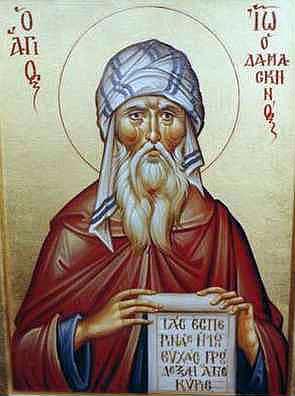
John of Damascus for Easter

Come, and let us drink of that New River,
Not from barren Rock divinely poured,
But the Fount of Life that is for ever
From the Sepulchre of CHRIST the LORD.

All the world hath bright illumination,—
Heav’n and Earth and things beneath the earth:
’Tis the Festival of all Creation:
CHRIST hath ris’n, Who gave Creation birth:

Yesterday with Thee in burial lying,
Now today with Thee aris’n I rise;
Yesterday the partner of Thy dying,
With Thyself upraise me to the skies.

Saturday, April 7, 2012

John of Damascus for Holy Saturday

Into the dim earth’s lowest parts descending,
And bursting by Thy might the infernal chain
That bound the prisoners, Thou, at three days’ ending,
As Jonah from the whale, hast risen again.

Thou brakest not the seal, Thy surety’s token,
Arising from the Tomb Who left’st in Birth
The portals of Virginity unbroken,
Opening the gates of heaven to sons of earth.

Thou, Sacrifice ineffable and living,
Didst to the FATHER by Thyself atone
As GOD eternal: resurrection giving
To Adam, general parent, by Thine own.


Friday, April 6, 2012

Gregory the Theologian for Good Friday

O Thou, the Word of truth divine!
All light I have not been,
Nor kept the day as wholly Thine;
For Thou dark spots hast seen.

The day is down: night hath prevailed:
My Lord I have belied;
I vowed, and thought to do, but failed;
My steps did somewhere slide.

There came a darkness from below
Obscuring safety's way.
Thy light, O Christ, again bestow;
Turn darkness into day.


Thursday, April 5, 2012

Andrew of Crete for Holy Thursday

O the mystery, passing wonder,
When, reclining at the board,
“Eat,” Thou saidst to Thy Disciples,
“That True Bread with quickening stored:
“Drink in faith the healing Chalice
“From a dying GOD outpoured.”

Then the glorious upper chamber
A celestial tent was made,
When the bloodless rite was offered,
And the soul’s true service paid,
And the table of the feasters
As an altar stood displayed.

CHRIST is now our mighty pascha,
Eaten for our mystic bread:
Take we of His broken Body,
Drink we of the Blood He shed,
As a lamb led out to slaughter,
And for this world offered.

To the Twelve spake Truth eternal,
To the Branches spake the Vine:
“Never more from this day
Shall I taste again this wine,
Till I drink it in the kingdom
Of My FATHER, and with Mine.”

Thou hast stretched those hands for silver
That had held the immortal Food;
With the lips that late had tasted
Of the Body and the Blood,
Thou hast given the kiss, O Judas;
Thou hast heard the woe bestowed.

CHRIST to all the world gives banquet
On that most celestial Meat:
Him, albeit with lips all earthly,
Yet with holy hearts we greet:
Him, the sacrificial Pascha,
Priest and Victim all complete.

Sunday, April 1, 2012

Andrew of Crete for Palm Sunday

Jesus, hastening for the world to suffer,
Enters in, Jerusalem, to thee:
With His Twelve He goeth forth to offer
That free sacrifice He came to be.

They that follow Him with true affection
Stand prepared to suffer for His Name:
Be we ready then for man’s rejection,
For the mockery, the reproach, the shame.

Now, in sorrow, sorrow finds its healing:
In the form wherein our father fell,
CHRIST appears, those quick’ning Wounds revealing,
Which shall save from sin and death and hell.

Now, Judaea, call thy Priesthood nigh thee!
Now for Deicide prepare thy hands!
Lo! thy Monarch, meek and gentle by thee!
Lo! the Lamb and Shepherd in thee stands!

To thy Monarch, Salem, give glad greeting!
Willingly He hastens to be slain
For the multitude His entrance meeting
With their false Hosanna’s ceaseless strain.
“Blest is He That comes,” they cry,
“On the Cross for man to die!”