The minister’s wife ought to be selected by a committee of the church. She should be warranted never to have a headache, or neuralgia; she should have nerves of iron; she should never be tired or sleepy, and should be everybody’s cheerful drudge; she should be cheerful, intellectual, pious, domesticated; she should keep her husband’s house, darn his stockings, make his shirts, cook his dinner, light his fire, and copy his sermons; she should keep up the style of a lady on the wages of a day-laborer, and be always at leisure for “good works,” and ready to receive morning calls; she should be secretary to the Band of Hope, Dorcas Society, and the Home Mission; she should conduct Bible classes and mothers’ meetings; should make clothes for the poor and gruel for the sick; and finally she should be pleased with everybody and everything, and desire no reward beyond the satisfaction of having done her own duty and other people’s too.
Showing posts with label marriage. Show all posts
Showing posts with label marriage. Show all posts
Tuesday, June 11, 2013
Some Standard Wisdom on Ministers' Wives
After a couple of weeks of more serious excerpts, it is time to return to more lighthearted fare. This offering, entitled "The Minister's Wife" was intended, almost certainly, as a sarcastic critique of the unrealistic expectation that congregations had for the spouses of their leaders. Still, I can't help but read it and think that, hovering just beneath the surface, is an genuine wish.


Saturday, March 23, 2013
The Necessity of Redefining Marriage
Ben Witherington has recently commented on a CNN article which lays out, in my opinion, perhaps the strongest case against gay marriage from a strictly secular standpoint. I mention Witherington rather than going directly to the article because he includes many theological considerations which readers here are likely to find interesting. My main concern, however, is the argument of Robert P. George and Sherif Girgis.
 The authors make a compelling observation that, legally, marriage does much more than standardize a primary relationship (e.g. defaulting who ought to be your medical proxy or to whom your possession belong in the event of your death). If this was its sole function, there would be no need for the legal structure which has been built up around marriage, one which institutionalizes matters of monogamy, sexual exclusivity, and permanence. If it were about formalizing a person's primary affective attachment, it should be as easy to change as a will and open to the possibility of multiple equal levels of attachment. Which it isn't; at least not legally.
In fact, American culture has largely done away with these pillars of marital theory, particularly permanence. It is not quite as easy to change a spouse as it is to change a beneficiary in your will, but it is done with strikingly more regularity nonetheless. Sexual exclusivity is eroding with a startlingly rapidity, so that primary relationships which have not yet been formalized are rarely assumed to be sexually exclusive and even married persons have a wealth of ways to violate the bounds of sexual exclusivity with impunity. (Someone care to look up statistics about the use of pornography by married men?) Only monogamy remains largely uncontested both legally and culturally, although the authors do point out the swelling phenomenon of polyamory.
The solution seems to me to require a redefinition of marriage rather than a feigned conservative defense of the grand old institution. The heterosexual marriage characterized by monogamy, fidelity, and permanence exists more as a convenient fiction than a staid bulwark against social decay. If we care about a definition of marriage that includes these principles than a cultural redefinition of marriage is in order, one that would accord with and allow for the revitalization of marriage laws. If, however, we recognize the cultural shift behind which the law has lagged, then the legal redefinition of marriage seems to be in order, not only to exclude the heterosexual requirement, but also all laws which are artifacts of a time when marriage was permanent, monogamous, and exclusive.
My preference has, traditionally, been for the latter, but only because it divorces what is legal from what is ethical in a way that neatly accords with my view of the world. More to the point, short of a spontaneous, universal, and enduring cultural revolution that recaptures the historic conception of marriage, changing the law to reflect culture seems to be the prudent course.
(None of which, of course, comments at all on the permissibility of homosexuality in Christian ethics.)
Marriage is far more than your emotional bond with “your Number One person,” to quote same-sex marriage proponent John Corvino. Just as the act that makes marital love also makes new life, so marriage itself is a multilevel — bodily as well as emotional — union that would be fulfilled by procreation and family life. That is what justifies its distinctive norms — monogamy, exclusivity, permanence — and the concept of marital consummation by conjugal intercourse.
...All human beings are equal in dignity and should be equal before the law. But equality only forbids arbitrary distinctions. And there is nothing arbitrary about maximizing the chances that children will know the love of their biological parents in a committed and exclusive bond. A strong marriage culture serves children, families and society by encouraging the ideal of giving kids both a mom and a dad.
 The authors make a compelling observation that, legally, marriage does much more than standardize a primary relationship (e.g. defaulting who ought to be your medical proxy or to whom your possession belong in the event of your death). If this was its sole function, there would be no need for the legal structure which has been built up around marriage, one which institutionalizes matters of monogamy, sexual exclusivity, and permanence. If it were about formalizing a person's primary affective attachment, it should be as easy to change as a will and open to the possibility of multiple equal levels of attachment. Which it isn't; at least not legally.
In fact, American culture has largely done away with these pillars of marital theory, particularly permanence. It is not quite as easy to change a spouse as it is to change a beneficiary in your will, but it is done with strikingly more regularity nonetheless. Sexual exclusivity is eroding with a startlingly rapidity, so that primary relationships which have not yet been formalized are rarely assumed to be sexually exclusive and even married persons have a wealth of ways to violate the bounds of sexual exclusivity with impunity. (Someone care to look up statistics about the use of pornography by married men?) Only monogamy remains largely uncontested both legally and culturally, although the authors do point out the swelling phenomenon of polyamory.
The solution seems to me to require a redefinition of marriage rather than a feigned conservative defense of the grand old institution. The heterosexual marriage characterized by monogamy, fidelity, and permanence exists more as a convenient fiction than a staid bulwark against social decay. If we care about a definition of marriage that includes these principles than a cultural redefinition of marriage is in order, one that would accord with and allow for the revitalization of marriage laws. If, however, we recognize the cultural shift behind which the law has lagged, then the legal redefinition of marriage seems to be in order, not only to exclude the heterosexual requirement, but also all laws which are artifacts of a time when marriage was permanent, monogamous, and exclusive.
My preference has, traditionally, been for the latter, but only because it divorces what is legal from what is ethical in a way that neatly accords with my view of the world. More to the point, short of a spontaneous, universal, and enduring cultural revolution that recaptures the historic conception of marriage, changing the law to reflect culture seems to be the prudent course.
(None of which, of course, comments at all on the permissibility of homosexuality in Christian ethics.)
Monday, March 18, 2013
Clean Monday: Straightening Out Alaska
Normally my Clean Monday thoughts tend more toward the devotional side. (I've already had some lagana this morning, have you?) But as I was perusing news from the Orthodox world, this little tidbit struck me as too delicious not to share.
The groups charges that the contract for the sale of Alaska is null and void because of a technicality about the method of payment. Ironically, this lawsuit is only coming to light now because of the group's own inability to abide by the legal technicalities of their own system.
Something tells me this isn't the kind of cleanliness Clean Monday is supposed to be about. It's a shame that Lent starts so much later for the Orthodox this year than for Catholics and Protestants--my preference would always be to observe them simultaneously--but, if nothing else, let those observing the Western fast season allow today serve as a reminder of the purity you committed yourself to back in February. Your Orthodox brothers and sisters around the world join you today in offering themselves as living sacrifices. If only for two weeks, Christians everywhere will be united in a period of self-reflection, purification, and anticipation of the resurrection.
US President Barack Obama must have known that his support of gay marriage would bring him trouble. But of all possible repercussions, a demand to roll back Alaska’s 1867 sale to the United States was one he was unlikely to have seen coming.
And yet that was the very claim that an ultraconservative religious group made in a Moscow arbitrage court, citing the need to protect fellow Christians from sin.
Obama’s alleged plans to legalize the “so-called same-sex marriage” threaten the freedom of religion of Alaska’s Orthodox Christians, who “would never accept sin for normal behavior,” the nongovernmental group Pchyolki (“Bees”) said.
“We see it as our duty to protect their right to freely practice their religion, which allows no tolerance to sin,” the group said in a statement on their website.
The groups charges that the contract for the sale of Alaska is null and void because of a technicality about the method of payment. Ironically, this lawsuit is only coming to light now because of the group's own inability to abide by the legal technicalities of their own system.
Something tells me this isn't the kind of cleanliness Clean Monday is supposed to be about. It's a shame that Lent starts so much later for the Orthodox this year than for Catholics and Protestants--my preference would always be to observe them simultaneously--but, if nothing else, let those observing the Western fast season allow today serve as a reminder of the purity you committed yourself to back in February. Your Orthodox brothers and sisters around the world join you today in offering themselves as living sacrifices. If only for two weeks, Christians everywhere will be united in a period of self-reflection, purification, and anticipation of the resurrection.
Thursday, November 29, 2012
The War on Men: A Digest
On Monday, Suzanne Venker published a brief article in which she argues:
I’ve accidentally stumbled upon a subculture of men who’ve told me, in no uncertain terms, that they’re never getting married. When I ask them why, the answer is always the same.
Women aren’t women anymore.
...Fortunately, there is good news: women have the power to turn everything around. All they have to do is surrender to their nature – their femininity – and let men surrender to theirs.
If they do, marriageable men will come out of the woodwork.
Unsurprisingly, the very women who Venker labels as "angry" and "defensive" were outraged by the suggestion and did not hesitate to express that outrage.
Meghan Casserly for Forbes, in one of the tamer articles, writes:
Women, do you hear Suzanne Venker? It’s all your fault. The women’s sexual revolution has left you too aggressive and too needy at the same time—two things “good men” absolutely abhor. But it’s not so much the changing that’s pissing mankind off, ladies. No, we’re pissing them off by expecting them to change along with us. To help us.
Venker writes that women have changed in recent decades and that men have stayed the same–as there hasn’t been a revolution that demanded it. But it seems that very revolution might be upon us. Modern men have two options: to change—or continue going the way of the buffalo.
Erin Gloria Ryan for Jezebel was predictably more outraged:
Venker's piece for Fox News, which extrapolated from changing attitudes about marriage that there's an entire subculture of men who don't want to get married, and that's because women are scaring them away by competing with them, was roundly mocked for being stupid, mindless garbage that paints women as testicle eating castrators and men as delicate babies upset that their feelings aren't being appropriately catered to. Women aren't letting men "win" in this ongoing battle of the sexes, and in response, men are taking their ball(s) and going home. Marital Lysistrata, if you will.
As was her counterpart, Jessica Wakeman, at Frisky:
2. I’ve … stumbled upon a subculture of men who’ve told me, in no uncertain terms, that they’re never getting married. When I ask them why, the answer is always the same. Women aren’t women anymore.
Also, Mommy makes his favorite Hamburger Helper whenever he asks and does not charge any rent for sleeping on that old couch in her basement. And she has no idea all that porn he’s downloaded is the reason why her computer is running so slow.
6. Now the men have nowhere to go.
Waaahhhhh. Fap fap fap fap fap.
Or the similarly lofty response of Kaili Joy Gray for Daily Kos:
Being a lady writer who writes about how ladies totally suck is such hard work.
It's especially hard work if you make your living telling other ladies they shouldn't make a living because of The ChildrenTM and also because it will make men feel bad about themselves. Keeping all the hatred and blame straight can really hurt your ladybrain and make you write things you totally didn't mean to write.
And Kristin Iversen of The L Magazine:
The opening shot [in the War on Men] was sounded today by Suzanne Venker when she posted an article on Foxnews.com entitled "The war on men." [sic] What about the war on capitalization, Suzanne? What about that?
Apparently, capitalization of titles is just one of the casualties in this epic struggle. But no matter, we have more important things to focus on. Namely, why don't men like women anymore? What did women do to fuck up the sweet deal that they've had for centuries? You know. The one where women didn't have the right to vote until less than a hundred years ago. The one where women still don't make anything like equal pay for doing an equal amount of work. The one where women are expected to take on all of the household chores and childcare responsibilities and look the other way while men have as much freedom as they want. THAT SWEET DEAL.
Emma Gray for the Huffington Post quips:
Meanwhile, we women will quit our jobs, purchase aprons with our last paychecks and bake like it's 1955. A workforce reduced by nearly half? That's bound to get this society headed in the right direction.
Meagan Morris for Cosmopolitan chimes in:
We've come a long way as a gender since the birth of feminism and—gender pay gap, be damned—have the same rights and opportunities as our dude counterparts.
Oopsies, though: We silly women now have too much equality, according to Suzanne Venker. The Fox News columnist hypothesizes that the reason why so-called "marriageable men" don't want to get married is because today's women don't make them feel like the super manly men women of say, the 1800s, would have...
So, all of us single ladies are destined to be single forever—and its our own fault—because we want to have careers and fulfilling lives.
Then there was Hanna Rosin at Slate:
I knew that women had become more educated. I knew they were steadily earning more money. I knew they had gained a lot of power of late, and sometimes even more money and power than the men around them. But I did not realize they had become so powerful that they could mess with the men’s DNA. How did I miss that? How has J.J. Abrams not made a movie about it?
Unfortunately, Venker is somewhat enigmatic about how to reverse this problem, beyond a few vague clues. Women, she says, “have the power to turn everything around” (Duh, of course, we have ALL the power). “All they have to do is surrender to their nature – their femininity – and let men surrender to theirs.” Surrender to my femininity. Surrender to my femininity. I get the general idea but what does it mean, like, in practice? Not wear pants so much? Let my hair grow. Ask my boss to pay me a little less? Open to ideas.
Are you noticing a trend here? No, it isn't the generally liberal or openly feminist bent of these publications. It isn't the condescending attitude that suggests that any challenge to prevailing notions about gender in public discourse is beneath serious reply. It isn't even the logically fallacious, but nevertheless ubiquitous, guilt-by-association with Phyllis Schlafly (which I did my best to edit out). It's the fact that all of these commentators are women.

Granted, I didn't lift up there skirts and check (as if any of them wear skirts...ha), though that surely would have been my prerogative in 1955 or the 1800s or whenever we're locating that fictionalized era when women were actively, systematically, and universally oppressed by men. Nevertheless, it seems clear that what we have here is a bunch of women sitting around in a closed off group trying to decide whether or not and how men are trying to oppress women and failing as men. Go figure.
Speaking on behalf of the testicled among us, or at least as one male among many, you women are welcome to continue to ascend in the workforce. Most of my colleagues are already women, as are most of my immediate supervisors. Continue to dominate academics. Be ever more consciously aggressive, more coldly rational, more unreservedly sexual, more delightfully vulgar because, after all, men have gotten away with it for years and anything we can do, you can do better. Earn equal pay for equal work, and, for the sake of reparations, reverse the pay gap for a while just to teach us a lesson. You have my permission, which you neither need nor want and which is undoubtedly a mere vestige of a paternalistic cultural heritage passed unconsciously to me by my forefathers (<--term deliberately not gender inclusive). Meanwhile, all I ask for is the simple right to find those qualities unattractive. If the idea of my home becoming a staging ground for working out gender equality doesn't comport with the notions of domestic bliss that I developed when I was a little boy playing house and you were a little girl playing sister suffragette, I trust you won't think me too primitive. While you are off pursuing your dreams, I ask only that you don't count among your goals the wholesale destruction of my dream of enjoying a wife who makes me feel like a man, the sort of man Nick Charles was in the 1930s with his young, rich, opinionated, strong-willed wife who adored him. I have never, nor would I ever, force a woman to do anything, but you'll forgive me if I don't buy into the newest, shiniest model of woman just because you're telling me she's the wave of the future. The old model works just fine, the kind who recognizes that the quests for love and equity are sometimes adversarial.
So you can scoff if you want and hurl petty insults at Suzanne Venker, but--personally, anecdotally--there seems to be more than a little truth in the argument that men aren't interested in competing all day at work and coming home to find domestic competition hovering just beneath the surface. What do you care? You don't want men like me anyway, and the men you do want don't want women like Suzanne Venker or Phyllis Schafly anyway--you know, the publicly outspoken, well-educated, career women that feminists are trying to get rid of.
If we're lucky, men will go on blaming the demise of marital tranquility on women; women will persistently nag men to change with the times and lament the failures of the brutish sex when empowered women can't find husbands; and before it's all over, maybe the world won't collapse under the wait of its own mushrooming population.
Monday, November 19, 2012
The Following is Rated M for Mature
Penile mutilation is chief among a collection of topics that I am not interested in discussing, hearing about, or reading about. (And lest a charge of sexism be leveled against me, the details of female circumcision are right there with it.) It certainly was not something I expected to find discussed at great length in Anthony Reid's Southeast Asia in the Age of Commerce. Yet, right in the heart of this Braudelian examination of the "land below the winds," Reid managed to work in an extensive and graphic discussion of grotesque penis surgeries that were enough to make my...stomach turn. Reid sees these surgeries as evidence of the inverted sexual power dynamic between the sexes in Southeast Asia society, a point which is proved as soon as the reader asks, "Why else would a man do that to his genitals?" In the interest of keeping myself well within the bounds of fair use, I have omitted much of Reid's account and encourage you to read it (beginning on page 148) if you find your appetite whetted by the following description:
So, gentleman, the next time your wives make some seemingly onerous request regarding their sexual satisfaction, comfort yourself in the knowledge that at least they aren't asking you to nail a spur into your penis or embed a cluster of grapes under the skin.
The most draconian surgery was the insertion of a metal pin, complemented by a variety of wheels, spurs, or studs, in the central and southern Philippines and parts of Borneo. Pigafetta was the first of the astonished Europeans to describe the practice:
"The males, large and small, have their penis pierced from one side to the other near the head with a gold or tin bolt as large as a goose quill. In both ends of the same bolt some have what resembles a spur, with points upon the ends; others are like the head of a cart nail. I very often asked many, both old and young, to see their penis, because I could not credit it. In the middle of the bolt is a hole, through which they urinate...They say their women wish it so, and that if they did otherwise they would not have communication with them. When the men wish to have communication with their women, the latter themselves take the penis not in the regular way and commence very gently to introduce it, with the spur on top first, and then the other part. When it is inside it takes the regular position; and thus the penis always stays inside until it gets soft, for otherwise they could not pull it out."
The same phenomenon is described by many others...who agree that its purpose was always explained as enhancing sexual pleasure, especially for women. Some peoples of northwest Borneo...continued this practice until modern times, and their oral tradition attributes its origins to a legendary woman who found sexual intercourse without such an aid less satisfying than masturbation.
The same result was obtained in other parts of Southeast Asia by the less painful but probably more delicate operation of inserting small balls or bells under the loose skin of the penis..."they open [the penis] up and insert a dozen tin beads inside the skin; they close it up and protect it with medicinal herbs...the beads look like a cluster of grapes...They make a tinkling sound, and this is regarded as beautiful."
So, gentleman, the next time your wives make some seemingly onerous request regarding their sexual satisfaction, comfort yourself in the knowledge that at least they aren't asking you to nail a spur into your penis or embed a cluster of grapes under the skin.
Wednesday, November 7, 2012
In Other News
When I went to bed last night, Barack Obama was president, Republicans controlled the House of Representatives, and Democrats controlled the Senate. When I woke up this morning, Barack Obama was president, Republicans controlled the House of Representatives, and Democrats controlled the Senate. More than a year of persistent hue and cry, an anticlimax, and now, with any luck, a swift denouement. Meanwhile, to the disinterested surprise of Americans, the rest of the world has continued to turn while they beat their heads against a political brick wall.
Copts have just selected a new pope at one of the most critical junctures in modern Coptic history. The new leader, Pope Theodoros II, has rejected the political activism of his predecessor and is encouraging the church to follow his lead:
This seems to be fine by the ruling Muslim Brotherhood who have encouraged the new primate "to “support the Islamic Shariaa,” to “let go of the seculars”, and to “revoke the Church’s political role.”"
In other parts of the Muslim world, Christians are facing more direct challenges from the government. Christians in Malaysia are being "converted" to Islam without their consent on government roles simply because of their names.
The implications of this are far ranging--not least because these "Muslims" are not legally allowed to marry the Christians in their own community--and the hurdles the government has thrown up to rectify the error are numerous. What makes this more serious than a minor bureaucratic foul-up, however, is that perennial problem of apostasy in Islam. There is no permissible way to cease to be a Muslim, a conundrum which has found itself institutionalized in the racial-religious identity cards of Malaysia.
The Church of the Holy Sepulchre, sitting on the supposed burial site of Jesus, is the site of yet more controversy, this time over the more mundane matter of an unpaid water bill. The hub for Christian pilgrimage insists that it has never paid water bills as part of an unstated agreement with the utility company. Hagihon, the water company, is no longer content to receive nothing for something and has frozen the church's assests until the $2.3 million in back bills is paid.
Tension in the Christian world comes home with still more revelations from the Orthodox Church in America. After much publicity and dutiful investigation, church officials have released their findings about the suspended bishop accused of sexual misconduct:
Unlike the Catholic stereotype of furtive reshuffling, the OCA has embraced a more public but no less Christian program of rehabilitation and penance. Matthias will ask forgiveness from the victim directly, be admitted to a residential therapeutic program, and submit to a “focused period of time under the guidance of a peer bishop to examine, articulate and provide concrete direction in managing the expectations and accompanying spiritual, emotional and interpersonal challenges of exercising the office of the bishop.”
And more besides. If only we had directed that one billion dollars to affecting actual change in the world. But, as always, where our treasure is indicates where our heart is. Money is always hard to find except when it comes to war and politics. If that doesn't indicate their affinity, perhaps nothing will.
Copts have just selected a new pope at one of the most critical junctures in modern Coptic history. The new leader, Pope Theodoros II, has rejected the political activism of his predecessor and is encouraging the church to follow his lead:
“The most important thing is for the church to go back and live consistently within the spiritual boundaries because this is its main work, spiritual work,” the bishop said, and he promised to begin a process of “rearranging the house from the inside” and “pushing new blood” after his installation later this month as Pope Tawadros II. Interviewed on Coptic television recently, he struck a new tone by including as his priorities “living with our brothers, the Muslims” and “the responsibility of preserving our shared life.”
“Integrating in the society is a fundamental scriptural Christian trait,” Bishop Tawadros said then. “This integration is a must — moderate constructive integration,” he added. “All of us, as Egyptians, have to participate.”
This seems to be fine by the ruling Muslim Brotherhood who have encouraged the new primate "to “support the Islamic Shariaa,” to “let go of the seculars”, and to “revoke the Church’s political role.”"
In other parts of the Muslim world, Christians are facing more direct challenges from the government. Christians in Malaysia are being "converted" to Islam without their consent on government roles simply because of their names.
Bumiputra Christians in Sabah continue to be “converted to Islam” by the National Registration Department (NRD) simply because they have “bin” and “binti” in their names. Sabah churches are seeking urgent solutions to the crisis but none seems to be in sight, Bob Teoh writes in My Sinchew.
The NRD has made it clear it would continue to list Bumiputera Christians in Sabah as Muslims as long as they are known by bin or binti. It would also not rectify past entry errors by way of changing the religion listing back to Christianity in the identity cards (MyKad) of those affected. The NRD would only act upon an order by a Syariah High Court to determine whether those Bumiputera Christians whom it had listed as Muslims are not Muslims indeed.
The implications of this are far ranging--not least because these "Muslims" are not legally allowed to marry the Christians in their own community--and the hurdles the government has thrown up to rectify the error are numerous. What makes this more serious than a minor bureaucratic foul-up, however, is that perennial problem of apostasy in Islam. There is no permissible way to cease to be a Muslim, a conundrum which has found itself institutionalized in the racial-religious identity cards of Malaysia.
The Church of the Holy Sepulchre, sitting on the supposed burial site of Jesus, is the site of yet more controversy, this time over the more mundane matter of an unpaid water bill. The hub for Christian pilgrimage insists that it has never paid water bills as part of an unstated agreement with the utility company. Hagihon, the water company, is no longer content to receive nothing for something and has frozen the church's assests until the $2.3 million in back bills is paid.
"We trust God and hope that people will help us," [the General Secretary of the Patriarchate, Archbishop of Constantina Aristarchos] said, adding that the Patriarchate has sent letters to Israeli President Shimon Peres and Prime Minister Benjamin Netanyahu.
Tension in the Christian world comes home with still more revelations from the Orthodox Church in America. After much publicity and dutiful investigation, church officials have released their findings about the suspended bishop accused of sexual misconduct:
Text messages and emails sent by the bishop of the Orthodox Church in America’s Diocese of the Midwest did constitute sexual misconduct, according to a letter posted to the church’s website Sunday...
“I wish that I could convince all of you what I am certain of in my heart — that conscious motives behind my interaction with this woman were not impure,” [the accused bishop] Matthias wrote. “But, I know that only active, demonstrated repentance — confession of my sins, pursuit of the means of changing, and a resulting change in conduct — will be convincing.”
Unlike the Catholic stereotype of furtive reshuffling, the OCA has embraced a more public but no less Christian program of rehabilitation and penance. Matthias will ask forgiveness from the victim directly, be admitted to a residential therapeutic program, and submit to a “focused period of time under the guidance of a peer bishop to examine, articulate and provide concrete direction in managing the expectations and accompanying spiritual, emotional and interpersonal challenges of exercising the office of the bishop.”
And more besides. If only we had directed that one billion dollars to affecting actual change in the world. But, as always, where our treasure is indicates where our heart is. Money is always hard to find except when it comes to war and politics. If that doesn't indicate their affinity, perhaps nothing will.
Wednesday, September 19, 2012
Breaking News: Text About Jesus' Wife Prompts Zero Controversy
There is breaking news coming out of Boston:
Of course, journalistic pot-stirring aside, this discovery will actually generate no controversy and will likely go entirely unnoticed in the debate about priestly celibacy. Why? It's not because the document is already facing serious scholarly doubts about its authenticity. It's also not because even the professor in question admits that the content of the papyrus in no way constitutes evidence that Jesus was actually married. This discovery, even if it is authentic, will mean absolutely nothing to the question of clerical celibacy because it isn't news to the Catholics. They, like everyone else remotely versed in the issues, already knows that numerous late antique heterodox sects believed that Jesus was married. They, probably rightly, lump them in with the people who thought Christ was a phantom and the people who thought, as a boy, he turned clay into pigeons.
If the Catholic Church can find a way to cope with the fact that Peter, ostensibly the first pope, was married, they can certainly ignore the fact that some fourth century fringe groups speculated that Jesus was too. And they will ignore it. And so should you.
A Harvard professor has identified what appears to be a scrap of fourth century Egyptian papyrus that contains the first known explicit reference to Jesus as married, a discovery that could fuel the millennia-old debate about priestly celibacy in the Catholic church.
Of course, journalistic pot-stirring aside, this discovery will actually generate no controversy and will likely go entirely unnoticed in the debate about priestly celibacy. Why? It's not because the document is already facing serious scholarly doubts about its authenticity. It's also not because even the professor in question admits that the content of the papyrus in no way constitutes evidence that Jesus was actually married. This discovery, even if it is authentic, will mean absolutely nothing to the question of clerical celibacy because it isn't news to the Catholics. They, like everyone else remotely versed in the issues, already knows that numerous late antique heterodox sects believed that Jesus was married. They, probably rightly, lump them in with the people who thought Christ was a phantom and the people who thought, as a boy, he turned clay into pigeons.
If the Catholic Church can find a way to cope with the fact that Peter, ostensibly the first pope, was married, they can certainly ignore the fact that some fourth century fringe groups speculated that Jesus was too. And they will ignore it. And so should you.
Thursday, August 30, 2012
Sexy Amendments to the Constitution
We have all heard the ultimately impotent advocacy for an amendment to the Constitution that would restrict marriage to heterosexual monogamy. We have also all heard the formulaic justification: protect the family, protect marriage. The main problem here is that if I am really interested in protecting the family and traditional marriage, if I toast my Pop Tart every morning in the warm glow of my righteous cause, then a Constitutional ban on same-sex marriage is not where I'm going to start.
You won't hear Mitt Romney or Sean Hannity say it (though you might keep an eye on Newt Gingrich), but what this country really needs to protect families is an Amendment that criminalizes premarital sex. Out of wedlock births are the problem. That is what's destroying the family. The Brookings Institution reports:
As of 1990, more than one in four children are born out of wedlock. Meanwhile, The National Gay and Lesbian Task force estimates that only 3-8% of the population are homosexuals, a number significantly higher than equally partisan Christian groups' estimates and higher even than Kinsey's statistic of 4% exclusively homosexual males. Even if we accept that high number thought, children born out of wedlock are a significantly higher percentage of children than homosexuals are of the general population. Even if suddenly same sex marriage were legal and immediately the entire homosexual population of America were to marry at the same rate the heterosexual population does, roughly half, the 12.5 million newly married homosexuals would still not match the roughly 20 million children under eighteen who were born out of wedlock. If we want to promote healthy families centered on heterosexual parents, the first step is to criminalize sex outside of marriage with an amendment to the Constitution.
Even if, oh were that it so, we could get that magical clause tacked on to the Constitution, gay marriage wouldn't be my next stop. After criminalizing pre-marital sex, the next greatest threat to traditional marriage is divorce. The oft quoted statistic that half of all marriages end in divorce, probably more scientifically stated as 40-50% of marriage will be disrupted by permanent separation or divorce, ought to be enough to prove that conclusively. In addition to destroying half of all traditional, heterosexual marriages, divorce leaves an estimated 1.1 million new children in broken homes every year. That is only slightly lower than the 1.2 million children born out of wedlock every year. The family is suffering.
If we follow our statistical path from the tentatively titled "No Milk Until You Buy the Cow Amendment," allowing same sex marriage would only see about a 2-4% increase in marriages, or roughly 100,000. Meanwhile, the legality of divorce allows for the destruction every year of well over one million marriages. The disparity is clear. Divorce poses roughly ten times the danger to marriage and the family that same sex marriage does. It must be criminalized, and it must be done at the Constitutional level.
It is a tragedy, really, that the "consistent conservatives" in this country have had so much trouble appropriately identifying and combating the real threats to traditional marriage. Perhaps if we made it an issues of America's standing in the world. Maybe if we point out that socialist Sweden has managed a significantly lower divorce rate than America. Or that in the sensuous Mediterranean climes of Spain, the out of wedlock birthrate is about 75% of what it is in the States. Canada is beating us in every category, which ought to be enough to infuriate every conservative. For single-parent households as a percentage of total households with children, America ranks below Canada, Japan, Denmark, France, Germany, Ireland, the Netherlands, Sweden, and the UK. We're dead last.
So let's get with it, defenders of traditional marriage. If you genuinely care about the state of marriage in this country, then it is time to stand up and make the hard decisions necessary to protect it. That, or maybe it is time to be honest with yourself and the public about what motivates your politics. Honesty in politics: God help us if we ever get it.
You won't hear Mitt Romney or Sean Hannity say it (though you might keep an eye on Newt Gingrich), but what this country really needs to protect families is an Amendment that criminalizes premarital sex. Out of wedlock births are the problem. That is what's destroying the family. The Brookings Institution reports:
In 1965, 24 percent of black infants and 3.1 percent of white infants were born to single mothers. By 1990 the rates had risen to 64 percent for black infants, 18 percent for whites. Every year about one million more children are born into fatherless families.
As of 1990, more than one in four children are born out of wedlock. Meanwhile, The National Gay and Lesbian Task force estimates that only 3-8% of the population are homosexuals, a number significantly higher than equally partisan Christian groups' estimates and higher even than Kinsey's statistic of 4% exclusively homosexual males. Even if we accept that high number thought, children born out of wedlock are a significantly higher percentage of children than homosexuals are of the general population. Even if suddenly same sex marriage were legal and immediately the entire homosexual population of America were to marry at the same rate the heterosexual population does, roughly half, the 12.5 million newly married homosexuals would still not match the roughly 20 million children under eighteen who were born out of wedlock. If we want to promote healthy families centered on heterosexual parents, the first step is to criminalize sex outside of marriage with an amendment to the Constitution.
Even if, oh were that it so, we could get that magical clause tacked on to the Constitution, gay marriage wouldn't be my next stop. After criminalizing pre-marital sex, the next greatest threat to traditional marriage is divorce. The oft quoted statistic that half of all marriages end in divorce, probably more scientifically stated as 40-50% of marriage will be disrupted by permanent separation or divorce, ought to be enough to prove that conclusively. In addition to destroying half of all traditional, heterosexual marriages, divorce leaves an estimated 1.1 million new children in broken homes every year. That is only slightly lower than the 1.2 million children born out of wedlock every year. The family is suffering.
If we follow our statistical path from the tentatively titled "No Milk Until You Buy the Cow Amendment," allowing same sex marriage would only see about a 2-4% increase in marriages, or roughly 100,000. Meanwhile, the legality of divorce allows for the destruction every year of well over one million marriages. The disparity is clear. Divorce poses roughly ten times the danger to marriage and the family that same sex marriage does. It must be criminalized, and it must be done at the Constitutional level.
It is a tragedy, really, that the "consistent conservatives" in this country have had so much trouble appropriately identifying and combating the real threats to traditional marriage. Perhaps if we made it an issues of America's standing in the world. Maybe if we point out that socialist Sweden has managed a significantly lower divorce rate than America. Or that in the sensuous Mediterranean climes of Spain, the out of wedlock birthrate is about 75% of what it is in the States. Canada is beating us in every category, which ought to be enough to infuriate every conservative. For single-parent households as a percentage of total households with children, America ranks below Canada, Japan, Denmark, France, Germany, Ireland, the Netherlands, Sweden, and the UK. We're dead last.
So let's get with it, defenders of traditional marriage. If you genuinely care about the state of marriage in this country, then it is time to stand up and make the hard decisions necessary to protect it. That, or maybe it is time to be honest with yourself and the public about what motivates your politics. Honesty in politics: God help us if we ever get it.
Monday, August 20, 2012
The Politics of Gun Control
I read Blake Zeff's recent article on gun control and found myself unexpectedly impressed. The piece begins with this simple premise:
And he proceeds from there to discuss not so much the "why" of gun control, which becomes so immediately repetitive in the wake of so many recent shootings, but the "how." Taking his cues from the movement to legalize same-sex marriage, he explores how gun control advocates need to be willing to invest financially in the cause and to take control of how the debate is framed. Both are pragmatic suggestions and both have worked very well for the same-sex marriage movement. It is an interesting exploration of the technology of politics.

Zeff also attempts to locate the major obstacle that gun control will face that same-sex marriage will not. For him, this is the established opposition represented symbolically (and fiscally) by the NRA. Now, I am skeptical that opposition movements to same-sex marriage can really be described as "relatively weak and poorly organized," except in places where it likely would have made no difference to begin with, but the political might of the NRA does make for a substantial hurdle to overcome.
Zeff does not, however, note a more crucial difference between the two movements. The press for same-sex marriage was, fundamentally, an attempt to expand a set of rights (as we conceive of them). Gun control, for whatever its merits may be, is an attempt to narrow a set of rights. It is critical to note that I am not saying that owning an assault weapon ought to be a right. For that matter, I am not saying getting married should be either. In simple pragmatic terms, however, where same-sex marriage has been permitted, people have been allowed to do something legally that they could not previously. Were gun control enacted, something that people could once do legally would no longer be licit.
You can frame the position as a libertarian one, as Zeff does. You can cite statistics about gun violence. You can appeal to examples of European nations with little to no gun crimes. You can reframe the parameters of the debate, restructure the narrative as much as you want. At the end of the day, Americans have a deeply ingrained cultural aversion to abridging rights. One need only look at Prohibition, that most dramatic of all prohibitive laws, and note that it took nearly one hundred years of temperance movements to see Prohibition amended to the Constitution and only thirteen years of spotty or non-existent enforcement to see it repealed. Once Americans have a taste of something or even the knowledge of the potential to taste of something, telling them they can't have it violates a spirit that permeates our society.
Zeff notes that the statistical data which shows a small majority of Americans in favor of at least some form of gun control is rendered pragmatically meaningless when the question of who will be motivated to translate those positions into votes. it is my suspicion that many people who will never own an assault rifle, even people who will never own a gun, when the time comes to decide whether or not to restrict a activity they have no intention of participating in, they will react viscerally and decisively. The Enlightenment sense of entitlement, of rights, is more essential to American culture even than Christian morality. To overturn it will require a more herculean effort even than the marginal gains that have been made toward legalizing same-sex marriage.
That is not to say it can't be done. It obviously can be. Americans have, from time to time and with varying degrees of permanence, broached new frontiers of government restriction of behavior. It is not typical, but it is possible. What's more, it is not even my intention to argue against trying to achieve gun control. While I recognize that pressing gun restrictions, even to the point that we already have, is antithetical to the spirit of those founders who drafted and supported the Bill of Rights, I also don't owe them any particular loyalty. I'd be happier in an America with fewer guns. Or no guns, since in my experience they exist primarily for sport hunting and violence directed at people--aggressive and defensive, licit and illicit.
All of that is beside the point. The point is that Zeff, while making an interesting and likely constructive argument for the mechanics of achieving gun control, fails to accurately grasp the problem of his parallel to same-sex marriage. This is not like knowing how to grow cucumbers and using that to learn how to grow squash. This is like knowing how to grow cucumbers and trying to use that to learn how to ungrow them. It's a whole different ball game.
There's a reason that nothing's happening to improve gun safety in America despite the mass shootings that now occur so regularly: No one in power is scared of the gun control movement.
And he proceeds from there to discuss not so much the "why" of gun control, which becomes so immediately repetitive in the wake of so many recent shootings, but the "how." Taking his cues from the movement to legalize same-sex marriage, he explores how gun control advocates need to be willing to invest financially in the cause and to take control of how the debate is framed. Both are pragmatic suggestions and both have worked very well for the same-sex marriage movement. It is an interesting exploration of the technology of politics.

Zeff also attempts to locate the major obstacle that gun control will face that same-sex marriage will not. For him, this is the established opposition represented symbolically (and fiscally) by the NRA. Now, I am skeptical that opposition movements to same-sex marriage can really be described as "relatively weak and poorly organized," except in places where it likely would have made no difference to begin with, but the political might of the NRA does make for a substantial hurdle to overcome.
Zeff does not, however, note a more crucial difference between the two movements. The press for same-sex marriage was, fundamentally, an attempt to expand a set of rights (as we conceive of them). Gun control, for whatever its merits may be, is an attempt to narrow a set of rights. It is critical to note that I am not saying that owning an assault weapon ought to be a right. For that matter, I am not saying getting married should be either. In simple pragmatic terms, however, where same-sex marriage has been permitted, people have been allowed to do something legally that they could not previously. Were gun control enacted, something that people could once do legally would no longer be licit.
You can frame the position as a libertarian one, as Zeff does. You can cite statistics about gun violence. You can appeal to examples of European nations with little to no gun crimes. You can reframe the parameters of the debate, restructure the narrative as much as you want. At the end of the day, Americans have a deeply ingrained cultural aversion to abridging rights. One need only look at Prohibition, that most dramatic of all prohibitive laws, and note that it took nearly one hundred years of temperance movements to see Prohibition amended to the Constitution and only thirteen years of spotty or non-existent enforcement to see it repealed. Once Americans have a taste of something or even the knowledge of the potential to taste of something, telling them they can't have it violates a spirit that permeates our society.
Zeff notes that the statistical data which shows a small majority of Americans in favor of at least some form of gun control is rendered pragmatically meaningless when the question of who will be motivated to translate those positions into votes. it is my suspicion that many people who will never own an assault rifle, even people who will never own a gun, when the time comes to decide whether or not to restrict a activity they have no intention of participating in, they will react viscerally and decisively. The Enlightenment sense of entitlement, of rights, is more essential to American culture even than Christian morality. To overturn it will require a more herculean effort even than the marginal gains that have been made toward legalizing same-sex marriage.
That is not to say it can't be done. It obviously can be. Americans have, from time to time and with varying degrees of permanence, broached new frontiers of government restriction of behavior. It is not typical, but it is possible. What's more, it is not even my intention to argue against trying to achieve gun control. While I recognize that pressing gun restrictions, even to the point that we already have, is antithetical to the spirit of those founders who drafted and supported the Bill of Rights, I also don't owe them any particular loyalty. I'd be happier in an America with fewer guns. Or no guns, since in my experience they exist primarily for sport hunting and violence directed at people--aggressive and defensive, licit and illicit.
All of that is beside the point. The point is that Zeff, while making an interesting and likely constructive argument for the mechanics of achieving gun control, fails to accurately grasp the problem of his parallel to same-sex marriage. This is not like knowing how to grow cucumbers and using that to learn how to grow squash. This is like knowing how to grow cucumbers and trying to use that to learn how to ungrow them. It's a whole different ball game.
Thursday, August 9, 2012
Mennonite on Trial for Kidnapping and Conscience
In case this story has been flying under your radar, here is what's happening:
Now, I am typically a person of decided opinions, but I confess that I don't know what to do with this case. As a matter of navigating everyday life, I reject the judge's mindset that one must prioritize what is legal to what is moral. As the state has no legitimate authority, it has no power to coerce Christians to do violate their consciences regardless of the law. The instructions to the jury are appropriate, however, for the context in which they were given. They are in a courtroom and not an ethics seminar.
The beauty of the American legal system rests on the rule of law, single code for everyone, evenly applied. At the same time, the counterbalance to this potentially inhuman system is the court's dependence on the weighty roll given to a jury of peers to decide whether or not actions warrant penalty.
I do not think that the courts should be deciding issues of custody based on the sexuality of the parents. I also sympathize, to put it mildly, with the Christian convert who, following Biblical commandments, insists on raising up the child in the way it should go.
As I struggle with these tensions, I try to put myself into the pastor's shoes. We share, at least in theory, a common outlook on civil disobedience. Were I in his place, I might have done exactly what he did. I might even try to avoid legal penalty as he seems to be doing, although here I think this may not be the most Christian course. The biblical examples of civil disobedience, as well as those incidences of resistance which are lauded in modern times, have not tried to circumvent the law with impunity. When the time comes for a confrontation with the state, no excuses are made and no legal wrangling is attempted. Miller's attorney is claiming innocence via technicality, but when Peter confronts the state, his attitude is closer to, "I am innocent before God, even as I am guilty before you. What does that say about you?" Early Christians were imprisoned, flogged, and executed without resistance, a fact which has richly colored Mennonite history as well. Perhaps the truer course would have been to spirit the woman away and, when she was safely among the church, to accept whatever civil penalty the state imposes for right behavior.
But what do I know? Miller has already shown more courage than most of us will ever be called to show, made a more difficult decision than any of us will have to face. My purpose is not to judge him, but to take his extreme situation and use it to animate our common, extreme ethos. Whatever happens or should happen, my hope is that he will allow God to enrich him through the consequences of his actions.
Eleven women and three men were impaneled [Tuesday] to hear the case against Mennonite Pastor Kenneth Miller, accused of helping a woman flee the United States with her daughter rather than share custody of the child with her former lesbian partner.
Miller, 46, of Stuarts Draft, Va., is charged with aiding in international kidnapping. A conviction carries a maximum prison term of three years...
The judge said jurors will have to set aside their opinions and deal with the facts and the law in the case.
‘‘What is at issue here is whether Mr. Miller committed a crime,’’ U.S. District Court Judge William Sessions said.
The trial is expected to last six days.
Lisa Miller, no relation to the defendant, and Janet Jenkins of Fair Haven entered a civil union in Vermont in 2000. Lisa Miller gave birth to her daughter, Isabella, in 2002. The couple later broke up, and Lisa Miller returned to her native Virginia.
Kenneth Miller is accused of helping Lisa Miller and her daughter travel from Virginia to Canada, then to Nicaragua in September 2009 where they lived among Mennonites. The current whereabouts of the mother and her now-10-year-old child are unknown.
Now, I am typically a person of decided opinions, but I confess that I don't know what to do with this case. As a matter of navigating everyday life, I reject the judge's mindset that one must prioritize what is legal to what is moral. As the state has no legitimate authority, it has no power to coerce Christians to do violate their consciences regardless of the law. The instructions to the jury are appropriate, however, for the context in which they were given. They are in a courtroom and not an ethics seminar.
The beauty of the American legal system rests on the rule of law, single code for everyone, evenly applied. At the same time, the counterbalance to this potentially inhuman system is the court's dependence on the weighty roll given to a jury of peers to decide whether or not actions warrant penalty.
I do not think that the courts should be deciding issues of custody based on the sexuality of the parents. I also sympathize, to put it mildly, with the Christian convert who, following Biblical commandments, insists on raising up the child in the way it should go.
As I struggle with these tensions, I try to put myself into the pastor's shoes. We share, at least in theory, a common outlook on civil disobedience. Were I in his place, I might have done exactly what he did. I might even try to avoid legal penalty as he seems to be doing, although here I think this may not be the most Christian course. The biblical examples of civil disobedience, as well as those incidences of resistance which are lauded in modern times, have not tried to circumvent the law with impunity. When the time comes for a confrontation with the state, no excuses are made and no legal wrangling is attempted. Miller's attorney is claiming innocence via technicality, but when Peter confronts the state, his attitude is closer to, "I am innocent before God, even as I am guilty before you. What does that say about you?" Early Christians were imprisoned, flogged, and executed without resistance, a fact which has richly colored Mennonite history as well. Perhaps the truer course would have been to spirit the woman away and, when she was safely among the church, to accept whatever civil penalty the state imposes for right behavior.
But what do I know? Miller has already shown more courage than most of us will ever be called to show, made a more difficult decision than any of us will have to face. My purpose is not to judge him, but to take his extreme situation and use it to animate our common, extreme ethos. Whatever happens or should happen, my hope is that he will allow God to enrich him through the consequences of his actions.
Sunday, February 19, 2012
Complementarianism: Olson's Gordian Knot
The following is part of an ongoing response to Roger E. Olson’s critique of extreme complementarianism. For the origin and nature of these posts, see Complementarianism: A Defense from a Nobody.
________________________________________________________________________
Let us shift now from complementarianism in theory and Olson's critique of it to a subsequent post where Olson attempts to upend complementarianism. He proposes to offer "a true conundrum that exposes the impossibility of consistent complementarianism" and solicits in response possible solutions from "leading evangelical complementarian theorists." Unfortunately, I am not a leading theorist in any respect, and thus my opinion has only marginal weight for Olson--as I am forced to conclude does the opinions of the millions of regular complementarians who go around every day not treating their wives like children or living in abject, debilitating subjugation to their husbands. Nevertheless, I will present Olson's Gordian Knot and, with my meager skills, attempt to untie it from the complementarian position I have outlined previously.
The scenario Olson describes is difficult, admittedly, but perhaps not in the way he thinks. It isn't difficult to resolve logically; its difficulty lies in the existential turmoil it evokes. The force of his argument rests primarily in its appeal to the universal human inclination to be covetous of what we own. Anyone who has been married for any period of time has weathered some kind of financial difficulty and, in all likelihood, has butted heads with his or her spouse over the proper course to take. When you pair that shared experience with the ubiquitous presence in sinful humanity of a desire to possess and preserve "treasures on earth," it is understandable why Olson's straw complementarians have shied away from answering.
The resolution, such as it is, comes first through reorienting the ethical priorities. For Olson, the clear focus is on the ethics of financial stewardship (to use a gross euphemism). When presented with the potential objection that the limit of submission is sin, he counters that "[the complementarian] has to define “sin” in such a way as to exclude from it the wife’s knowing participation in financial ruin for their whole family." What looms large in the ethical picture then is the suggestion that the possibility of financial ruin is more critical than the possibility that some tertiary Christian principle (something totally incidental like submission) might be violated.
Instead of focusing on the dire prospect that "money for their childrens’ college educations and for retirement" might not be there--concerns which smack of an affluent Christianity foreign to the apostolic age, or to most Christian ages for that matter--the primary ethical question ought to be whether or not the foundational Christian principle of self-sacrificial love is at play. With this being the new focus, there are a number of actions which would be morally virtuous regardless of the consequences (and thus undermining Olson's utilitarian vision of ethics). For example, it would be morally virtuous for the wife to opt to submit to the husband and allow the money to be invested. If the money should be lost, credit God with using the wife's sacrifice as a tool for teaching the husband humility. If the investment should prove profitable, credit God with using the husband's prudence as a tool for teaching the wife humility. In either case, whatever happens to the money is incidental. The wife's choice to submit is morally virtuous.
Before any objections to this are raised, let me continue by adding that it would also be morally virtuous if the husband opted to forgo the investment out of sacrificial love for his wife. It is a fool (or a polemicist) who believes that true leadership consists of always getting your way. Plato understood leadership to be whatever actions best ensured that all those led were maximizing their potential. Paul had a less calculating but nonetheless compatible vision when he told husbands that they should give themselves up for their wives as Christ gave himself up for the church. If the investment turns out to have been unsound for others, credit God with using the wife's prudence as a tool for teaching the husband humility. If the investment turns out to have been sound for others, credit God with using the husband's sacrifice as a tool for teaching the wife humility. In either case, the husband can only ever act virtuous when he sacrifices his will out of love for his wife.
The ultimate issue at stake here is not how to make sound investments but how to have a sound marriage before God. The key to this does not lie in equal rights or even in a calculated, non-traditional division of labor. It lies in the willingness of the spouses to emulate Jesus Christ, who submits himself eternally to God the Father and who gave himself up ultimately for his bride the church. As the hypothetical couples counselor, I don't care at all what happens to their money. I'm not their stockbroker. My concern is helping them to grow into conformity with the image of Christ, for which submission is essential. Olson frames the question as a conflict between doing what is good and doing what is legal, but in reality it is a clash between doing what is right and doing what is desirable. The focus on the money betrays who our true master is. If it is God rather than Mammon, then the issue comes into sharper focus.
Not, I imagine, for Olson, mind you. It is clear from his proposed dilemma that he sees unsound investment as a sin (a damning judgment on so many in America and the world right now). There is a more unsettling undercurrent to Olson's argument, however, a response to which may sum up my point here. In his opening salvo, Olson poses this question with apparent indignation: "What is permanent, docile, subordination and submission if not a curse?" I would suggest that it is the appropriate human disposition before God. If submission is a curse, than the Son is accursed of the Father. If submission is a curse, then Adam and all of creation were cursed before Even ever arrived on the scene. If submission is a curse, then Paul enjoins all Christians to be cursed by one another and by God. In fact, the permanent, docile, and voluntary (an adjective that Olson always seems to omit) submission before God is the wonderful disposition in which God exalts and beatifies all creation. That wives may be asked to practice this before their husbands ("as to the Lord"), Christians before one another, congregants before elders, children before parents, slaves before masters, and on and on is not the shame of anyone but to their glorious and eternal benefit.
________________________________________________________________________
Let us shift now from complementarianism in theory and Olson's critique of it to a subsequent post where Olson attempts to upend complementarianism. He proposes to offer "a true conundrum that exposes the impossibility of consistent complementarianism" and solicits in response possible solutions from "leading evangelical complementarian theorists." Unfortunately, I am not a leading theorist in any respect, and thus my opinion has only marginal weight for Olson--as I am forced to conclude does the opinions of the millions of regular complementarians who go around every day not treating their wives like children or living in abject, debilitating subjugation to their husbands. Nevertheless, I will present Olson's Gordian Knot and, with my meager skills, attempt to untie it from the complementarian position I have outlined previously.
Suppose a married couple comes to you (the complementarian pastor or counselor or whatever) for advice. They are both committed evangelical Christians who sincerely want to “do the right thing.” They are trying to live according to the guidelines of evangelical complementarianism. However, a problem has arisen in their marriage. The wife acquired sound knowledge and understanding of finances including investments before the couple became Christians. The husband is a car mechanic who knows little to nothing about finances or investments. A good, trusted friend has come to the husband and offered him an opportunity to make a lot of money by investing the couple’s savings (money for their childrens’ college educations and for retirement) in a capital venture. The husband wants to do it. The wife, whose knowledge of finances and investments is well known and acknowledged by everyone, is adamantly opposed to it and says she knows, without doubt, that the money will be lost in that particular investment. She sees something in it the husband doesn’t see and she can’t convince him that it is a bad investment. The husband wants to take all their savings and put it into this investment, but he can’t do it without his wife’s signature. The wife won’t sign. However, after long debate, the couple has agreed to leave the matter in your hands. The husband insists this is a test of the wife’s God-ordained subordination to him. The wife insists this is an exception to their otherwise complementarian marriage. You, the complementarian adviser of the couple, realize the wife is right about the investment. The money will be lost if the investment is made. You try to talk the husband out of it but he won’t listen. All he’s there for is to have you decide biblically and theologically what she, the wife, should do. What do you advise?
The scenario Olson describes is difficult, admittedly, but perhaps not in the way he thinks. It isn't difficult to resolve logically; its difficulty lies in the existential turmoil it evokes. The force of his argument rests primarily in its appeal to the universal human inclination to be covetous of what we own. Anyone who has been married for any period of time has weathered some kind of financial difficulty and, in all likelihood, has butted heads with his or her spouse over the proper course to take. When you pair that shared experience with the ubiquitous presence in sinful humanity of a desire to possess and preserve "treasures on earth," it is understandable why Olson's straw complementarians have shied away from answering.
The resolution, such as it is, comes first through reorienting the ethical priorities. For Olson, the clear focus is on the ethics of financial stewardship (to use a gross euphemism). When presented with the potential objection that the limit of submission is sin, he counters that "[the complementarian] has to define “sin” in such a way as to exclude from it the wife’s knowing participation in financial ruin for their whole family." What looms large in the ethical picture then is the suggestion that the possibility of financial ruin is more critical than the possibility that some tertiary Christian principle (something totally incidental like submission) might be violated.
Instead of focusing on the dire prospect that "money for their childrens’ college educations and for retirement" might not be there--concerns which smack of an affluent Christianity foreign to the apostolic age, or to most Christian ages for that matter--the primary ethical question ought to be whether or not the foundational Christian principle of self-sacrificial love is at play. With this being the new focus, there are a number of actions which would be morally virtuous regardless of the consequences (and thus undermining Olson's utilitarian vision of ethics). For example, it would be morally virtuous for the wife to opt to submit to the husband and allow the money to be invested. If the money should be lost, credit God with using the wife's sacrifice as a tool for teaching the husband humility. If the investment should prove profitable, credit God with using the husband's prudence as a tool for teaching the wife humility. In either case, whatever happens to the money is incidental. The wife's choice to submit is morally virtuous.
Before any objections to this are raised, let me continue by adding that it would also be morally virtuous if the husband opted to forgo the investment out of sacrificial love for his wife. It is a fool (or a polemicist) who believes that true leadership consists of always getting your way. Plato understood leadership to be whatever actions best ensured that all those led were maximizing their potential. Paul had a less calculating but nonetheless compatible vision when he told husbands that they should give themselves up for their wives as Christ gave himself up for the church. If the investment turns out to have been unsound for others, credit God with using the wife's prudence as a tool for teaching the husband humility. If the investment turns out to have been sound for others, credit God with using the husband's sacrifice as a tool for teaching the wife humility. In either case, the husband can only ever act virtuous when he sacrifices his will out of love for his wife.
The ultimate issue at stake here is not how to make sound investments but how to have a sound marriage before God. The key to this does not lie in equal rights or even in a calculated, non-traditional division of labor. It lies in the willingness of the spouses to emulate Jesus Christ, who submits himself eternally to God the Father and who gave himself up ultimately for his bride the church. As the hypothetical couples counselor, I don't care at all what happens to their money. I'm not their stockbroker. My concern is helping them to grow into conformity with the image of Christ, for which submission is essential. Olson frames the question as a conflict between doing what is good and doing what is legal, but in reality it is a clash between doing what is right and doing what is desirable. The focus on the money betrays who our true master is. If it is God rather than Mammon, then the issue comes into sharper focus.
Not, I imagine, for Olson, mind you. It is clear from his proposed dilemma that he sees unsound investment as a sin (a damning judgment on so many in America and the world right now). There is a more unsettling undercurrent to Olson's argument, however, a response to which may sum up my point here. In his opening salvo, Olson poses this question with apparent indignation: "What is permanent, docile, subordination and submission if not a curse?" I would suggest that it is the appropriate human disposition before God. If submission is a curse, than the Son is accursed of the Father. If submission is a curse, then Adam and all of creation were cursed before Even ever arrived on the scene. If submission is a curse, then Paul enjoins all Christians to be cursed by one another and by God. In fact, the permanent, docile, and voluntary (an adjective that Olson always seems to omit) submission before God is the wonderful disposition in which God exalts and beatifies all creation. That wives may be asked to practice this before their husbands ("as to the Lord"), Christians before one another, congregants before elders, children before parents, slaves before masters, and on and on is not the shame of anyone but to their glorious and eternal benefit.
Thursday, January 12, 2012
Compelling Morality: Our Redundant History
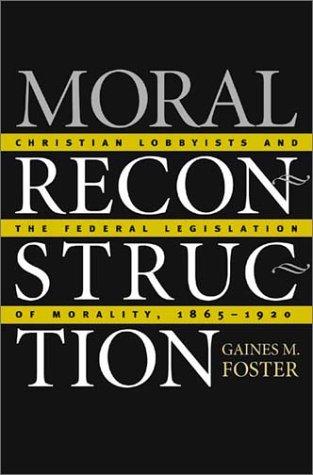
It is in no sense an overstatement to say that Gaines M. Foster's Moral Reconstruction: Christian Lobbyists and the Federal Legislation of Morality, 1865-1920 is a near perfect blend of historical insight and timeliness. Foster's simple book has simple scope: the examination of the rise of the Christian lobby in late nineteenth century America and the moral legislation it pursued. He makes clear, however, from the first sentence of the introduction that this is not intended to be a purely academic exercise. The rise of the Christian right in the late 1970s has made matters of the origins and precedents of religious lobbying and moral legislation issues of extreme importance for contemporary American moral polity. Foster convincingly suggests that the strongest, most germane parallel to the modern movement for moral reform is the late nineteenth century campaign to revise the moral character of the nation. The rise of the Christian lobby was more than merely a political shift or, as the lobbyists undoubtedly believed, an awakening of the American moral conscious in the face of some novel evil. It was a dramatic cultural and philosophical shift away from antebellum theories of states' rights, personal liberty, and moral suasion into new concepts of nationalism and corporate social responsibility. In this, and countless other nuances of Foster's book, there are striking ideological parallels to more recent impulses in American politics. In the interest of brevity, however, there are two points from Foster's work which stand out as especially noteworthy for reflection.
One of the most striking features of the Christian lobby, which Foster deliberately emphasizes in his narrative, was that even in its successes it understood and respected (or at least conceded to accept) the Constitutional limits of the federal government. There is little debate any longer about whether or not the federal government has some role in structuring national morality. As Foster will admit in his conclusion, few people object to the federal government having a hand in, for example, protecting children from the sexual advances of adults. In truth, most Americans probably do not even think of this in terms of the government legislating morality, though that is certainly what is occurring. As desensitized to the concept as modern Americans are, the idea that the government should make any universal laws regarding any morality was entirely foreign to early Americans. In fact, the Thirteenth Amendment represented something of a strange and wonderful novelty to nineteenth century Americans. They accepted that slavery was wrong (though some, only after being compelled by force of arms to accept that opinion), but that the government could seize the right to make that qualitative judgment was unusual. The Thirteenth Amendment would prove to be the justifying precedent cited most frequently by moral reformers.
Even with this powerful antecedent, the Christian lobby was forced to respect that most Americans understood the federal government to be restricted to a very small number of jurisdictions: interstate commerce, international treaties, administration of the military, and direct governance of the District of Columbia and the territories. In view of these limitations, the moral reformers were forced to pursue their agenda of national moral legislation within the confines of a traditional view of a limited federal government. They focused their efforts initially on enacting Sunday laws in DC, stricter divorce rules in the territories, prohibition in the military, and the restriction of interstate distribution of obscene materials (e.g. information on birth control). They understood that they could not make adultery illegal, but they did eventually convince the government that it had the power to make transporting a woman across state lines for the purpose of adultery should be. Even when the moral reformers did make their final push to outlaw the production and sale of all intoxicating beverages, Prohibition came with two important concessions to the limits of federal power. First, reformers readily admitted and accepted that Congress could not simply pass a law to achieve prohibition. A constitutional amendment would be necessary, as the Constitution did not give Congress the kind of sweeping moral power to outlaw behavior that the Christian lobby required. Second, in spite of initial attempts to include it, the provision which made possessing and consuming alcohol in one's home was removed from the wording of the amendment. The country was not ready to accept the idea that the government had the right to regulate moral behavior within one's own home. What authority it had, stopped at the domestic threshold. The home was a fortress, even if it was a den of wicked vice.
In addition to recognizing and working within the constitutional limits of the federal government, the history of the moral reformers teaches contemporary reformers and important lesson about the impermanence of moral reform. When the Volstead Act finally took effect, enforcing the Eighteenth Amendment, the reform periodical American Issue triumphantly declared, "The future historian will accord to January 16, 1920 a place second only to that of the advent of the Redeemer." Historians have a funny way of defying predictions. No one would today suggest that the onset of Prohibition in the United States was an event of permanent and global magnitude. Few school children know anything more than a passing quick fact about the Eighteenth Amendment and even less about the myriad moral reforms which preceded it. Even to the most conservative modern critic, the goals of the Christian lobby in the late nineteenth and early twentieth century seem antiquated if not comic. While many still oppose, largely futilely, ready access to abortion, on the most marginal members of society think it ought to be illegal to distribute information about birth control. Boxing, while not America's proudest past time, is legal to stage, promote, record, and distribute. (Imagine what the moral reformers would have thought of the mixed martial arts craze which has gripped the popular imagination.) The film industry not only escaped government content controls, but modern technology has made it possible for anyone and everyone to pipe any number of genuinely obscene pictures onto their computers, televisions, and telephones. Perhaps most notoriously at all, Prohibition was a miserable failure and social drinking (unlike boxing) is among the great American past times. From a historical perspective, efforts at national moral reform appear to have been the most dismal failure. Only a select few reforms from the period persist in any recognizable form: higher age of consent laws, laws against selling cigarettes to minors, and the end of mail delivery on Sundays. In his conclusion, Foster suggests that "the story of moral reconstruction provides no sure lessons to be applied to the renewed debate over legislating morality...but it does provide a historical context." Yet this historical context may in fact be the sure lesson which moral reformers need to learn; history has proved that it will be infinitely easier to repeal moral legislation than it was to pass it. It took the reformers nearly sixty years to enact prohibition through a constitutional amendment and only thirteen years for Americans to collectively regret and reject prohibition through another amendment.
There can be few complaints about Foster's work. Admittedly, it is dry, deeply encyclopedic reading which at times carries with it the uneasy feeling that one is actually just reading the congressional record. This impression is reenforced by the final eighty pages (or one quarter) of the book which is consumed by extensive appendices, notes, and other scholarly apparatus. At the same time, this exhaustive treatment reassures the reader that Moral Reconstruction is among the most well researched treatments of the period and subject that has yet been written. Though not a page turner for the average reader, the book is worth a second glance and more for professionals or dedicated hobbyists interested in grasping the historical context of ongoing movements among Christian especially to legislate a better moral polity for America.
Wednesday, December 14, 2011
Some Elephants Forget
I have already addressed the ironic history of government attempts to legislate marriage and divorce, so--though tempting--I will not rehash my previous thoughts in their entirety. I would, however, like to share another interesting quote from Foster's Moral Reconstruction which is illustrative of just how far the Republican Party has come in terms of changing its social policies (emphasis added):
The Roberts case revived interest in a constitutional amendment against polygamy and polygamous cohabitation; the later provision would have outlawed living with plural wives married before the Church of Jesus Christ of Latter-day Saints presumed reversal on polygamy. Over the next few years, many resolutions or bills in behalf of a broad antipolygamy amendment were entered; none ever passed. Frank J. Cannon, son of a high Mormon official who broke with his father and became an anti-Mormon agitator, claimed that in 1900 a representative of the Republican Party reached an agreement with Mormon leaders in which they promised to support William McKinley's reelection in return for the party's pledge to block a constitutional amendment that would give the federal government power over marriage and divorce. Such a deal, if in fact it was made, would surely have applied to an antipolygamy amendment.Interestingly, contemporary Republicans are running on precisely the opposite platform. This is a particularly intriguing position for Mitt Romney, given the way historical amendments of this nature were specifically designed to discriminate against marriage practices in his faith and to disenfranchise Mormons as a people.
Thursday, October 13, 2011
Government Involvement in Marriage and Its Ironic History
In his book Moral Reconstruction, a history of moral lobbying and legislation between the Civil War and Prohibition, Gaines M. Foster recalls a period at the turn of the century when Christian lobbyists and special interest groups were pressuring the government for stricter laws regarding marriage and divorce. Interestingly, among the measures proposed was an amendment to the Constitution which would explicitly give the federal government power over marriage. In all, forty-two resolutions to give the government power over marriage were introduced to Congress between 1892 and 1920, none of which received so much as a favorable committee report. Given the striking parallels between the moral polity of the period and the current political climate (a secondary purpose of Foster's book), the three reasons given for the widespread failure of reformers to achieve such federal legislation is intriguing:
1) Such legislation met with overwhelming opposition in the South because many southerners feared it would result in federal intervention in state antimiscegenation laws.
2) The American Bar Association and the Interchurch Conference opposed the measures because they preferred state measures to regulate marriage and divorce.
3) Christians could not effectively mobilize support for legislation because there was widespread disagreement about precisely what the Bible said about marriage and divorce.
The obvious, superficial irony is immediately apparent. Unlike contemporary movements to grant the federal government powers over marriage, Christians and southerners were the key to opposing extending federal powers. The role reversal becomes even more pronounced when one considers that the new support for such measures in the South is born out of the desire of southerners to have their peculiar discriminatory marriage laws universalized. In the past, southerners feared for their idiosyncratic conception of a "true" marriage. A look at the history of moral legislation would seem, thankfully, to justify the fears of nineteenth century southerners rather than bolster the aspirations of those in the 21st century. Granting moral power to the federal government tends to have a liberalizing effect on public morality. Which makes almost amusing the fact that so many supposed supporters of "states rights" also support an amendment granting the federal government a new and unprecedented field of power, while their predecessors had the foresight one hundred years ago to oppose federal involvement in marriage consistent with a belief in restricting the power of the federal government.
In the interest of learning from history, it is perhaps time to realize that whether moral legislation fails (as did federal marriage legislation at the turn of the century) or succeeds (as did Prohibition), in the long term the tendency of the federal government is never toward stricter moral codes. If American history is any judge, progressive moral ideologies win the war of attrition, and time is a surer constant than political favor.
1) Such legislation met with overwhelming opposition in the South because many southerners feared it would result in federal intervention in state antimiscegenation laws.
2) The American Bar Association and the Interchurch Conference opposed the measures because they preferred state measures to regulate marriage and divorce.
3) Christians could not effectively mobilize support for legislation because there was widespread disagreement about precisely what the Bible said about marriage and divorce.
The obvious, superficial irony is immediately apparent. Unlike contemporary movements to grant the federal government powers over marriage, Christians and southerners were the key to opposing extending federal powers. The role reversal becomes even more pronounced when one considers that the new support for such measures in the South is born out of the desire of southerners to have their peculiar discriminatory marriage laws universalized. In the past, southerners feared for their idiosyncratic conception of a "true" marriage. A look at the history of moral legislation would seem, thankfully, to justify the fears of nineteenth century southerners rather than bolster the aspirations of those in the 21st century. Granting moral power to the federal government tends to have a liberalizing effect on public morality. Which makes almost amusing the fact that so many supposed supporters of "states rights" also support an amendment granting the federal government a new and unprecedented field of power, while their predecessors had the foresight one hundred years ago to oppose federal involvement in marriage consistent with a belief in restricting the power of the federal government.
In the interest of learning from history, it is perhaps time to realize that whether moral legislation fails (as did federal marriage legislation at the turn of the century) or succeeds (as did Prohibition), in the long term the tendency of the federal government is never toward stricter moral codes. If American history is any judge, progressive moral ideologies win the war of attrition, and time is a surer constant than political favor.
Tuesday, October 4, 2011
Newt Gingrich endorses marriage by rape...by implication
There are few things that upset me more than a bad argument for a good position. In view of this, I was understandably unnerved when I saw that Newt Gingrich is making waves (third-tier GOP candidate size tsunamis) for suggesting that homosexual marriage is "a temporary aberration that will dissipate." The fuller quote reads:
In short, Gingrich attempts to overcome homosexual marriage on two grounds: intuition and history. We'll leave aside the former, since it would seem that Gingrich is woefully out of touch with presently goes against everything his culture knows. What is left is the question of history. As the linked article shows, many are content only to go so far back as Gingrich's own checked marital past and dismiss his argument at that. The problem with this, however, is that such a shallow engagement doesn't address what ought to be the startling truth of Gingrich's historical assertion, at least on the surface. Same-sex marriage is a historical novelty, such that even in cultures where homosexual behaviors were tolerated and even idealized the idea of a homosexual marriage was unthinkable.
The real problem with Gingrich's argument is not his personal disqualification on the basis of adultery and serial monogamy or even an incorrect assumption that same-sex marriage has some kind of historical precedent. The quandary arises when anyone attempts to apply Gingrich's historical canon to marriage more generally. For example, a majority of societies historically have permitted if not widely practiced polygamy, and the practice has been historically permitted in four of the five major world religions: Judaism, Islam, Hinduism, and Buddhism. Numerous contemporary cultures continue the practice, including sub-cultures within the United States itself. By the historical logic of Gingrich, polygamy should be permissible under US law.
We might apply the same historical logic to the proper age of marriage. In ancient Greece, the ideal age for a woman to be married was her early teens. This expectation carried into that other archetypal Western culture, and is enshrined in Roman law which permits marriage before the age of twelve provided the consummation does not occur until twelve years of age. The Corpus Juris Civilis even includes this curious law which addresses what happens to a wife who cheats on her husband prior to that age of consummation: "Where a girl, less than twelve years old...commits adultery...she cannot be accused of adultery by her husband, for the reason that she committed it before reaching the marriageable age." Medieval law proves more telling, in that Gratian allows that a girl may consent to be married as young as seven. In Elizabethan England, a girl could consent to marriage at twelve and could not revoke that consent after fourteen. By Gingrich's historical logic, I ought to be able to marry a girl on the very cusp of pubescence--though it is perhaps up for debate what legal recourse I have if my eleven year old wife elects to have sex with another man.
The implications of applying such a historical logic for marital practices raises countless more problems. Should we allow for arranged marriages that do not have the consent of those involved or perhaps have a coerced consent? Should women have the right to file for divorce? Should we go back to the borderline chattle slavery system of marriage in classical Athens? Or to the guardianship system of Rome? Will we go back to a system of marriage by capture (in which case, can someone find me Jena Malone's address)? Which parts of recorded history do you suppose Gingrich is interested in endorsing?
There is no doubt that I do not think people of the same sex ought to be having intercourse, cohabitating, raising children, or getting married. My arguments, however, are moral and religious. Attempting to appeal to history as an arbiter in the discussion of the legal permissibility of same-sex marriage raises more problems than it solves, in large part because the history of human dependence on prolific procreation--only recently escaped--is an appeal to a dead priority. More obviously, it is an appeal to the human race which has proved more than willing to shape legal and cultural norms to its whims for the entirety of its history. That means that if marrying multiple young girls through rape was expedient and enjoyable (and why wouldn't it be), then it was culturally and legally enshrined until countervailing ideological (or more commonly military) forces dislodged it. Unfortunately, much like advocates of the amusingly oxymoronic "civil Sabbath" in the nineteenth century, opponents to same-sex marriage are forced to find a secular logic for their fundamentally religious opposition the practice because admitting their exclusively religious motivation would disqualify their position from consideration. Of course, if Gingrich were to admit this it might represent a frightening step down the road toward incurable Ron Paul.
I believe that marriage is between a man and woman. It has been for all of recorded history and I think this is a temporary aberration that will dissipate. I think that it is just fundamentally goes against everything we know.
In short, Gingrich attempts to overcome homosexual marriage on two grounds: intuition and history. We'll leave aside the former, since it would seem that Gingrich is woefully out of touch with presently goes against everything his culture knows. What is left is the question of history. As the linked article shows, many are content only to go so far back as Gingrich's own checked marital past and dismiss his argument at that. The problem with this, however, is that such a shallow engagement doesn't address what ought to be the startling truth of Gingrich's historical assertion, at least on the surface. Same-sex marriage is a historical novelty, such that even in cultures where homosexual behaviors were tolerated and even idealized the idea of a homosexual marriage was unthinkable.
The real problem with Gingrich's argument is not his personal disqualification on the basis of adultery and serial monogamy or even an incorrect assumption that same-sex marriage has some kind of historical precedent. The quandary arises when anyone attempts to apply Gingrich's historical canon to marriage more generally. For example, a majority of societies historically have permitted if not widely practiced polygamy, and the practice has been historically permitted in four of the five major world religions: Judaism, Islam, Hinduism, and Buddhism. Numerous contemporary cultures continue the practice, including sub-cultures within the United States itself. By the historical logic of Gingrich, polygamy should be permissible under US law.
We might apply the same historical logic to the proper age of marriage. In ancient Greece, the ideal age for a woman to be married was her early teens. This expectation carried into that other archetypal Western culture, and is enshrined in Roman law which permits marriage before the age of twelve provided the consummation does not occur until twelve years of age. The Corpus Juris Civilis even includes this curious law which addresses what happens to a wife who cheats on her husband prior to that age of consummation: "Where a girl, less than twelve years old...commits adultery...she cannot be accused of adultery by her husband, for the reason that she committed it before reaching the marriageable age." Medieval law proves more telling, in that Gratian allows that a girl may consent to be married as young as seven. In Elizabethan England, a girl could consent to marriage at twelve and could not revoke that consent after fourteen. By Gingrich's historical logic, I ought to be able to marry a girl on the very cusp of pubescence--though it is perhaps up for debate what legal recourse I have if my eleven year old wife elects to have sex with another man.
The implications of applying such a historical logic for marital practices raises countless more problems. Should we allow for arranged marriages that do not have the consent of those involved or perhaps have a coerced consent? Should women have the right to file for divorce? Should we go back to the borderline chattle slavery system of marriage in classical Athens? Or to the guardianship system of Rome? Will we go back to a system of marriage by capture (in which case, can someone find me Jena Malone's address)? Which parts of recorded history do you suppose Gingrich is interested in endorsing?

There is no doubt that I do not think people of the same sex ought to be having intercourse, cohabitating, raising children, or getting married. My arguments, however, are moral and religious. Attempting to appeal to history as an arbiter in the discussion of the legal permissibility of same-sex marriage raises more problems than it solves, in large part because the history of human dependence on prolific procreation--only recently escaped--is an appeal to a dead priority. More obviously, it is an appeal to the human race which has proved more than willing to shape legal and cultural norms to its whims for the entirety of its history. That means that if marrying multiple young girls through rape was expedient and enjoyable (and why wouldn't it be), then it was culturally and legally enshrined until countervailing ideological (or more commonly military) forces dislodged it. Unfortunately, much like advocates of the amusingly oxymoronic "civil Sabbath" in the nineteenth century, opponents to same-sex marriage are forced to find a secular logic for their fundamentally religious opposition the practice because admitting their exclusively religious motivation would disqualify their position from consideration. Of course, if Gingrich were to admit this it might represent a frightening step down the road toward incurable Ron Paul.
Saturday, June 4, 2011
Gay Marriage: It's the American Way
I have previously voiced my belief that it is patently unamerican that homosexuals are not allowed to marry in this country. I frankly cannot understand why the American government (at the behest of the American people) is involved in sexual ethics at all. It is legal in this country for two men to hold hands, to kiss, to have sexual intercourse, to cohabitate, to adopt children (with a little hoop jumping), to grant each other power of attorney, and to name one another in their wills. If twelve male dwarves wanted to have an orgy in a vat of chocolate pudding, they could do it legally and make the pet parrot watch. We may be disgusted by it (and I may never each chocolate pudding again after concocting that image), but there seems to be a pretty general consensus that our government should not be involved in the sexual behavior of consenting adults. It boggles my mind, in view of all this, that so many Americans would take such a firm stand on whether or not homosexuals can enter into the (unfortunately) public contract of marriage.
And since we are talking about the "rights" of homosexuals anyway, now seems as good a time as any to share a selection from Ron Paul's Liberty Defined on this very issue:
While I do not recall Paul mentioning it, I think it warrants remembering that marriage licences have been used throughout the past century of American history by the government in order to enforce what it believes are acceptable standards for marriages. In times not so long past, the government protected us from the possible catastrophe of marriages between whites and blacks or, worse still, Japanese! The practice is not as distant as we might like to believe. At some point, it might be nice if the people realized that they did not need the government to protect them from the gay menace. If you don't want to marry, befriend, or even break bread with a homosexual, then you are more than welcome not to. In the meantime, if you do not want the government poking around in your private contracts (or your privates in general) then it is the height of hypocrisy to demand that it interfere with the affairs of everyone else.
And since we are talking about the "rights" of homosexuals anyway, now seems as good a time as any to share a selection from Ron Paul's Liberty Defined on this very issue:
Most Americans do not question the requirement to obtain a license to get married. As in just about everything else, this requirement generates unnecessary problems and heated disagreements. If the government was not involved there would be no discussion or controversy over the definition of marriage. Why should the government give permission to two individuals for them to call themselves married? In a free society, something that we do not truly enjoy, all voluntary and consensual agreements would be recognized. If disputes arose, the courts could be involved as in any other civil dispute…
I’d like to settle the debate by turning it into a First Amendment issue: the right of free speech. Everyone can have his or her own definition of what marriage means, and if an agreement or contract is reached by the participants, it will qualify as a civil contract if desired…
I personally identify with the dictionary definition of marriage: “The social institution under which a man and woman establish their decision to live together as husband and wife by legal commitments or religious ceremony.” If others who choose a different definition do not impose their standards on anyone else, they have a First Amendment right to their own definition and access to the courts to arbitrate any civil disputes.
While I do not recall Paul mentioning it, I think it warrants remembering that marriage licences have been used throughout the past century of American history by the government in order to enforce what it believes are acceptable standards for marriages. In times not so long past, the government protected us from the possible catastrophe of marriages between whites and blacks or, worse still, Japanese! The practice is not as distant as we might like to believe. At some point, it might be nice if the people realized that they did not need the government to protect them from the gay menace. If you don't want to marry, befriend, or even break bread with a homosexual, then you are more than welcome not to. In the meantime, if you do not want the government poking around in your private contracts (or your privates in general) then it is the height of hypocrisy to demand that it interfere with the affairs of everyone else.
Monday, November 15, 2010
Language and the Corruption of Meaning
It is interesting (which is, in this particular context, a euphemistic way of saying “tragic”) the way the dynamic and cultural nature of language can completely transform the meaning of words. Specifically it is “interesting” how Christians have been able to constantly reinterpret the Bible and the rich theology therein—at times under the conscious aegis of contemporary contextualization but more often entirely unconsciously and thus uncritically—with a ceaselessly shifting cultural lexicon. Words which have a very specific meaning have crossed time and language, arriving at the present only semantically equal to the original with the meaning totally lost. The form persists while the function is obscured. There would be little cause for alarm if, as many seem to think, the problem could be solved merely by opening a dictionary of ancient words. In truth, the dictionary only compounds the problem: explaining ancient words with modern glosses or, at best, drawing tenuous parallels to modern concepts.
That is perhaps all too vague to be much of a complaint. An example: Vladimir Lossky has suggested to some acclaim that the formula “one substance in three persons” has been corrupted by the modern understanding of personality. Speaking of the Father, Son, and Spirit as “persons” was filtered (and thus altered) immediately into Latin where the term carried with it a connotation of “mask” that is entirely absent in the Greek. The concept was further altered in the West as culture embraced a radical form of humanism in the Renaissance and, even more dramatically, in the Enlightenment. Western culture (and this embraces the Eastern Church) now understands the person in terms of radical individualism, the thing which makes the “me” actually “me” and not “you.” Contemporary culture lacks not only the appropriate language to speak about the hypostases of God but lacks the appropriate concepts to grasp the personhood in theology. The solution for generally embraced in theological discourse is to abandon the corrupted terms (something that the preceding sentence demonstrates that I am guilty of as well). Instead of the three “persons,” English theology reverts to a transliterated form of the Greek: “hypostasis.” This by no means solves the problem. Simply changing the word to more nearly resemble the original does not automatically attach to it the original concepts. Even as theologians strain to unravel the mystery of the original terminology, how the ancients conceived of hypostases is continually colored by how moderns conceive of personhood. In its extreme form, this tendency produces literature like The Shack where God is depicted as three people with different voices, different senses of humor, different tasks, and different interests, in short, different personalities. This, for Lossky and later for David Bentley Hart, represents a fundamental reversal of the way conceptual transformation ought to work. Christians are constantly allowing the changes in the concepts conveyed by language to alter the original concepts: modern personhood explains theological personhood. Hart suggests that rather than altering the language (i.e. using “hypostasis” instead of “person”), people ought to be rethinking the concept of modern personhood. A true understanding of theological personhood ought to have radical effects on how Christians conceptualize human personhood. In the most basic terms possible, instead of thinking that God is persons in the way humans are persons, people ought to understand how they are persons by thinking about how God is persons.
The problem is not restricted to the esoteric fields of theology proper and anthropology, nor is that my primary concern in arguing this point. In fact, the specific problem which is the catalyst for this thought was actually inspired in part (heaven help me) by the pope and in part by the Jars of Clay song, “Love Song for a Savior.” The pope, several weeks ago, warned a group of children that the “love” which was being peddled on the Internet and in popular culture was not really love at all. I agree, but, while the pope may recognize (at least in speeches) that “love” as expressed in the contemporary idiom is not love in the true sense, in the Christian sense, the secular definition of love has crept into our religious thought and corrupted our understanding of love as God intends it or as the biblical authors mean it. Case and point is the aforementioned Jars of Clay song, the first verse of which describes a girl in a rosy haze thanking Jesus for flowers, running into his arms, and singing over and over: “I want to fall in love with you.” This picture of “true love” is contrasted to those people who sit in church and ignore the sermon. Someday, they too will sing the young girl’s chorus: “I want to fall in love with you…my heart beats for you.”
It could not be more evident (to me at least) that this is a clear permeation of the secular idea of love into what ought to be a truer, more theologically sound conception of love. Jars of Clay is by no means the lone, or even the most egregious, offender. This idea of Christians “loving” Jesus and God “loving” us has seeped into our hymnography, into Christian pop music, into sermons, and into the popular consciousness. The idea is pervasive that the way God loves mirrors in some way the sentimentality of the contemporary understanding of love and that we should, therefore, reciprocate that “love” in kind. The statement “I love Jesus” is more likely to denote nothing more than a positive affection for the Savior than it is to suggest any concrete reality that aligns itself with biblical or historical theological perspectives on love. The affirmation that God loves us is likewise diluted beyond the point of substantial meaning such that God might just as easily be caricatured as our Heavenly Father who carries pictures of all His children in his wallet.
It may be alarmist of me, but I would suggest that the contemporary contextualization (which is, in this particular context, a euphemistic way of saying “rape”) of the meaning of “love” is the root of a number of significant theological problems. I wonder, for example, if the “faith alone” mentality which understands faith as the mere desire of Jesus to “come into my heart” is possible with a more concrete, less romantic view of what it is to love God and be loved by Him. More certainly, this false idea of love stands behind the overwhelming majority of objections to Christianity which begin, “How can a loving God” and end with a description of behavior which we would never permit from our spouses or relatives or friends—as if that were some kind of objective measure of love. Still more troubling are the manifold “loveless” marriages that people are stuck in. Love, rightly considered, is not something that is fallen into our fallen out of so much as it is something which the lover consciously chooses to express to the beloved through certain behaviors and dispositions. If God could fall out of love with humanity, then we would all be quite doomed. For just this reason, I object to the language of Jars of Clay about wanting to “fall in love” with Jesus, not—as with Dr. John Stackhouse—because it gives me the “homoerotic creeps” but because loving Jesus is not something which I fall into anymore than love (properly so-called) is something which I fall into with my wife.
The problem is not, as I said, so much with the words. We have preserved the right language. God should be spoken of as three persons and our basic stance toward Him ought to be described as love. The problem is the direction of meaning transformation for our words. Rather than allowing love rightly understood through divine guidance to determine how we ought to love both God and neighbor, we allow how we love apart from divine guidance to influence what we think is expected of us in the greatest commands. Human personhood ought to be defined relative to divine personhood, and human love ought to be define relative to divine love. In reversing these, our “contemporary contextualization” of meaning has led us into an unbelievably “interesting” modern problem.
That is perhaps all too vague to be much of a complaint. An example: Vladimir Lossky has suggested to some acclaim that the formula “one substance in three persons” has been corrupted by the modern understanding of personality. Speaking of the Father, Son, and Spirit as “persons” was filtered (and thus altered) immediately into Latin where the term carried with it a connotation of “mask” that is entirely absent in the Greek. The concept was further altered in the West as culture embraced a radical form of humanism in the Renaissance and, even more dramatically, in the Enlightenment. Western culture (and this embraces the Eastern Church) now understands the person in terms of radical individualism, the thing which makes the “me” actually “me” and not “you.” Contemporary culture lacks not only the appropriate language to speak about the hypostases of God but lacks the appropriate concepts to grasp the personhood in theology. The solution for generally embraced in theological discourse is to abandon the corrupted terms (something that the preceding sentence demonstrates that I am guilty of as well). Instead of the three “persons,” English theology reverts to a transliterated form of the Greek: “hypostasis.” This by no means solves the problem. Simply changing the word to more nearly resemble the original does not automatically attach to it the original concepts. Even as theologians strain to unravel the mystery of the original terminology, how the ancients conceived of hypostases is continually colored by how moderns conceive of personhood. In its extreme form, this tendency produces literature like The Shack where God is depicted as three people with different voices, different senses of humor, different tasks, and different interests, in short, different personalities. This, for Lossky and later for David Bentley Hart, represents a fundamental reversal of the way conceptual transformation ought to work. Christians are constantly allowing the changes in the concepts conveyed by language to alter the original concepts: modern personhood explains theological personhood. Hart suggests that rather than altering the language (i.e. using “hypostasis” instead of “person”), people ought to be rethinking the concept of modern personhood. A true understanding of theological personhood ought to have radical effects on how Christians conceptualize human personhood. In the most basic terms possible, instead of thinking that God is persons in the way humans are persons, people ought to understand how they are persons by thinking about how God is persons.
The problem is not restricted to the esoteric fields of theology proper and anthropology, nor is that my primary concern in arguing this point. In fact, the specific problem which is the catalyst for this thought was actually inspired in part (heaven help me) by the pope and in part by the Jars of Clay song, “Love Song for a Savior.” The pope, several weeks ago, warned a group of children that the “love” which was being peddled on the Internet and in popular culture was not really love at all. I agree, but, while the pope may recognize (at least in speeches) that “love” as expressed in the contemporary idiom is not love in the true sense, in the Christian sense, the secular definition of love has crept into our religious thought and corrupted our understanding of love as God intends it or as the biblical authors mean it. Case and point is the aforementioned Jars of Clay song, the first verse of which describes a girl in a rosy haze thanking Jesus for flowers, running into his arms, and singing over and over: “I want to fall in love with you.” This picture of “true love” is contrasted to those people who sit in church and ignore the sermon. Someday, they too will sing the young girl’s chorus: “I want to fall in love with you…my heart beats for you.”
It could not be more evident (to me at least) that this is a clear permeation of the secular idea of love into what ought to be a truer, more theologically sound conception of love. Jars of Clay is by no means the lone, or even the most egregious, offender. This idea of Christians “loving” Jesus and God “loving” us has seeped into our hymnography, into Christian pop music, into sermons, and into the popular consciousness. The idea is pervasive that the way God loves mirrors in some way the sentimentality of the contemporary understanding of love and that we should, therefore, reciprocate that “love” in kind. The statement “I love Jesus” is more likely to denote nothing more than a positive affection for the Savior than it is to suggest any concrete reality that aligns itself with biblical or historical theological perspectives on love. The affirmation that God loves us is likewise diluted beyond the point of substantial meaning such that God might just as easily be caricatured as our Heavenly Father who carries pictures of all His children in his wallet.
It may be alarmist of me, but I would suggest that the contemporary contextualization (which is, in this particular context, a euphemistic way of saying “rape”) of the meaning of “love” is the root of a number of significant theological problems. I wonder, for example, if the “faith alone” mentality which understands faith as the mere desire of Jesus to “come into my heart” is possible with a more concrete, less romantic view of what it is to love God and be loved by Him. More certainly, this false idea of love stands behind the overwhelming majority of objections to Christianity which begin, “How can a loving God” and end with a description of behavior which we would never permit from our spouses or relatives or friends—as if that were some kind of objective measure of love. Still more troubling are the manifold “loveless” marriages that people are stuck in. Love, rightly considered, is not something that is fallen into our fallen out of so much as it is something which the lover consciously chooses to express to the beloved through certain behaviors and dispositions. If God could fall out of love with humanity, then we would all be quite doomed. For just this reason, I object to the language of Jars of Clay about wanting to “fall in love” with Jesus, not—as with Dr. John Stackhouse—because it gives me the “homoerotic creeps” but because loving Jesus is not something which I fall into anymore than love (properly so-called) is something which I fall into with my wife.
The problem is not, as I said, so much with the words. We have preserved the right language. God should be spoken of as three persons and our basic stance toward Him ought to be described as love. The problem is the direction of meaning transformation for our words. Rather than allowing love rightly understood through divine guidance to determine how we ought to love both God and neighbor, we allow how we love apart from divine guidance to influence what we think is expected of us in the greatest commands. Human personhood ought to be defined relative to divine personhood, and human love ought to be define relative to divine love. In reversing these, our “contemporary contextualization” of meaning has led us into an unbelievably “interesting” modern problem.
Thursday, September 30, 2010
Marriage: A Tabernacle of Truth
In reading (and inevitably rereading) David Bentley Hart, I have grown very fond of his explanation of a concept he typically refers to as "difference" within the Trinity, but which might be more familiar to the typical Christian as a theology of relationality or community. (I realize that in making this connection, as with others that will follow, I am being painfully imprecise in a way that would likely infuriate Hart. Nevertheless, because the concept of community is so prevalent in theology at the moment and because I believe that the emphasis on community arises from the same spirit as Hart's stress on the priority of difference I think some profit may be derived from equating the two, if only provisionally for the sake of simplicity.) In contrast to the "perverse and sinful fiction" that is contemporary understanding of personality, the Trinity as dogma demonstrates the absolute priority of difference (and again, I know that the imprecision of my language will not do justice to Hart's theology) against the illusion that a person exists as, in any sense, a self-contained autonomous self. Trinity affirms that relationality is not fundamentally the interaction of independent beings but actually the foundational makeup of Being itself, the essential substance of truth.
To highlight this, Hart makes reference to the analogies used by the early church to comprehend the Trinity. Particularly instructive are the social analogies of the Cappadocian fathers and the psychological analogies of Augustine. Rather than one being more fitting than the other, it is important to realize that both balance each other to create an ineffably distant analogy to the Trinitarian life. The relationality of the Trinity manifests both as an interior reality within the unity God (as in the psychological analogy) and as actual difference manifest in distinct persons (as in the social analogy) - though these persons are always understood in terms of the constant interplay of giving and receiving and giving again.
Thus Hart writes:
In general, the very nature of humanity can be understood as one of these tabernacles of God's truth, a window into the infinite Trinitarian reality subsisting in perpetual unity in difference. As with the aforementioned analogies for Trinity, relationality makes up the essential character of all humanities being. There is no need to demonstrate the social nature of the human experience of difference, but Hart argues that even within ourselves there is interior difference. Humans experience themselves within themselves as an "exterior" object. Even in saying "I am..." we necessarily remove ourselves as the speaker, speaking about ourselves as we would an object that could be externally observed. Hart words it better:
Or consider:
It was after reading and synthesizing this understanding of the Trinity (infinitely superior to other "community" themed explanations of the Trinity which I have lately been made to read) and its significance for anthropology that I saw an immediate and fantastic application to marriage as understood through the creation accounts. It struck me that marriage is also one such tabernacle of Trinitarian truth in which humans could "at infinite analogical remove" (to borrow from Hart) participate and understand the incomprehensible divine dynamic of difference. The dance - an Orthodox analogy - of experiencing the self as other and incorporating the other into the self without negating its otherness fits neatly into the language of the garden and the creation of woman. Eve is she who was taken from Adam (his rib) and formed into the other but who Adam immediately takes back into himself (as bone of my bone, flesh of my flesh) without ever negating her complimentary nature. The unity in marriage, the ideal unity perhaps inaccessible in this life of sin, is not a unity of purpose or will, not an exterior contract willingly accepted by two autonomous parties but the embracing of the other into the self so that, without negating the difference, there is separation of will or purpose. It is replaced by a unity of giving up self and embracing the other into self.
If this is true, then some of Hart's most beautiful language about the Trinity applies, however equivocally, to the marital relationship as an analogy of the divine life. Marriage is that relationship "of self-oblation according to which each 'I'...is also 'not I' but rather Thou." It is a symphony of mutual joy - the joy of knowing and of loving - which consists of a perpetual self-giving to the different other who is nevertheless self. It is the "fullness of shared love," a perpetual expression of the "dynamism of distinction and unity."
That, I think, is a beautiful image of marriage based analogically on a beautiful image of the Trinity. After all, as Hart reminds, we can always affirm that "God is beautiful: not only that God is beauty or the essence and archetype of beauty, nor even only that God is the highest beauty, but that, as Gregory the Theologian says, God is beauty and also beautiful, whose radiance shines upon and is reflected in his creatures."
To highlight this, Hart makes reference to the analogies used by the early church to comprehend the Trinity. Particularly instructive are the social analogies of the Cappadocian fathers and the psychological analogies of Augustine. Rather than one being more fitting than the other, it is important to realize that both balance each other to create an ineffably distant analogy to the Trinitarian life. The relationality of the Trinity manifests both as an interior reality within the unity God (as in the psychological analogy) and as actual difference manifest in distinct persons (as in the social analogy) - though these persons are always understood in terms of the constant interplay of giving and receiving and giving again.
Thus Hart writes:
As the Son is the true image of the Father, faithfully reflecting him in infinite distance, and as the Spirit forever "prismates" the radiance of God's image into all the beautiful measures of that distance, one may speak of God as a God who is, in himself, always somehow analogous; the coincidence in God of mediacy and immediacy, image and difference, is the "proportion" that makes every finite interval a possible disclosure - a tabernacle - of God's truth.
In general, the very nature of humanity can be understood as one of these tabernacles of God's truth, a window into the infinite Trinitarian reality subsisting in perpetual unity in difference. As with the aforementioned analogies for Trinity, relationality makes up the essential character of all humanities being. There is no need to demonstrate the social nature of the human experience of difference, but Hart argues that even within ourselves there is interior difference. Humans experience themselves within themselves as an "exterior" object. Even in saying "I am..." we necessarily remove ourselves as the speaker, speaking about ourselves as we would an object that could be externally observed. Hart words it better:
...do we really possess identity apart from relation: is not even our "purest" interiority reflexive, knowing and loving itself as expression and recognition, engaged with the world of others through memoria and desire, inward discourse and outward intention (hence the genius of Augustine's "interior" analogies)?
Or consider:
...knowledge and love of neighbor fulfill the soul's velleity toward the world, and so grant each of us that internally constituted "self" that exists only through an engagement with a world of others; but that engagement is only possible only in that the structure of interiority is already "othered" and "othering," in distinct moments of consciousness' inherence in itself.
It was after reading and synthesizing this understanding of the Trinity (infinitely superior to other "community" themed explanations of the Trinity which I have lately been made to read) and its significance for anthropology that I saw an immediate and fantastic application to marriage as understood through the creation accounts. It struck me that marriage is also one such tabernacle of Trinitarian truth in which humans could "at infinite analogical remove" (to borrow from Hart) participate and understand the incomprehensible divine dynamic of difference. The dance - an Orthodox analogy - of experiencing the self as other and incorporating the other into the self without negating its otherness fits neatly into the language of the garden and the creation of woman. Eve is she who was taken from Adam (his rib) and formed into the other but who Adam immediately takes back into himself (as bone of my bone, flesh of my flesh) without ever negating her complimentary nature. The unity in marriage, the ideal unity perhaps inaccessible in this life of sin, is not a unity of purpose or will, not an exterior contract willingly accepted by two autonomous parties but the embracing of the other into the self so that, without negating the difference, there is separation of will or purpose. It is replaced by a unity of giving up self and embracing the other into self.
If this is true, then some of Hart's most beautiful language about the Trinity applies, however equivocally, to the marital relationship as an analogy of the divine life. Marriage is that relationship "of self-oblation according to which each 'I'...is also 'not I' but rather Thou." It is a symphony of mutual joy - the joy of knowing and of loving - which consists of a perpetual self-giving to the different other who is nevertheless self. It is the "fullness of shared love," a perpetual expression of the "dynamism of distinction and unity."
That, I think, is a beautiful image of marriage based analogically on a beautiful image of the Trinity. After all, as Hart reminds, we can always affirm that "God is beautiful: not only that God is beauty or the essence and archetype of beauty, nor even only that God is the highest beauty, but that, as Gregory the Theologian says, God is beauty and also beautiful, whose radiance shines upon and is reflected in his creatures."
Tuesday, April 20, 2010
Reading Titus with John Chrysostom (1:5-11)
John's second homily on Titus addresses 1:5-11, the qualifications for elders:
It should be noted that by John's time the episcopacy has been established for at least three centuries, so that these verses are understood exclusively in episcopal terms. I have used various titles to refer to church leaders below, but it should always be understood that John sees these passages as addressing bishops.
The text of the homily can be found here.
From God Be the Glory
“Retire from the earth, and look to that theater that is in Heaven.”
I found it somewhat ironic that in his exposition on a passage of scripture which gives a man (Titus) the means by which to judge the character of other men (potential elders) John should find the occasions to so vehemently reject the notion that Christians ought to care about the judgments of men. Upon further reflection, however, it seemed quite appropriate if the list of qualifications given is understood not as the human means of judging character but instead God’s. What is presented in Titus is God’s rubric for the character of a man, and that is the only judgment the Christian should consider.
For John there is nothing “so tyrannical, [and] so universally prevalent,” as the wanton pursuit of glory, i.e. human accolades. John sees in his congregation and in the hearts of all men the tendency to act primarily so that others will see and applaud our good works. The glory which is acquired is, nevertheless, utterly worthless. “…human glory is empty, and an imitation of glory; it is not true glory.” Only glory which is from God is true glory, and seeking that glory, according to John, is the only way to overcome the temptations of vainglory.
“When in doing any good thou considerst that it ought to be displayed to men, and thou seekest for some spectators of the action, and art in travail to be seen, reflect that God beholds thee, and all that desire will be extinguished. Retire from the earth, and look to that theater that is in Heaven. If men should praise thee, yet hereafter they will blame thee, will envy thee, will assail thy character; or if they do not yet their praise will not benefit thee. It is not so with God.”
When this true glory from God is understood as the real aim of our virtuous deeds and is sought accordingly, the praise which is received from men becomes meaningless in comparison. Thus, John exhorts us to become “as those who desire gold, but receive clay.” Whatever praise is given by men is to glory from God what dirt is to the most precious material man can imagine.
Having God as the sole judge, living according to His standards, comes at a price. God, who is always watching when a good deed is performed, sees every evil, even the “hidden” evil deep within the heart. For the pious, this is good news, for “thou obtainest glory for thy piety. If thou art truly pious, and conscious of no guilt, thou shouldest rejoice, not because thou are reputed pious, but because thou art so.” On the other hand, “if while conscious of guilt, thou art supposed by all to be pure, instead of rejoicing, thou shouldest grieve and mourn bitterly, keeping constantly in view that Day, in which all things will be revealed, in which the hidden things of darkness will be brought to light.” If God alone is judge, then the need to be pious becomes more important than the need to be seen being pious. If God alone is judge, it is more critical that one avoids being impious than that one avoids being seen to be impious. For this reason, John exhorts “Let us cast away the sheep’s clothing, and rather become sheep.”
In reading a text on the virtue of the leaders of the church, John sees the perfect opportunity (and perhaps justly so) to remind his congregants that the glory which is afforded to the great men of the church is from God alone. Whatever judgments are made in the selection of leaders and whatever honor is accorded to them because of their apparent virtues, the true judgment rests in the hands of God. The best that can be done here and now is to judge ourselves in view of what God requires of us, to find joy in the knowledge that He rejoices in our virtues and to be shamed by the fact that He will make known our vices.
Prescription for Christians from Descriptions of Elders
The elders being selected in Titus 1 are undoubtedly intended to be the pillars of the church, the cream of the crop, so to speak. What Paul offers is a list of qualifications that seem largely descriptive (though they are undoubtedly commands to Titus to select such men). John, however, sees in these ideal descriptions the grounds for which to make a number of practical assertions about everyday life for Christians.
The command that the elder should have only one wife is for John a tacit affirmation of the sanctity of marriage. In a modern context that does not seem all that crucial, but in early Christian times as far back as the New Testament, the question of the validity of marriage in God’s plan was widely questioned. Here, John goes further than many other authors who merely accept marriage either as permissible or inevitable. He declares that “it is not an unholy thing in itself, but so far honorable, that a married man might ascend the holy throne.” Leaders, and therefore all men, should have a high regard for marriage. Entering into a single marriage and never a second shows the high regard for one’s wife that Christ has had for his bride, the church.
John also has a word for absentee fathers based on the section relative to the orderly behavior of an elder’s children. Apparently, as is still the case, there were fathers in ancient times who were “occupied in the pursuit of wealth” such that they had “made [their] children a secondary concern, and not bestowed much care upon them…” This neglect is unacceptable to John, as it should be, and he places the sins of the children on the heads of the fathers (a nice reversal of biblical imagery). “Sins are not so prevalent by nature, as to overcome so much previous care,” John speculates. If fathers would dedicate sufficient time and offer adequate instruction, their children would not be delinquents. A father has not only a great length of time, but the force of laws and nature to inculcate virtue into his children. He must take responsibility for that.
Finally, John has advice for rulers of any sort, advice which seems obvious now but may appear strange given the authoritarian way the government and the church in antiquity are viewed. Beginning with the affirmation that an elder ought not to be “a striker” (NIV, violent), John concludes that “…a ruler without, as he rules by law and compulsion, perhaps does not consult the wishes of those under his rule…if he so conduct himself as to do everything of his own will, and share counsels with no one, makes his presidency tyrannical rather than popular.” Instead, leaders “ought to rule men with their own consent” so that their subjects “will be thankful for his rule.” Authoritarian leaders are not good leaders, a maxim as true in the fourth century as it is now.
It seems perfectly reasonable to me to take these qualifications for leaders and extrapolate them to other areas of life. Certainly the behaviors which are good elders who are fathers are good for all fathers. Surely virtues which are necessary of leaders in the church are necessary for Christian leaders in business, in the community, or even in the home. All men, in fact, ought to aspire to live a life worth of position of elder without the ambition, perhaps, to actually attain that office.
The reason I left you in Crete was that you might straighten out what was left unfinished and appoint elders in every town, as I directed you. An elder must be blameless, the husband of but one wife, a man whose children believe and are not open to the charge of being wild and disobedient. Since an overseer is entrusted with God's work, he must be blameless—not overbearing, not quick-tempered, not given to drunkenness, not violent, not pursuing dishonest gain. Rather he must be hospitable, one who loves what is good, who is self-controlled, upright, holy and disciplined. He must hold firmly to the trustworthy message as it has been taught, so that he can encourage others by sound doctrine and refute those who oppose it.
For there are many rebellious people, mere talkers and deceivers, especially those of the circumcision group. They must be silenced, because they are ruining whole households by teaching things they ought not to teach—and that for the sake of dishonest gain. (NIV)
It should be noted that by John's time the episcopacy has been established for at least three centuries, so that these verses are understood exclusively in episcopal terms. I have used various titles to refer to church leaders below, but it should always be understood that John sees these passages as addressing bishops.
The text of the homily can be found here.
From God Be the Glory
“Retire from the earth, and look to that theater that is in Heaven.”
I found it somewhat ironic that in his exposition on a passage of scripture which gives a man (Titus) the means by which to judge the character of other men (potential elders) John should find the occasions to so vehemently reject the notion that Christians ought to care about the judgments of men. Upon further reflection, however, it seemed quite appropriate if the list of qualifications given is understood not as the human means of judging character but instead God’s. What is presented in Titus is God’s rubric for the character of a man, and that is the only judgment the Christian should consider.
For John there is nothing “so tyrannical, [and] so universally prevalent,” as the wanton pursuit of glory, i.e. human accolades. John sees in his congregation and in the hearts of all men the tendency to act primarily so that others will see and applaud our good works. The glory which is acquired is, nevertheless, utterly worthless. “…human glory is empty, and an imitation of glory; it is not true glory.” Only glory which is from God is true glory, and seeking that glory, according to John, is the only way to overcome the temptations of vainglory.
“When in doing any good thou considerst that it ought to be displayed to men, and thou seekest for some spectators of the action, and art in travail to be seen, reflect that God beholds thee, and all that desire will be extinguished. Retire from the earth, and look to that theater that is in Heaven. If men should praise thee, yet hereafter they will blame thee, will envy thee, will assail thy character; or if they do not yet their praise will not benefit thee. It is not so with God.”
When this true glory from God is understood as the real aim of our virtuous deeds and is sought accordingly, the praise which is received from men becomes meaningless in comparison. Thus, John exhorts us to become “as those who desire gold, but receive clay.” Whatever praise is given by men is to glory from God what dirt is to the most precious material man can imagine.
Having God as the sole judge, living according to His standards, comes at a price. God, who is always watching when a good deed is performed, sees every evil, even the “hidden” evil deep within the heart. For the pious, this is good news, for “thou obtainest glory for thy piety. If thou art truly pious, and conscious of no guilt, thou shouldest rejoice, not because thou are reputed pious, but because thou art so.” On the other hand, “if while conscious of guilt, thou art supposed by all to be pure, instead of rejoicing, thou shouldest grieve and mourn bitterly, keeping constantly in view that Day, in which all things will be revealed, in which the hidden things of darkness will be brought to light.” If God alone is judge, then the need to be pious becomes more important than the need to be seen being pious. If God alone is judge, it is more critical that one avoids being impious than that one avoids being seen to be impious. For this reason, John exhorts “Let us cast away the sheep’s clothing, and rather become sheep.”
In reading a text on the virtue of the leaders of the church, John sees the perfect opportunity (and perhaps justly so) to remind his congregants that the glory which is afforded to the great men of the church is from God alone. Whatever judgments are made in the selection of leaders and whatever honor is accorded to them because of their apparent virtues, the true judgment rests in the hands of God. The best that can be done here and now is to judge ourselves in view of what God requires of us, to find joy in the knowledge that He rejoices in our virtues and to be shamed by the fact that He will make known our vices.
Prescription for Christians from Descriptions of Elders
The elders being selected in Titus 1 are undoubtedly intended to be the pillars of the church, the cream of the crop, so to speak. What Paul offers is a list of qualifications that seem largely descriptive (though they are undoubtedly commands to Titus to select such men). John, however, sees in these ideal descriptions the grounds for which to make a number of practical assertions about everyday life for Christians.
The command that the elder should have only one wife is for John a tacit affirmation of the sanctity of marriage. In a modern context that does not seem all that crucial, but in early Christian times as far back as the New Testament, the question of the validity of marriage in God’s plan was widely questioned. Here, John goes further than many other authors who merely accept marriage either as permissible or inevitable. He declares that “it is not an unholy thing in itself, but so far honorable, that a married man might ascend the holy throne.” Leaders, and therefore all men, should have a high regard for marriage. Entering into a single marriage and never a second shows the high regard for one’s wife that Christ has had for his bride, the church.
John also has a word for absentee fathers based on the section relative to the orderly behavior of an elder’s children. Apparently, as is still the case, there were fathers in ancient times who were “occupied in the pursuit of wealth” such that they had “made [their] children a secondary concern, and not bestowed much care upon them…” This neglect is unacceptable to John, as it should be, and he places the sins of the children on the heads of the fathers (a nice reversal of biblical imagery). “Sins are not so prevalent by nature, as to overcome so much previous care,” John speculates. If fathers would dedicate sufficient time and offer adequate instruction, their children would not be delinquents. A father has not only a great length of time, but the force of laws and nature to inculcate virtue into his children. He must take responsibility for that.
Finally, John has advice for rulers of any sort, advice which seems obvious now but may appear strange given the authoritarian way the government and the church in antiquity are viewed. Beginning with the affirmation that an elder ought not to be “a striker” (NIV, violent), John concludes that “…a ruler without, as he rules by law and compulsion, perhaps does not consult the wishes of those under his rule…if he so conduct himself as to do everything of his own will, and share counsels with no one, makes his presidency tyrannical rather than popular.” Instead, leaders “ought to rule men with their own consent” so that their subjects “will be thankful for his rule.” Authoritarian leaders are not good leaders, a maxim as true in the fourth century as it is now.
It seems perfectly reasonable to me to take these qualifications for leaders and extrapolate them to other areas of life. Certainly the behaviors which are good elders who are fathers are good for all fathers. Surely virtues which are necessary of leaders in the church are necessary for Christian leaders in business, in the community, or even in the home. All men, in fact, ought to aspire to live a life worth of position of elder without the ambition, perhaps, to actually attain that office.
Subscribe to:
Posts (Atom)