Showing posts with label activism. Show all posts

Wednesday, March 6, 2013

Dorothy Day, the Activist

Having reflected on the the false tension between Catholicism and social justice from the perspective of Day as a Catholic, it is time now to turn to that more familiar persona of Day as an advocate for social justice. That Day should be an powerful voice for the poor, the oppressed, and the marginalized should by no means surprise anyone. But as I read The Long Loneliness, I was struck by the emotional depth and theological richness of her conviction as she narrated the very painful and very personal journey from a child who understood only the impossible gap between what was real and what was right to a woman who could blur those lines so that even what was possible would come in to doubt. Whatever the success or the validity of her methods as they began to express themselves practically, the acute connection that Day shared to society's outcasts crafted in her a moving ethos in which the active pursuit of social justice was central. Writing of time she spent imprisoned with other activists, Day said:

I lost all feeling of my own identity. I reflected on the desolation of poverty, of destitution, of sickness and sin. That I would be free after thirty days meant nothing to me. I would never be free again, never free when I knew that behind bars all over the world there were women and men, young girls and boys, suffering constraint, punishment, isolation and hardship for crimes of which all of us were guilty. The mother who had murdered her child, the drug addict—who were the mad and who the sane? Why were prostitutes prosecuted in some cases and in others respected and fawned on? People sold themselves for jobs, for the pay check, and if they only received a high enough price, they were honored. If their cheating, their theft, their lie, were of colossal proportions, if it were successful, they met with praise, not blame. Why were some caught, not others? Why were some termed criminals and others good businessmen? What was right and wrong? What was good and evil? I lay there in utter confusion and misery.

What is striking here is just how profoundly Day the activist differs from both traditional evangelical activists and from contemporary left-wing activists. Unlike the conventional evangelical rendering of social ills, Day could not see poverty, prostitution, murder, greed, and the host of other evils merely as problems of sin in individuals. She recognized the truth which is attested in the most antique Christian tradition's reflection on sin: it is everywhere. Beyond the individual, sin perverts institutions, cultures, and even the physical world itself. Preaching repentance to sinners and charity to saints would never be enough to combat an all-pervading sin like this.

I had an ugly sense of the futility of human effort, man’s helpless misery, the triumph of might. Man’s dignity was but a word and a lie. Evil triumphed. I was a petty creature, filled with self-deception, self-importance, unreal, false, and so, rightly scorned and punished.

The solution advocated by so many activists now, activists who have laid hold to Dorothy Day as a patron saint, is institutional reform. That can never be the essence of Day's activism though because, like all Christian anarchists, she realizes that sinful people cannot employ sinful means to redeem sinful institutions. Instead, she recommends a different path, one that can all too easily be misconstrued--in the decontextualized form I offer it--to be just another admonition to charitable works. To interpret it this way is to admit a complete ignorance of the Catholic Worker movement and of Day's life, an ignorance I was supremely guilty of before starting this project. What Day advocates here is not charity (in the sense of material benevolence) but empathy. It is an actual, existential participation in the life of the oppressed. It is Christ eating with prostitutes and publicans. It is a living out of the radical equality which has been reduced to rhetoric in our sanitized relationship to the "least of these" Christians exist to serve.

Going to the people is the purest and best act in Christian tradition and revolutionary tradition and is the beginning of world brotherhood.

Sunday, May 13, 2012

Activism vs. Quietism: Where Anarchism Falls

The following is part of the Anarchy in May series which examines Christian anarchism and quotes prominent Christian anarchist thinkers. For a more detailed introduction and a table of contents, please see Anarchy in May: Brief Introduction and Contents.
------------------------------------------------------------------------
As is so often the case, the question of whether Christians are to be quietists or activists presents a false dichotomy. It is one, nevertheless, which has powerful rhetorical force. There are few, if any, legitimate quietists left in the world, and those that do exist have a relatively muted voice in the public discourse (unsurprisingly). The specter of quietism, however, looms large because any time anyone expresses any pessimism about the ultimate efficacy of human effort—divinely empowered or otherwise—they are immediately labeled as quietist heretics and left to scramble for some other justification for Christian service to society.

There is some value in this, admittedly, because quietism is antithetical to the Gospel. For our purposes here, let quietism be defined as the belief that because humanity is incapable of achieving the aims of the Kingdom by its own activities, such activities are meaningless. How can this view stand up to Scripture? Jesus came to announce the imminence of the Kingdom and with this made a clear effort to heal the sick, feed the hungry, and set the captive free. In enjoining that his disciples do the same, Jesus made impossible any honest attempt at quietism.

But activism is no less futile and no less incompatible with the true message of the Gospel. Activism is just as destructive if we understand it to be the belief that we have been tasked with the Kingdom purpose of feeding the hungry and therefore must believe it is possible and pursue as an end the total elimination of hunger by human effort (with the same being true of healing the sick and setting the captive free). Such a hope and such an effort is not only the height of human pretension, but it has always invited Christianity to align itself with decidedly unchristian forces pursuing the same ends—because, of course, it is the temporal end of defeating biological hunger which is falsely kept in the forefront.

Anarchism, properly understood, provides an alternative social ethic. Unfortunately, the temptation toward quietism is great for anarchists, and accusations of quietism make the temptation toward activism even greater. Rightly employed, however, anarchist thought invites Christians to take the possibility of achieving total implementation of the Kingdom out of the picture. In fact, at the heart of anarchism is both a hearty pessimism about human ability to achieve anything, especially the aims of the Kingdom, and the eschatological mindset which makes attempts to achieve those aims nonsensical anyway. What Christian anarchists are left with is a clear command to engage in social ethics without any confusion about whether or not society can be redeemed through our efforts.

Instead, the anarchist social ethic—active without being activist—insists that the hungry are fed as a critique of contemporary human (and therefore futile, transitory) structures of power and as a witness to the church’s proleptic experience of the eschatological Kingdom. We feed the hungry as a condemnation of a world which has refused to feed them in spite of protestations that it is within their power and as an invitation to the hope that there is a God who can make good on His promises. With this in mind, quietism can be ultimately rejected as a false Christianity which, in neglecting its social duties, is in fact neglecting the very proclamation of the Gospel, the living homily which calls people out of the flawed, oppressive, and dying world and into a community oriented toward the perfect, liberating, and eternal Kingdom. At the same time, this social ethic can never follow activism down the path of unholy alliance with the coercive and incompetent methods of secular attempts to solve social problems out of a misguided, optimistic, and ultimately idolatrous humanism.

This is not to say that Christians cannot or should not praise or even participate in efforts toward social justice out of some vague judgment that Christians can only be involved in Christian charities. (Although, if Christians were doing social justice right, it would be everyone else who would be coming to us to get involved and not the other way around.) It merely means that the social ethics enjoined by Christ and incumbent upon all Christians are not an end unto themselves to be pursued by any means and with any company. Almost more importantly, the social aims of the Kingdom are certainly and necessarily beyond the scope of human power to achieve, and any confusion on that point is an invitation to idolatry: the belief that if we just work hard enough, there are human solutions through which every little African baby will be cured of AIDS and every American can have health insurance and all God’s children can eat their fill of organic, free-trade flaxseed burgers. We pursue social justice not because we can achieve it but as a testimony to our participation in a kingdom and commitment to a king Who, greater and more faithful than human governments, can do all we ask or imagine.

Thursday, January 12, 2012

Compelling Morality: Our Redundant History


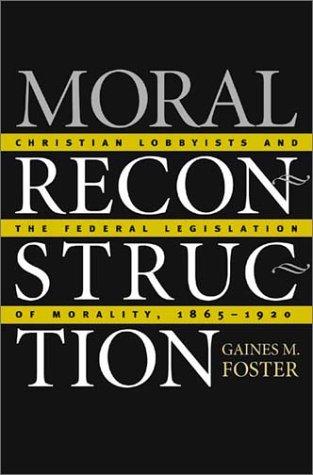
It is in no sense an overstatement to say that Gaines M. Foster's Moral Reconstruction: Christian Lobbyists and the Federal Legislation of Morality, 1865-1920 is a near perfect blend of historical insight and timeliness. Foster's simple book has simple scope: the examination of the rise of the Christian lobby in late nineteenth century America and the moral legislation it pursued. He makes clear, however, from the first sentence of the introduction that this is not intended to be a purely academic exercise. The rise of the Christian right in the late 1970s has made matters of the origins and precedents of religious lobbying and moral legislation issues of extreme importance for contemporary American moral polity. Foster convincingly suggests that the strongest, most germane parallel to the modern movement for moral reform is the late nineteenth century campaign to revise the moral character of the nation. The rise of the Christian lobby was more than merely a political shift or, as the lobbyists undoubtedly believed, an awakening of the American moral conscious in the face of some novel evil. It was a dramatic cultural and philosophical shift away from antebellum theories of states' rights, personal liberty, and moral suasion into new concepts of nationalism and corporate social responsibility. In this, and countless other nuances of Foster's book, there are striking ideological parallels to more recent impulses in American politics. In the interest of brevity, however, there are two points from Foster's work which stand out as especially noteworthy for reflection.

One of the most striking features of the Christian lobby, which Foster deliberately emphasizes in his narrative, was that even in its successes it understood and respected (or at least conceded to accept) the Constitutional limits of the federal government. There is little debate any longer about whether or not the federal government has some role in structuring national morality. As Foster will admit in his conclusion, few people object to the federal government having a hand in, for example, protecting children from the sexual advances of adults. In truth, most Americans probably do not even think of this in terms of the government legislating morality, though that is certainly what is occurring. As desensitized to the concept as modern Americans are, the idea that the government should make any universal laws regarding any morality was entirely foreign to early Americans. In fact, the Thirteenth Amendment represented something of a strange and wonderful novelty to nineteenth century Americans. They accepted that slavery was wrong (though some, only after being compelled by force of arms to accept that opinion), but that the government could seize the right to make that qualitative judgment was unusual. The Thirteenth Amendment would prove to be the justifying precedent cited most frequently by moral reformers.

Even with this powerful antecedent, the Christian lobby was forced to respect that most Americans understood the federal government to be restricted to a very small number of jurisdictions: interstate commerce, international treaties, administration of the military, and direct governance of the District of Columbia and the territories. In view of these limitations, the moral reformers were forced to pursue their agenda of national moral legislation within the confines of a traditional view of a limited federal government. They focused their efforts initially on enacting Sunday laws in DC, stricter divorce rules in the territories, prohibition in the military, and the restriction of interstate distribution of obscene materials (e.g. information on birth control). They understood that they could not make adultery illegal, but they did eventually convince the government that it had the power to make transporting a woman across state lines for the purpose of adultery should be. Even when the moral reformers did make their final push to outlaw the production and sale of all intoxicating beverages, Prohibition came with two important concessions to the limits of federal power. First, reformers readily admitted and accepted that Congress could not simply pass a law to achieve prohibition. A constitutional amendment would be necessary, as the Constitution did not give Congress the kind of sweeping moral power to outlaw behavior that the Christian lobby required. Second, in spite of initial attempts to include it, the provision which made possessing and consuming alcohol in one's home was removed from the wording of the amendment. The country was not ready to accept the idea that the government had the right to regulate moral behavior within one's own home. What authority it had, stopped at the domestic threshold. The home was a fortress, even if it was a den of wicked vice.

In addition to recognizing and working within the constitutional limits of the federal government, the history of the moral reformers teaches contemporary reformers and important lesson about the impermanence of moral reform. When the Volstead Act finally took effect, enforcing the Eighteenth Amendment, the reform periodical American Issue triumphantly declared, "The future historian will accord to January 16, 1920 a place second only to that of the advent of the Redeemer." Historians have a funny way of defying predictions. No one would today suggest that the onset of Prohibition in the United States was an event of permanent and global magnitude. Few school children know anything more than a passing quick fact about the Eighteenth Amendment and even less about the myriad moral reforms which preceded it. Even to the most conservative modern critic, the goals of the Christian lobby in the late nineteenth and early twentieth century seem antiquated if not comic. While many still oppose, largely futilely, ready access to abortion, on the most marginal members of society think it ought to be illegal to distribute information about birth control. Boxing, while not America's proudest past time, is legal to stage, promote, record, and distribute. (Imagine what the moral reformers would have thought of the mixed martial arts craze which has gripped the popular imagination.) The film industry not only escaped government content controls, but modern technology has made it possible for anyone and everyone to pipe any number of genuinely obscene pictures onto their computers, televisions, and telephones. Perhaps most notoriously at all, Prohibition was a miserable failure and social drinking (unlike boxing) is among the great American past times. From a historical perspective, efforts at national moral reform appear to have been the most dismal failure. Only a select few reforms from the period persist in any recognizable form: higher age of consent laws, laws against selling cigarettes to minors, and the end of mail delivery on Sundays. In his conclusion, Foster suggests that "the story of moral reconstruction provides no sure lessons to be applied to the renewed debate over legislating morality...but it does provide a historical context." Yet this historical context may in fact be the sure lesson which moral reformers need to learn; history has proved that it will be infinitely easier to repeal moral legislation than it was to pass it. It took the reformers nearly sixty years to enact prohibition through a constitutional amendment and only thirteen years for Americans to collectively regret and reject prohibition through another amendment.

There can be few complaints about Foster's work. Admittedly, it is dry, deeply encyclopedic reading which at times carries with it the uneasy feeling that one is actually just reading the congressional record. This impression is reenforced by the final eighty pages (or one quarter) of the book which is consumed by extensive appendices, notes, and other scholarly apparatus. At the same time, this exhaustive treatment reassures the reader that Moral Reconstruction is among the most well researched treatments of the period and subject that has yet been written. Though not a page turner for the average reader, the book is worth a second glance and more for professionals or dedicated hobbyists interested in grasping the historical context of ongoing movements among Christian especially to legislate a better moral polity for America.

Wednesday, August 31, 2011

A Different Kind of Loyalist

It has often been request of me, and I have long desired, to write up a more comprehensive statement of my view of the relationship between Christians and civil governments. Unfortunately, this is not such a statement. Instead, I recently encountered a quote in an unrelated context which seemed to me to capture, if not the totality, then at least the spirit of what I understand to be a correct stance of Christians toward civil government. In an article about the Sandemanians and their politics during the American Revolutionary War, Jean Hankins summarizes their position thus: "Sounding like activists, but acting like pacifists, New England's Sandemanians emerge as a different kind of loyalist." In this brief statement can be found three critical principles for a Christian relationship to government:

Submission: The term "loyalist," while an accurate term historically for supporters of the rights of the English crown to rule the colonies, would not describe appropriately a Christian disposition toward human government (i.e. I would not describe myself as "loyal" to America or her interests). The error is, however, semantic. What the quote describes is the basic framework for the relationship to Christian government, which is one of obligatory respect and submission. It is the same raw context for civic ethics that Paul enjoins in Romans 13:1 or Peter commands in 1 Peter 2:17. Whatever instances of so-called civil disobedience may be permitted, they are permitted as exceptions to the rule of submission not as a rule which allows for incidental or occasional submission. (Incidentally, since the American Revolution is the context of the quote, I wonder what contemporary Christians who idolize--and that word is deliberately chosen--the Revolution and its architects do with verses like these.)

Pacifism: I realize this will be the most contentious suggestion, particularly in an era in which American Christianity has so steeped itself in militarism that it has embraced a spiritual baptism in the blood of national imperial martyrs instead of the blood of a peaceful savior. Yet in our modern world of mass-produced warfare and ever more coercive governments, pacifism provides the primary means for suspending our obligation to submit to civil government. Gone are the days when "We must serve God rather than men" functioned primarily to oppose religious censorship. Now our governments require a full participation of the citizen in all the tainted mechanisms of government, and that participation is always and completely a moral activity, a tacit endorsement of the necessary means of human structures of power. Without enumerating what I believe are the many applications of this antagonism between a Christian vision of peace and civil government, let it suffice to say that as often as being a peacemaker stands contrary to the mechanisms of civil government--and those occasions will certainly be frequent--it is our ethical commitment to peace which takes precedence.

Activism: The most frequent critique of pacifism confuses a rejection of unrighteous means with a rejection of righteous ends. I cannot count the number of times I have seen arguments which boil down to this: if you don't support opposing injustice with violence, then you are supporting injustice by implication. It simply isn't true. Pacifism simply makes the claim--one which I obviously find convincing--that it is logically inconsistent to pretend to oppose injustice with violence, an unjust tool. Instead, pacifists make an effort to oppose injustice with just means. Pacifism is not quietism. It is absolutely the Christian's duty to "sound like an activist," which is to say we should be active through every ethically available means to promote peace, justice, and mercy in a world which thirsts for them. There is no virtue in pursuing justice at any cost, especially when the cost is the peace and mercy which we ought to be promoting with and through justice.

Admittedly, it is something of a contrivance to use Hankins's quote as a the framework for cutting to the heart of the question of a Christian relationship. Nevertheless, the broad categories it outlines demonstrate the main areas of discussion necessary: in what sense are Christians "loyalists," in what sense are we "pacifists," and in what sense are we "activists." I think the image presented to describe the Sandemanians (who, I admit, I know very little about) captures very nearly a picture of Christian civic virtue that grows naturally out of the Gospel.