Showing posts with label abortion. Show all posts

Saturday, December 15, 2012

Abortion is Murder, Rabbi

In an ill-advised recent article, Rabbi Boteach attempted to argue in the Huffington Post that the Catholic Church ought to abandon its stance on abortion because it is based on a mistranslation of the Hebrew in the Septuagint. There are countless reasons--logical and illogical--why the Catholic Church, not to mention other "Bible-believing" Christians, can ignore Boteach's argument, not the least of which is that the very last Christian denomination that would take doctrinal advice about its tradition from a rabbi is the Roman Catholic Church. There are better reasons of course, including that the Catholic Church does not view the Septuagint with the same disdain that modern Jews do (the opinions of late-antique Jews notwithstanding). It is also worth noting that even if the tradition were based on a faulty reading of the text in question, the Catholic Church has traditionally been loathe to interpret Scripture without tradition as a hermeneutical lens. Wrong or not, the tradition gives the normative starting point for reading the sacred text.

The best reason, however, for ignoring Boteach is that the Christian pro-life tradition does not spring exclusively (or even primarily) from the verse in question. Boteach rightly identifies a passage in Exodus as the prooftext to which many contemporary Christians turn to ground their opposition to abortion in Scripture:

The Hebrew Bible makes only one reference to abortion, and this is by implication. Exodus 21:22-23 states: "And if two men strive together and hurt a woman with child, so that her fruit depart, and yet no harm follow, he shall be surely fined, accordingly as the woman's husband shall lay upon him, and he shall pay as the judges determine. But if any harm follows, though shalt give life for life."

He even goes through the trouble of tracing the Catholic tradition of interpretation for this verse back through Byzantine law to the writings of the second century Latin father Tertullian--a noble effort for a HuffPo article. Not being in a position--nor thinking it particularly relevant--to challenge this historical account, I grant it to him, arguendo. I will even grant him his exegetical work on the meaning of the original text. In both cases the points are moot. 

What truly matters is that Boteach fails to consider a Christian tradition against abortion that antedates even Tertullian and is based on another text in the Hebrew Bible which references abortion by implication: "Thou shalt not kill." Outrage is sure to follow at the suggestion that the commandment can be simply construed to prohibit abortion, but the argument being made here is not an exegetical one. It is historical. I need not demonstrate that the prohibition on murder extends to the unborn, only that the text was not corrupted in its translation to the Septuagint and that an early Christian tradition construed the verse to prohibit abortion.

If anyone seriously doubts the first point, I will be glad to argue it, but for my purposes here, the latter point is the more novel and more contentious. Yet, had Boteach bothered to dig only a little deeper he would have found an earlier contemporary of Tertullian, Athenagoras, writing passionately against all murder, including abortion. The following is from his A Plea for Christians, specifically from a section when he is answering charges that Christians kill and eat babies as part of their "love feasts:"

For when they know that we cannot endure even to see a man put to death, though justly; who of them can accuse us of murder or cannibalism? Who does not reckon among the things of greatest interest the contests of gladiators and wild beasts, especially those which are given by you? But we, deeming that to see a man put to death is much the same as killing him, have abjured such spectacles. How, then, when we do not even look on, lest we should contract guilt and pollution, can we put people to death? And when we say that those women who use drugs to bring on abortion commit murder, and will have to give an account to God for the abortion, on what principle should we commit murder? For it does not belong to the same person to regard the very foetus in the womb as a created being, and therefore an object of God’s care, and when it has passed into life, to kill it; and not to expose an infant, because those who expose them are chargeable with child-murder, and on the other hand, when it has been reared to destroy it.

The passage is interesting for its implications both for the Christian position on capital punishment and our modern delight in virtualizing our love of torture. For the moment, however, consider that abortion falls into a single category, "murder," considered here by Athenagoras: execution, abortion, infanticide. They are all equally beneath the broad heading of murder which, naturally, Christians abstain from. All these are not only opposed by Christians on the grounds that all are murder, but Athenagoras thought them so central to Christian belief and practice that anyone who knew a Christian would know that he abhorred execution and opposed abortion and that on those grounds could be freed from any suspicion of infanticide. There is no complex exegetical wrangling, no attempt to define the way Hebrew law applies to Christian ethics. Just the simple maxim Christians do not murder and the obvious (at least in the second century) implication that this includes abortion.

The precedent goes back even farther than even Athenagoras. The late first century Didache includes a clear statement on abortion and it links it again, not with the passage Boteach cited, but with the general prohibition on murder:

Thou shalt do no murder, thou shalt not commit adultery, thou shalt not corrupt boys, thou shalt not commit fornication, thou shalt not steal, thou shalt not deal in magic, thou shalt do no sorcery, thou shalt not murder a child by abortion nor kill them when born, thou shalt not covet thy neighbour's goods, thou shalt not perjure thyself, thou shalt not bear false witness, thou shalt not speak evil, thou shalt not cherish a grudge, thou shalt not be double-minded nor double-tongued

Here the connection with the Ten Commandments is even clearer, as the various applications of the commands are interspersed haphazardly with quotes from the Decalogue. Not only does the general command not to murder apply, but it applies specifically to murder of "a child by abortion" and, as with Athenagoras, infanticide.

The two passages offered provide wonderful avenues for further contemplation. The language of creation and the perception of the fetus as a child as early as the first century would seem to lend legitimacy to much of the rhetoric used by the pro-life camp. More important, however, at least for my purpose here is the fact that the anti-abortion stance of Christianity, the tradition that Boteach ties specifically to the Catholic Church, is neither bound to the passage Boteach considers nor is it as late in its articulation as he imagines. The belief that God has tasked his people with the preservation of life--in all the richest, theologically-informed meanings of the word--is not something the exegetical acrobatics and critiques of tradition can remove, especially not ones that fail by their own critical criteria.

Tuesday, November 6, 2012

Here’s an Idea, Don't Vote: Violence and Representative Democracy

There's an election today. Have you heard? This will come as a shock to no one who has ever visited this site, but I will not be voting this year. I also didn't vote four years ago. Or four years before that. Or...you get the drift. As a committed old, tried and true Christian anarchist, I have watched the campaign season very closely, the way I might watch a really interesting football game, or a Spike "world's most unbelievable car crashes" marathon. Politics--infinitely more than contact sports and traffic accidents--has proves itself again and again to be irredeemably violent. Beyond that basically standard pacifist complaint, however, I would like to offer three reasons why I, as a Christian, am not voting and, wait for it, why I encourage other Christians not to vote either. If you're not a Christian, you should vote; it'd be a shame if you didn't. (Not nearly as big a shame as it is that you're not a Christian, of course.) In any case...

With this final argument, I will most nearly approach the essential quarrel that Christian anarchism has with government generally and representative democracy specifically. To do this, however, requires an examination both of the nature of the state and the moral implications in our republican form of government. Though less concrete and more nuanced than other pleas to avoid participation in the democratic process, it still serves as the most compelling reason to see voting as immoral rather than merely unnecessary, ineffective, or unimportant.

David Lipscomb states succinctly what later theologians have agonized over with regard to man's original sin: "God would govern and guide man; man would govern the under-creation, and so the whole world would be held under the government of God, man immediately and the under-creation through man. But, man refused to be governed by God...The institution of human government was an act of rebellion and began among those in rebellion against God, with the purpose of superseding the Divine rule with the rule of man." The term en vogue now to discuss man's fall is "autonomy," but the notions are the same. The account of the first sin in Genesis boils down to the belief that humanity knew better than God how to manage its own affairs.

It is not a coincidence that the second sin is murder. Violence follows logically on the heels of rebellion. Eve having usurped the divine prerogative to rule, Cain usurps the divine prerogative to judge. Ignoring the divine approbation showered on Abel, Cain renders his own terminal judgment about his brother and summarily executes him.

It is equally understandable then that civil government should arise both as an attempt to curb the influences of these sins and as their supreme manifestation. On the one hand, civil government exists to give wrest the rights of authority and judgement from the hands of the individual, a transfer of power which is necessary in order for society to function. At the same time, however, civil government exists as the collaborative human expression of that primary impulse toward autonomy. God is no more lawgiver and judge now than in the days after the fall. Instead, humanity set up an alternative lawgiver and judge to stand in the place of God. The state is essentially and inescapably an idol to our own sense of superior self-determination.

It's a truth so inescapable, God Himself might as well have uttered it:

Then all the elders of Israel gathered together and came to Samuel at Ramah and said to him, “Behold, you are old and your sons do not walk in your ways. Now appoint for us a king to judge us like all the nations.” But the thing displeased Samuel when they said, “Give us a king to judge us.” And Samuel prayed to the LORD. And the LORD said to Samuel, “Obey the voice of the people in all that they say to you, for they have not rejected you, but they have rejected me from being king over them. According to all the deeds that they have done, from the day I brought them up out of Egypt even to this day, forsaking me and serving other gods, so they are also doing to you. Now then, obey their voice; only you shall solemnly warn them and show them the ways of the king who shall reign over them.”

Samuel obeys, and in his subsequent warning to the people he points out that the king will be the source of constant oppression for the people. "And in that day you will cry out because of your king, whom you have chosen for yourselves, but the LORD will not answer you in that day." Samuel, to say nothing of the LORD, recognizes that human governments will always be tied inexorably to violence. Civil government, simply defined, is the ability--granted or assumed--to coerce others to behave in ways they would not otherwise. People pay their taxes because they fear the IRS, not because they have any confidence in the federal government to invest their money wisely. People drive the speed limit to avoid getting a ticket, not because they are opposed in principle to driving more than 25-mph in a school zone. A government which does not have coercive authority--which is a poor euphemism for violence--to enforce its laws instantly collapses.

But, as we've already seen, Christians have no investment in coercing non-Christians to mimic a Christian society. All our efforts to do so have in fact been counterproductive. It shouldn't surprise anyone. There is no government which can function on the principles of the Sermon on the Mount because civil government unavoidably implies violence. A foreign policy which extols "turn the other cheek" and "resist not evil" invites invasion. Imagine, moreover, a candidate running on the economic platform, "Do not lay up for yourselves treasures on earth." (Never mind that the recent rescue of Wall Street, the banks, and big business has proved the biblical adage "Where your treasure is, there your heart will be also.") Our judicial system would grind to an immediate halt if it were to embrace "Judge not, that you be not judged"--without moving over to talk about "he who is without sin." There's no reason to even discuss the golden rule. The fundamental incompatibility of Christianity and civil government should be obvious merely from a liberal exercise of human reason, but Paul does Christians the service of highlighting the dichotomy in Romans when he tells Christians that they must express love and peace and allow the government to be God's unwitting agent for vengeance.

Therein lies the special problem for representative democracy. For Paul, it was simple: Christians and governments were discrete ethical units. The same is not true in a representative democracy. It has been a while since most of us took a high school civics course, and, if yours was anything like mine, it was worthless to begin with. Here is the way our government works. Our nation is too large and unwieldy to have a direct democracy, wherein everyone actually exercises a specific voice in the construction of policy. Instead, through voting and other means of political activism, Americans elect a small representative group of people to construct policy on their behalf. For the non-Christian, the process is simple enough: choose whichever candidate is most likely to achieve the political ends most important to you.

Here is the problem for Christians. By choosing to elect a representative, we make ourselves complicit in everything that is done on our behalf. That's unpleasant to think about and easy to dismiss uncritically, but that is the nature of the American system of government. President Obama has your proxy to act in the executive branch. Maybe you didn't vote for him, and maybe that means you can sleep better at night know that your spotless Christian hands aren't stained with the blood of the people he assassinated by remote control. But unless you make a habit of losing, there is someone who is representing you in the American government, and it is necessary then to come to terms with the fact that government by its very nature behaves in ways forbidden to Christians.

War serves a legitimate function in statecraft, as does, arguably, capital punishment. But the Christ who told Peter to sheath his sword and stepped in front of the Jewish firing squad to save an adulteress models a different behavior, an ethical lifestyle that Christians are obligated to follow. Whoever you vote for, whoever is elected is employed only and entirely in the business of violence, that is in the business of coercing people to do what they would not do if given the choice. Whether it is taxes, speed limits, capital punishment, marriage rights, restrictions on abortion, or a war in Iran (because dying in the Middle East is the new American pastime) is irrelevant. Government is in the business of violence, and our government is in the business of doing violence with the consent of and on behalf of the voting public.

There is a solution, of course, for Christians. If to vote means to insinuate yourself ethically if not personally into the vile business of politics, then don't vote. It's not a matter of apathy or a recognition of futility. Instead, it is an affirmation that you belong to a different kingdom with a different King. Moreover--unlike America which continues to prove both its ambition and ineptitude on this front--our King will one day have everything put into subjection under his feet, without need of my vote or my campaign contributions. This is not a disengagement with the world. It is a proud boast that, in Christ, we have be granted a different mode of engagement with the world. One in which "when reviled, we bless; when persecuted, we endure; when slandered, we entreat." Christians reject, loudly and audaciously, the governing assumption the state that order is born out of violence and community out of coercion. By not voting, we concede the work of evil to the working of evildoers and reserve for ourselves the practice of untainted righteousness.

Perhaps more importantly, when Christians refuse to vote, we protect ourselves from the errors of the Israelites. We forget neither that God is our King nor the deeds He has worked on our behalf. We heed the advice of Solomon to "Trust in the Lord with all your heart, and do not lean on your own understanding." and sing with the psalmist, "It is better to take refuge in the LORD than to trust in princes." There is a stand to take this election more important than opposition to abortion. There is a gospel to preach truer than economic equality of opportunity. That message begins when Christians extricate themselves from the polls and resume their stance as critics from without, voices in the wilderness crying "Repent, the kingdom of heaven is at hand."

If the kingdom of heaven really is at hand, why are we so invested in the politics of the kingdoms of this world?

[Reason 1; Reason 2]

Monday, November 5, 2012

Here's an Idea, Don't Vote: Politics and Christian PR

There's an election tomorrow. Have you heard? This will come as a shock to no one who has ever visited this site, but I will not be voting this year. I also didn't vote four years ago. Or four years before that. Or...you get the drift. As a committed old, tried and true Christian anarchist, I have watched the campaign season very closely, the way I might watch a really interesting football game, or a Spike "world's most unbelievable car crashes" marathon. Politics--infinitely more than contact sports and traffic accidents--has proves itself again and again to be irredeemably violent. Beyond that basically standard pacifist complaint, however, I would like to offer three reasons why I, as a Christian, am not voting and, wait for it, why I encourage other Christians not to vote either. If you're not a Christian, you should vote; it'd be a shame if you didn't. (Not nearly as big a shame as it is that you're not a Christian, of course.) In any case...

The following argument will strike many as trivial, which is precisely why I have sandwiched it between what I believe are two more essential points. Nevertheless, having disposed of the notion that Christians are obligated to construct a moral society through legislation, it is important to look at the consequences of continuing to attempt to achieve such political ends. Admittedly there is a real sense in which Scripture acknowledges that that to be a Christian means to open yourself up to ridicule. Paul even accept that the world will always look down on the wisdom of God, ironically labeling it folly. Nevertheless, it is important to distinguish between opening ourselves up to be mocked and causing God to be mocked.

You are the light of the world. A city set on a hill cannot be hidden. Nor do people light a lamp and put it under a basket, but on a stand, and it gives light to all in the house. In the same way, let your light shine before others, so that they may see your good works and give glory to your Father who is in heaven.

Aspire to live quietly, and to mind your own affairs, and to work with your hands, as we instructed you, so that you may walk properly before outsiders and be dependent on no one.

Jesus and Paul agree here on what ought to be a self-evident truth: people are watching Christians and what they see determines what they believe. Christians individually probably are not to keen on the notion that their lives are under a microscope, and why should they be? God is more than fully aware that we all still sin. Christ is the image of the perfect human, not me. Nevertheless, the corporate behavior of Christianity speaks volumes to the world, particularly given how loudly we shout about certain issues. Unfortunately, what we're shouting about isn't meekness, poverty, righteousness, purity, peace, and mercy as in the Beatitudes--which precede the first quote--nor are is the public face of Christianity brotherly love, quiet living, and industriousness as in the passage from 1 Thessalonians. What are the loudest messages about God instead?


And if that seems like an extreme example to you, there are certainly others. Look at the now infamous statements of Richard Mourdock: "Even when life begins in that horrible situation of rape, that is something that God intended to happen." Frankly, I don't find that sentiment all that appalling, not because I agree with it but because I know it represents a large and historic branch of Christian theology. The popular media and the vocal critics of Christianity are less philosophical about it. It is sentiments like these given voice only because they are attached to political power: constitutionally challenged and protected protests or theology spilling into public policy. Meanwhile, I could walk into work tomorrow morning and proudly declare that I believe therapeutic abortion (i.e. abortion to save the life of the mother) is wrong--and I do believe that--and no one would bat an eye. They know that I have no interest in launching Christian ethics into the public sphere and so derision is replaced with apathy.

Meanwhile, regardless of what I believe about abortion--which is made largely irrelevant by my theoretical lack of a uterus--I would hope that when people describe me it is in terms more personal and therefore more sympathetic than the way most people choose to describe Mourdock or the Westboro Baptists. Those groups exist only as their public faces, only insofar as their behavior has consequences on a political scale. Yet when people interacted with Jesus, he specifically rejected any reduction of himself into a political persona. He was a healer of the sick, a feeder of the hungry, and a forgiver of sinners--not to mention a man of indisputably impeccable character himself. Richard Mourdock may very well donate to food drives. He may volunteer at hospitals. He may forgive any and everyone, even rape victims who get abortions. It's irrelevant. He will always be that Christian who thinks God is a rapist and wants to write laws on the basis of that belief.

It is time for Christians to take a long, hard look at just how extensively our involvement in democratic politics has opened us and, much more importantly, God to ceaseless ridicule. By allowing the public presence of the Christian faith to be reduced to its political manifestation--either is moralistic bigotry or socialistic coerced charity--we have transformed God the Father, Son, and Spirit from persons to partisans. There is no rehabilitating Christianity's political image. It is not possible to offer to the world a kinder, gentler, truer Christianity that will make the faith politically palatable. God makes radical ethical demands of His followers, and libertines are never going to be okay with that. God makes radical social justice demands of his followers, and aristocrats are never going to be okay with that. As long as the faith is married to political agendas, it will never be anything more than a caricature of the truth which Jesus came to impart, a revolutionary practical, ethical truth. In the meantime, more people are likely to disassociate with Christianity in favor of some vague notion of "spirituality" because to be in church means to be Richard Mourdock, et. al.


[Reason 1; Reason 3]

Sunday, November 4, 2012

Here's an Idea, Don't Vote: Christianity and the Moral Society

There's an election in a few days. Have you heard? This will come as a shock to no one who has ever visited this site, but I will not be voting this year. I also didn't vote four years ago. Or four years before that. Or...you get the drift. As a committed old, tried and true Christian anarchist, I have watched the campaign season very closely, the way I might watch a really interesting football game, or a Spike "world's most unbelievable car crashes" marathon. Politics--infinitely more than contact sports and traffic accidents--has proves itself again and again to be irredeemably violent. Beyond that basically standard pacifist complaint, however, I would like to offer three reasons why I, as a Christian, am not voting and, wait for it, why I encourage other Christians not to vote either. If you're not a Christian, you should vote; it'd be a shame if you didn't. (Not nearly as big a shame as it is that you're not a Christian, of course.) In any case...

One of the most common arguments I hear in favor of the notion that Christians have a duty to vote is that by not voting we are allowing society to slip deeper and deeper into the quagmire of sin. By not casting my vote--typically in this scenario for the Republican candidate, but it can go either way--I become culpable for constructing a society in which school children can see a man kissing another man on a taxpayer funded field trip to an abortion clinic. (Or, if you prefer, I become culpable for constructing a society in which a misogynistic plutocrat can oppress the poor, shackle his wife to the kitchen--metaphorically or literally--and deny life-saving medical treatment to his cancer-ridden, home-schooled daughter because God told him to.) Setting aside entirely the philosophical issue of moral culpability in the absence of intention or action, there is a more obvious problem here with the way Christians have come to understand their role in constructing a moral society.

It is simple enough to begin this argument with the rather inoffensive statement that God is omnipotent. As a subset of this omnipotence, it also seems fairly obvious to indicate that it is within God's capability to prevent people from doing evil. For those of us committed to the notion of free will (and I'm sure I'll lose some of you here), that God choose is not to prevent people from doing evil is an expression of a moral truth no less crucial than God's omnipotence: compulsory goodness is no goodness at all. God, in structuring the world, has made it evident to humanity that agency is a prerequisite for morality. That is why Jesus went to such great length to convince people of the value of the ethical teachings he proclaimed. Had he wanted to, ♫ he could have called ten thousand angels ♫ and told the world, "Love one another, or else." But he didn't. Christ, the great king, unlike every government devised by man put morality in the hands of human agents and tried to persuade them to make the right decisions.

You can see where I'm going with this, and it sounds nice in theory. But you're a good, Bible-believing Christian. If only there were a verse that clearly stated that it wasn't Christians' job to police the morality of the world. Enter Paul:

I wrote to you in my letter not to associate with sexually immoral people— not at all meaning the sexually immoral of this world, or the greedy and swindlers, or idolaters, since then you would need to go out of the world. But now I am writing to you not to associate with anyone who bears the name of brother if he is guilty of sexual immorality or greed, or is an idolater, reviler, drunkard, or swindler—not even to eat with such a one. For what have I to do with judging outsiders? Is it not those inside the church whom you are to judge? God judges those outside. “Purge the evil person from among you.”

I give you the context there so you can understand where Paul is coming from. There is rampant immorality in the church in Corinth--quite unlike the pure, wholesome churches of America--but it would seem that the Corinthians still seem more interested in condemning those nasty pagans with their nasty habits. Paul will have none of it. The purity of the world is none of his concern. He understood then what so few seem to understand now: it is foolish to expect non-Christians to act like Christians. You might as well beat your head against a wall. It would certainly elicit more sympathy than trying to beat the gay out of people.

The responsibility for Christians to construct a moral society is simple. The church is holy, and it is our job as Christians to keep it holy. The world is not holy. It has been given over to the lusts of impure hearts, to dishonor, to self-destruction, and to folly. Christians can purify the church; God will purify the world--with fire, no less, but don't tell limp-wristed, left-wing, bleeding hearts like me that...we can't handle the imagery. God is not interested in forcing people to behave. You can choose to live as a Christian or you can choose to live as a pagan. According to Paul, the only thing the church needs to worry about is making sure that it is composed only of those who are choosing to behave like Christians.

As for the residents of the rest of society, they are going to keep having abortions. They are going to keep going keep stealing, embezzling, defrauding, and withholding while people literally die in the streets. They are going to keep debauching themselves in inventive ways, videotaping it, and distributing it for a small monthly fee on the Internet. They are going to keep getting drunk, stoned, and...well, I lack the appropriate drug vernacular to put together a good list, but you see where I'm going.

Society will continue to be the Roman society that existed in the days of the apostles. The only difference between Paul and Christians now is that democracy has led us into the delusion that, having failed to do the difficult work of convincing the world that God is good and sin is bad, we can just pass a law and make everyone righteous. It won't work. We shouldn't try. It's wrong.

[Reason 2; Reason 3]

Wednesday, October 24, 2012

Shane Blackshear, Starting to Get it Right

A minister recently pointed me to this entry by Shane Blackshear--she described him to me as "an emergent church guy" and assured me I shouldn't feel bad for never having heard of him. Blackshear begins with the gut-wrenching confession to the Christian community: "I'm not voting." It is a tragedy that it has come to this, come to a point where it requires more than a little courage to say with anything other than youthful apathy, "I will not be voting come November." Yet this is far from melodrama on Blackshear's part. My wife finds herself regularly harassed at work and among her relatives when it comes up that she does not vote. Just yesterday, I invited the ire of one of my colleagues by announcing, "I'm not voting. I don't have a dog in your fight." The notion that Christian principles could tend toward anything other than full and patriotic participation in American democracy is entirely foreign to the modern mind.

Blackshear, for his part, makes the beginnings of a good case for why he won't be voting in this election. Proceeding from the principle that he is pro-life, he asks two important questions:

Remember when we had a Republican President and abortion stopped for 8 years?

...Remember when a Democrat was elected 4 years ago and our soldiers were brought home?

There is in this a microcosm of the futility of conscientious voting for Christians, and Blackshear seems to feel it acutely, quoting Psalm 14 and discouraging Christians from trusting "in princes." Yet he proves willfully unwilling to press these observations to their logical conclusion. Appealing vaguely to the "valid reasons" for voting for each candidate, Blackshear makes it clear that this is a personal protest and not a Christian imperative. Where is the recognition that every vote is a vote for warfare? Why is it so difficult to extrapolate from the last twelve years of anecdotal evidence the profound truth that governments exist solely for the purpose of violence? The logical conclusion is easy enough to draw: in a representative republic, we elect people to govern on our behalf. Every abortion Obama facilitates, every "enemy combatant" Romney "subdues," it is done on behalf of the voting public and they partake fully in the culpability for those actions.

If Blackshear, making the right stand as I believe he does, really wants to argue that he cannot , as a Christian, cast his vote for another politician who cannot respect life, then it is incumbent upon him to realize that, as a Christian, he cannot vote. At which point, I'll be the first to welcome him into the rich, historic fold of Christian anarchism.

Sunday, September 30, 2012

The Wisdom of Mark Noll

I had some familiarity with the first edition of Religion and American Politics, a volume of essays edited and introduced by Mark Noll. I enjoyed the apology for the continued scholarly interest in the interplay between American religious and political life. Yet, as Noll points out in his introduction to the second edition, such an apology has become unnecessary in the years since the book's initial publication. Americans are not thoroughly aware of the substantial, if not dominant, role of religion in American politics. In an effort to reorient the book, Noll suggests that a new argument must be made to the American people:

[Contemporary Americans need] to incorporate a little bit of historical distance when tempted to extremes of approbation, condemnation, or bewilderment in the face of current events. The religious-political agitations of the recent past are, in fact, far from novel. Beginning with the Civil Rights movement of the 1950s and 1960s and going on to the rise of politically conservative evangelical Protestantism, American politics has returned to the normative situation that prevailed for most of American history...

Against the fuller sweep of American history, the political-religious interactions of the last few decades represent no new thing. From arguments over religious freedom during the Constitutional Convention and antebellum sectional division accompanied by learned public debates from Scripture about the morality of slavery, through religion-infused experiences on the home front and with armies during the Civil War, and imposition of racial segregation after the end of Reconstruction, the rise of populism, the national campaign for prohibition, and the arguments used for entrance into World War I (and against entering that war), to the presidential election of 1928, when the Catholic faith of Democratic candidate Al Smith loomed large, religion was an ever-present if also constantly evolving fixture in American politics.

Attention to this wider history shows, for instance, that religious vitriol was spread around more widely during the Thomas Jefferson-John Adams presidential race of 1800 than with Bush versus Kerry in 2004; that public debate over the morality of slavery reached a depth of intensity beyond what has been experienced in debates over, first, African-American civil rights and then abortion and gay marriage; and that Jews and Catholics experienced levels of discrimination into the twentieth century that far exceed discrimination against Muslims that has been documented for the early twenty-first century.

Noll's purpose is obviously not to trivialize the seriousness of modern religiously infused debates, particularly not, for example, civil rights or religious discrimination. His is simply a plea to contextualize these discussions historically and to resist the urge to particularize the modern mindset. Americans are, unfortunately and by no means uniquely, a people who delight in bringing their religion to bear on statecraft.

Wednesday, April 18, 2012

Why Aren't We Killing the Abortionists?

Hilter was not a nice man. I think we can all agree to that, and if for whatever reason you are unwilling to admit that, you may have to accept that premise arguendo. After all, Hitler started a war that ultimately resulted in the death of 2.5% of the world’s population, perhaps as many as 75 million people. When you add to this his most notorious atrocity, the systematic extermination of socially marginal groups like Jews, homosexuals, Romani, the disabled, and political dissidents, it is no wonder that Hitler has become the quintessential evil. The greatest—or at least the peskiest—argument that pacifists face is, “So are you saying we shouldn’t have stopped the Holocaust?” Of course there are countless reasoned arguments to make against this, but, as is so often the case (and I am not intended to bemoan this fact), what is reasonable has difficulty triumphing over what seems right.

Meanwhile, in the United States alone, well over one million abortions occur every year. In fact, between 1973 and 2008, some fifty million abortions occurred in the United States. These numbers reflect the world in a microcosm. Worldwide abortion statistics show that the number of abortions per annum stays consistently above forty million with no significant signs of long term decline in total abortions. This is by no means merely a third world problem either; the number of abortions per capita between developed and developing is comparable (24 and 29 per 1,000 women respectively). So my question is, why aren’t we killing the abortionists?

Clearly my point isn’t actually to suggest violence towards abortionists or even to suggest (and so defeat my own argument) that every doctor who performs abortions is the equivalent of Hitler. There is a comparison to be made, however, between the Holocaust and abortion statistics, one that ought to be telling. Consider that every year in world five times more abortions are performed than people were killed during the Holocaust. In fact, in America alone the death rates among the unborn and Holocaust victims is the same (if we date the Holocaust from 1933-1945). More startling still, when it is considered that six years of global warfare claimed almost 80 million lives, we cannot help but realize that abortions are occurring globally at three times that rate.

I wonder then why those who believe that Hitler was so evil and the Holocaust so atrocious (and I don’t dispute either of those analyses) that they needed to be countered with lethal violence and also believe that abortion is murder are so slow in taking up arms and opposing doctors who perform abortions with the same verve that they laud in our opposition of the Third Reich. After all, with 53% of Americans believing that abortion is morally wrong most of the time (and less than ten percent of abortions are therapeutic, eugenic, or as a result of rape or incest), there ought to be a significant portion of the American population who, if they consistently applied their beliefs, would be opposing abortion not with rallies, petitions, and grumblings from their living rooms but with the righteous use of deadly force.

With any luck, this farcical call to arms will have the effect of causing people to reevaluate the way they approach justified uses of violence. After all, I would hope that as many people who look at Hitler and feel icky at the thought of not having opposed him by force will feel just as icky about the idea of picking up a gun and shooting up the local Planned Parenthood. The problem is not with pacifists, who know never to pick up guns and shoot our co-bearers of the divine image, but with fair-weather militants who would gladly take a gun and shoot the guards at Auschwitz but to whom it never occurred to take the same action against the statistically more offensive abortionists.

If nothing else, the next time someone unthinkingly attempts to shut down pacifism by asking me “So you wouldn’t have killed Hitler?” I will be able to just as blithely respond, “So why haven’t you killed Cecile Richards?”

Wednesday, March 14, 2012

Lawmakers Resort to Schoolyard Antics

Throwing caution to the wind--not to mention principle and process--several lawmakers have decided that the most effective political tool is sarcasm. A number of female lawmakers around the country have been proposing facetious bills in what is best described as a legislative effort to prove "anything you can do, I can do better:"

Democratic Ohio state Sen. Nina Turner is the third female lawmaker to introduce a bill that would limit men's access to Viagra and other erectile dysfunction drugs to make a statement about the dozens of anti-abortion bills that have passed statehouses around the country over the last year...Turner's bill would mandate that men seeking Viagra be "tested for heart problems, receive counseling about possible side effects and receive information about 'pursuing celibacy as a viable lifestyle choice.'"

Turner said on MSNBC Monday that the bill is about showing "men as much love in the reproductive health arena as they have shown us over the years. My Senate Bill 307 is all about the love and making sure we look out for men's sexual health."

The fact that the public trust in their various elected officials and their confidence in the ability of government to be efficient and productive are at startling lows does not seem to bother these lawmakers. When asked why she would waste congressional time by proposing legislation which she herself admits is repugnant simply because other lawmakers are wasting congressional time by proposing legislation she finds repugnant, Turner responded, "Because my mama always taught me that two wrongs do make a right." Or, at least, what else could she say?

Friday, February 3, 2012

Komen vs. Planned Parenthood: The Real Story is Hypocrisy


The news media, blogosphere, and (of course) posturing politicians all have some new and exciting news to howl about: Susan G. Komen for the Cure has ended its financial partnership with Planned Parenthood. The story, only a few days old now, has provoked vitriolic responses from the masses, or at least from masses of Democrats, feminists, and pro-choice advocates. The assumption fueling the hue and cry, in spite of denials from Komen, is that the charity has collapsed under political pressure from pro-life groups who criticized the partnership with a program that provides abortions. Responses have ranged from denunciations from members of Congress, calls to arms by political commentators, and withdrawn support on the part of every day people.

Let's say, for the sake of argument, that Komen did terminate its partnership with Planned Parenthood as a result of abortion controversy (and frankly it is hard to imagine that isn't the case). Surely those voicing their strong negative reactions to this decision can see the hypocrisy in their response. Yes, Planned Parenthood does so much more than provide abortions. Yes, in fact, abortion services are only a very small portion of the many wonderful services being provided by Planned Parenthood. Yes, this move may very well make it harder for some poor women to receive cancer screenings (although that appears to be more scare tactic than fact). So, yes, I can understand frustration over Komen's decision to generalize a small portion of Planned Parenthood's activities into the entire identity of the program.

But Planned Parenthood was only a small part of what Komen did. In the past two years, Komen gave $1.25 million in grants to Planned Parenthood. Extrapolating from those numbers, that is roughly $7.5 million dollars since the partnership began in 2005. When you consider that Komen has donated more than $1.9 billion dollars to breast cancer related causes since its 1982, the portion of funds that had been dedicated to Planned Parenthood were less than 4%. In other words, to condemn the entirety Susan G. Komen for the Cure for a single politically driven action is no different than Komen condemning all of Planned Parenthood for a single politically charged service. Just as Komen's move is likely to inadvertently effect, for the worse, the health of many women who might have received help from Planned Parenthood totally unrelated to abortion, going to war against and boycotting Komen is bound adversely effect the health of the same women protestors self-deludedly purport to represent. It is the height of hypocrisy.

One blogger, joining loudly in the politically fashionable rage against the machine (the heartless breast cancer fighting machine), has argued that to claim to be pro-life and be against Planned Parenthood is oxymoronic. Any such oxymoron isn't truly concerned about life but about propping up a worthless self-image. In truth, the whole battle--and contestants on both sides--are actually only interested in projecting their own values into the public sphere for the purpose of triumphing over another's values. If either party were primarily concerned about women's health, they would realize that Komen is a fantastic tool for saving lives, that Planned Parenthood is also a fantastic tool for saving lives, that neither is perfect, and that condemning either outright on the basis of their imperfection is nonsensical. Mostly they need to realize that lambasting any organization that has dedicated nearly two billion dollars to preserving women's lives is not feminism. It's partisanship, an ugly, self-interested, doctrinaire contest in which their are no winners. Ever.

Wednesday, February 1, 2012

Then again...(or Positive Secularism Fights Back)

Perhaps my last offering was prematurely triumphant. I awoke this morning to find an article analyzing President Obama's decision to press the issue of faith-based organizations providing sterilization, contraceptives, and abortifacients as part of their health insurance regardless of any moral qualms or religious conscience. The position taken by the executive branch seems more ideological than practical, forcing Catholic groups to provide birth control which is freely and widely available elsewhere. For the author of the article, the message the government is sending is clear:

Obama's decision also reflects a certain view of liberalism. Classical liberalism was concerned with the freedom to hold and practice beliefs at odds with a public consensus. Modern liberalism uses the power of the state to impose liberal values on institutions it regards as backward. It is the difference between pluralism and anti-clericalism.

I don't know that this can necessarily be cast as "anti-clericalism," and I certainly reject the provocative claim that "the war on religion is now formally declared." This is, however, indicative of this shift in American conceptions of liberalism that I referenced last night, away from the idea of non-intrusive freedom that dominated, at the very least, in the antebellum period and toward a new idea of government sponsored, socially mandated positive pluralism. It is no longer enough to merely not infringe upon the life and liberty of another; in fact, infringing on that liberty can be seen as a moral good provide it is done in the service of securing an increasingly bloated list of rights on behalf of another. (Imagine suggesting to an American two hundred years ago--or one hundred, or fifty, or twenty--that abortion, sterilization, and birth control were inalienable human rights that trumped religious liberty.) There does some to be a clash in cultures occurring here--though again, not some vague war on religion--which no longer sees conscience as the liberty so essential that it became enshrined in the very first amendment to the Constitution, but instead considers it to be a private peccadillo to be tolerated so long as it doesn't interfere with the liberated mindset of post-sexual revolution America.

Without climbing too high onto my soapbox, I'd like to suggest that this viewpoint is only possible because of the trivial way contemporary Christians have handled their faith, allowing it to become more about politics than piety, more about sexual ethics than kingdom ethics. I am ultimately convicted that if Christians were to take faith in Christ as the all-consuming, life-transforming, community-constituting reality that it is and allowed it to distinguish us from society at large rather than trying to conform it to social expectations, perhaps it would be harder for the world to see faith as secondary in importance to the all-powerful right to have a thin, lubricated layer of latex between you and the sexual partner of your choice.

Thursday, January 12, 2012

Compelling Morality: Our Redundant History


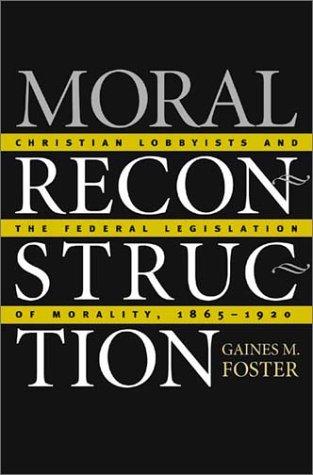
It is in no sense an overstatement to say that Gaines M. Foster's Moral Reconstruction: Christian Lobbyists and the Federal Legislation of Morality, 1865-1920 is a near perfect blend of historical insight and timeliness. Foster's simple book has simple scope: the examination of the rise of the Christian lobby in late nineteenth century America and the moral legislation it pursued. He makes clear, however, from the first sentence of the introduction that this is not intended to be a purely academic exercise. The rise of the Christian right in the late 1970s has made matters of the origins and precedents of religious lobbying and moral legislation issues of extreme importance for contemporary American moral polity. Foster convincingly suggests that the strongest, most germane parallel to the modern movement for moral reform is the late nineteenth century campaign to revise the moral character of the nation. The rise of the Christian lobby was more than merely a political shift or, as the lobbyists undoubtedly believed, an awakening of the American moral conscious in the face of some novel evil. It was a dramatic cultural and philosophical shift away from antebellum theories of states' rights, personal liberty, and moral suasion into new concepts of nationalism and corporate social responsibility. In this, and countless other nuances of Foster's book, there are striking ideological parallels to more recent impulses in American politics. In the interest of brevity, however, there are two points from Foster's work which stand out as especially noteworthy for reflection.

One of the most striking features of the Christian lobby, which Foster deliberately emphasizes in his narrative, was that even in its successes it understood and respected (or at least conceded to accept) the Constitutional limits of the federal government. There is little debate any longer about whether or not the federal government has some role in structuring national morality. As Foster will admit in his conclusion, few people object to the federal government having a hand in, for example, protecting children from the sexual advances of adults. In truth, most Americans probably do not even think of this in terms of the government legislating morality, though that is certainly what is occurring. As desensitized to the concept as modern Americans are, the idea that the government should make any universal laws regarding any morality was entirely foreign to early Americans. In fact, the Thirteenth Amendment represented something of a strange and wonderful novelty to nineteenth century Americans. They accepted that slavery was wrong (though some, only after being compelled by force of arms to accept that opinion), but that the government could seize the right to make that qualitative judgment was unusual. The Thirteenth Amendment would prove to be the justifying precedent cited most frequently by moral reformers.

Even with this powerful antecedent, the Christian lobby was forced to respect that most Americans understood the federal government to be restricted to a very small number of jurisdictions: interstate commerce, international treaties, administration of the military, and direct governance of the District of Columbia and the territories. In view of these limitations, the moral reformers were forced to pursue their agenda of national moral legislation within the confines of a traditional view of a limited federal government. They focused their efforts initially on enacting Sunday laws in DC, stricter divorce rules in the territories, prohibition in the military, and the restriction of interstate distribution of obscene materials (e.g. information on birth control). They understood that they could not make adultery illegal, but they did eventually convince the government that it had the power to make transporting a woman across state lines for the purpose of adultery should be. Even when the moral reformers did make their final push to outlaw the production and sale of all intoxicating beverages, Prohibition came with two important concessions to the limits of federal power. First, reformers readily admitted and accepted that Congress could not simply pass a law to achieve prohibition. A constitutional amendment would be necessary, as the Constitution did not give Congress the kind of sweeping moral power to outlaw behavior that the Christian lobby required. Second, in spite of initial attempts to include it, the provision which made possessing and consuming alcohol in one's home was removed from the wording of the amendment. The country was not ready to accept the idea that the government had the right to regulate moral behavior within one's own home. What authority it had, stopped at the domestic threshold. The home was a fortress, even if it was a den of wicked vice.

In addition to recognizing and working within the constitutional limits of the federal government, the history of the moral reformers teaches contemporary reformers and important lesson about the impermanence of moral reform. When the Volstead Act finally took effect, enforcing the Eighteenth Amendment, the reform periodical American Issue triumphantly declared, "The future historian will accord to January 16, 1920 a place second only to that of the advent of the Redeemer." Historians have a funny way of defying predictions. No one would today suggest that the onset of Prohibition in the United States was an event of permanent and global magnitude. Few school children know anything more than a passing quick fact about the Eighteenth Amendment and even less about the myriad moral reforms which preceded it. Even to the most conservative modern critic, the goals of the Christian lobby in the late nineteenth and early twentieth century seem antiquated if not comic. While many still oppose, largely futilely, ready access to abortion, on the most marginal members of society think it ought to be illegal to distribute information about birth control. Boxing, while not America's proudest past time, is legal to stage, promote, record, and distribute. (Imagine what the moral reformers would have thought of the mixed martial arts craze which has gripped the popular imagination.) The film industry not only escaped government content controls, but modern technology has made it possible for anyone and everyone to pipe any number of genuinely obscene pictures onto their computers, televisions, and telephones. Perhaps most notoriously at all, Prohibition was a miserable failure and social drinking (unlike boxing) is among the great American past times. From a historical perspective, efforts at national moral reform appear to have been the most dismal failure. Only a select few reforms from the period persist in any recognizable form: higher age of consent laws, laws against selling cigarettes to minors, and the end of mail delivery on Sundays. In his conclusion, Foster suggests that "the story of moral reconstruction provides no sure lessons to be applied to the renewed debate over legislating morality...but it does provide a historical context." Yet this historical context may in fact be the sure lesson which moral reformers need to learn; history has proved that it will be infinitely easier to repeal moral legislation than it was to pass it. It took the reformers nearly sixty years to enact prohibition through a constitutional amendment and only thirteen years for Americans to collectively regret and reject prohibition through another amendment.

There can be few complaints about Foster's work. Admittedly, it is dry, deeply encyclopedic reading which at times carries with it the uneasy feeling that one is actually just reading the congressional record. This impression is reenforced by the final eighty pages (or one quarter) of the book which is consumed by extensive appendices, notes, and other scholarly apparatus. At the same time, this exhaustive treatment reassures the reader that Moral Reconstruction is among the most well researched treatments of the period and subject that has yet been written. Though not a page turner for the average reader, the book is worth a second glance and more for professionals or dedicated hobbyists interested in grasping the historical context of ongoing movements among Christian especially to legislate a better moral polity for America.

Thursday, January 13, 2011

The Darker Side of American Pregnancy

Continuing a trend, I found a New York Times article on infertility and abortion recommended in another blog and wanted to recommend it here as well. There are some startling statistics quoted in it which play into the writer's larger, grimmer picture of the state of pregnancy in our society. It is surprisingly low on bias and rhetoric, though all the while being starkly realistic about the status quo. I found the conclusion to be both true and, in its implications, disturbing:

This is the paradox of America’s unborn. No life is so desperately sought after, so hungrily desired, so carefully nurtured. And yet no life is so legally unprotected, and so frequently destroyed.

Tuesday, November 30, 2010

Buddhism and Abortion

I'm not sure why it never occurred to me (given the essential role that respect for life plays in Buddhism), but reading about abortion laws in Thailand has made me realize just how "pro-life" Theravada Buddhism can be:

In [the] Buddhist view, both having an abortion and performing an abortion amount to murder. Those involved in abortions will face distress in both this life and the next because their sins will follow them.