Showing posts with label divorce. Show all posts

Saturday, March 23, 2013

The Necessity of Redefining Marriage

Ben Witherington has recently commented on a CNN article which lays out, in my opinion, perhaps the strongest case against gay marriage from a strictly secular standpoint. I mention Witherington rather than going directly to the article because he includes many theological considerations which readers here are likely to find interesting. My main concern, however, is the argument of Robert P. George and Sherif Girgis.

Marriage is far more than your emotional bond with “your Number One person,” to quote same-sex marriage proponent John Corvino. Just as the act that makes marital love also makes new life, so marriage itself is a multilevel — bodily as well as emotional — union that would be fulfilled by procreation and family life. That is what justifies its distinctive norms — monogamy, exclusivity, permanence — and the concept of marital consummation by conjugal intercourse.

...All human beings are equal in dignity and should be equal before the law. But equality only forbids arbitrary distinctions. And there is nothing arbitrary about maximizing the chances that children will know the love of their biological parents in a committed and exclusive bond. A strong marriage culture serves children, families and society by encouraging the ideal of giving kids both a mom and a dad.

The authors make a compelling observation that, legally, marriage does much more than standardize a primary relationship (e.g. defaulting who ought to be your medical proxy or to whom your possession belong in the event of your death). If this was its sole function, there would be no need for the legal structure which has been built up around marriage, one which institutionalizes matters of monogamy, sexual exclusivity, and permanence. If it were about formalizing a person's primary affective attachment, it should be as easy to change as a will and open to the possibility of multiple equal levels of attachment. Which it isn't; at least not legally.

In fact, American culture has largely done away with these pillars of marital theory, particularly permanence. It is not quite as easy to change a spouse as it is to change a beneficiary in your will, but it is done with strikingly more regularity nonetheless. Sexual exclusivity is eroding with a startlingly rapidity, so that primary relationships which have not yet been formalized are rarely assumed to be sexually exclusive and even married persons have a wealth of ways to violate the bounds of sexual exclusivity with impunity. (Someone care to look up statistics about the use of pornography by married men?) Only monogamy remains largely uncontested both legally and culturally, although the authors do point out the swelling phenomenon of polyamory.

The solution seems to me to require a redefinition of marriage rather than a feigned conservative defense of the grand old institution. The heterosexual marriage characterized by monogamy, fidelity, and permanence exists more as a convenient fiction than a staid bulwark against social decay. If we care about a definition of marriage that includes these principles than a cultural redefinition of marriage is in order, one that would accord with and allow for the revitalization of marriage laws. If, however, we recognize the cultural shift behind which the law has lagged, then the legal redefinition of marriage seems to be in order, not only to exclude the heterosexual requirement, but also all laws which are artifacts of a time when marriage was permanent, monogamous, and exclusive.

My preference has, traditionally, been for the latter, but only because it divorces what is legal from what is ethical in a way that neatly accords with my view of the world. More to the point, short of a spontaneous, universal, and enduring cultural revolution that recaptures the historic conception of marriage, changing the law to reflect culture seems to be the prudent course.

(None of which, of course, comments at all on the permissibility of homosexuality in Christian ethics.)

Wednesday, February 20, 2013

Dorothy Day, the Woman

Being myself both anti-abortion and anti-war, both a complementarian and an environmentalist, you might think that I would realize that others, like myself, do not fall neatly into the media constructed left-right continuum of social and political thought. Nevertheless, I still found myself going into The Long Loneliness with the assumption that Dorothy Day, hero of the radical left, must be a rabid feminist of the latest type. Of course, as a historian, I should have realized the anachronism of assuming that a woman who came of age just as so-called first wave feminists were making strides toward legal equality could not be expected to share the concerns of so-called second wave feminists who would begin to blur the distinctions between equality and uniformity in the 1960s. Especially since Day's book was published in 1952. (For all I know, she went on to mirror the changing landscape of feminist thought, but that is a topic for another study.) Whatever my misconceptions and miscalculations, I was pleasantly surprised to read Day's own reflections on her womanhood, not because they necessarily paralleled or reinforced my own thoughts on gender but simply because she represented a strong, thoughtful, articulate woman who was, nonetheless, still a woman and saw herself as distinct from--dare I say complementary to--man.

I was lonely, deadly lonely. And I was to find out then, as I found out so many times, over and over again, that women especially are social beings, who are not content with just husband and family, but must have a community, a group, an exchange with others. A child is not enough. A husband and children, no matter how busy one may be kept by them, are not enough. Young and old, even in the busiest years of our lives, we women especially are victims of the long loneliness. Men may go away and become desert Fathers, but there were no desert mothers. Even the anchoresses led rather sociable lives, with bookbinding and spiritual counseling, even if they did have to stay in one place.

That observation was inoffensive enough, but she would make others that might not sit quite so well as she pitted her own womanhood against the work she wanted to do:

I am quite ready to concede now that men are the single-minded, the pure of heart, in these movements. Women by their very nature are more materialistic, thinking of the home, the children, and of all things needful to them, especially love. And in their constant searching after it, they go against their own best interests. So, I say, I do not really know myself as I was then. I do not know how sincere I was in my love of the poor and my desire to serve them. I know that I was in favor of works of mercy as we know them, regarding the drives for food and clothing for strikers in the light of justice, and an aid in furthering the revolution. But I was bent on following journalist’s side of the work. I wanted the privileges of the woman and the work of the man, without following the work of the woman. I wanted to go on picket lines, to go to jail, to write, to influence others and so make my mark on the world. How much ambition and how much self-seeking there was in all this!

In that struggle, she did not always choose what the "woman" in her desired. Perhaps, as I think some feminists would argue, this was her overcoming the gender norms foisted upon her by a misogynistic society. Perhaps, as I would suggest, this is merely the sacrifice of self that makes Day's life so profound. Reflecting on her conversion, which precipitated her divorce, she wrote:

I saw the film Grapes of Wrath at this time and the picture of that valiant woman, the vigorous mother, the heart of the home, the loved one, appealed to me strongly. Yet men are terrified of momism and women in turn want a shoulder to lean on. That conflict was in me. A woman does not feel whole without a man. And for a woman who had known the joys of marriage, yes, it was hard. It was years before I awakened without that longing for a face pressed against my breast, an arm about my shoulder. The sense of loss was there. It was a price I had paid.

It was not all so dreadfully serious, and one anecdote caught my attention precisely for how typically human it was. It reminded of the kind of casual, unreflective assumptions about gender that you hear every day walking through the mall or rattled off in casual conversation around the office. Here she explains to a friend precisely how she sees a mutual acquaintance from her feminine perspective:

“I tell you, I do like him. I like him very much. But why do I have to go into raptures about him? Do you want me to fall in love with him? But that is just it—the only thing I do not like about him is that he always is raving about women—kissing his hand to them, going down on his knees to them and saying ‘Ah, how I love them, and how they have wrecked my life!’ Women don’t like such a man. He is too easy to get. They prefer a more aloof type so that if he does make love them they can flatter themselves that there is some rare quality in them which made him succumb.”

And yet, sixty years later, guys like that still exist. Go figure.

Thursday, August 30, 2012

Sexy Amendments to the Constitution

We have all heard the ultimately impotent advocacy for an amendment to the Constitution that would restrict marriage to heterosexual monogamy. We have also all heard the formulaic justification: protect the family, protect marriage. The main problem here is that if I am really interested in protecting the family and traditional marriage, if I toast my Pop Tart every morning in the warm glow of my righteous cause, then a Constitutional ban on same-sex marriage is not where I'm going to start.

You won't hear Mitt Romney or Sean Hannity say it (though you might keep an eye on Newt Gingrich), but what this country really needs to protect families is an Amendment that criminalizes premarital sex. Out of wedlock births are the problem. That is what's destroying the family. The Brookings Institution reports:

In 1965, 24 percent of black infants and 3.1 percent of white infants were born to single mothers. By 1990 the rates had risen to 64 percent for black infants, 18 percent for whites. Every year about one million more children are born into fatherless families.

As of 1990, more than one in four children are born out of wedlock. Meanwhile, The National Gay and Lesbian Task force estimates that only 3-8% of the population are homosexuals, a number significantly higher than equally partisan Christian groups' estimates and higher even than Kinsey's statistic of 4% exclusively homosexual males. Even if we accept that high number thought, children born out of wedlock are a significantly higher percentage of children than homosexuals are of the general population. Even if suddenly same sex marriage were legal and immediately the entire homosexual population of America were to marry at the same rate the heterosexual population does, roughly half, the 12.5 million newly married homosexuals would still not match the roughly 20 million children under eighteen who were born out of wedlock. If we want to promote healthy families centered on heterosexual parents, the first step is to criminalize sex outside of marriage with an amendment to the Constitution.

Even if, oh were that it so, we could get that magical clause tacked on to the Constitution, gay marriage wouldn't be my next stop. After criminalizing pre-marital sex, the next greatest threat to traditional marriage is divorce. The oft quoted statistic that half of all marriages end in divorce, probably more scientifically stated as 40-50% of marriage will be disrupted by permanent separation or divorce, ought to be enough to prove that conclusively. In addition to destroying half of all traditional, heterosexual marriages, divorce leaves an estimated 1.1 million new children in broken homes every year. That is only slightly lower than the 1.2 million children born out of wedlock every year. The family is suffering.

If we follow our statistical path from the tentatively titled "No Milk Until You Buy the Cow Amendment," allowing same sex marriage would only see about a 2-4% increase in marriages, or roughly 100,000. Meanwhile, the legality of divorce allows for the destruction every year of well over one million marriages. The disparity is clear. Divorce poses roughly ten times the danger to marriage and the family that same sex marriage does. It must be criminalized, and it must be done at the Constitutional level.

It is a tragedy, really, that the "consistent conservatives" in this country have had so much trouble appropriately identifying and combating the real threats to traditional marriage. Perhaps if we made it an issues of America's standing in the world. Maybe if we point out that socialist Sweden has managed a significantly lower divorce rate than America. Or that in the sensuous Mediterranean climes of Spain, the out of wedlock birthrate is about 75% of what it is in the States. Canada is beating us in every category, which ought to be enough to infuriate every conservative. For single-parent households as a percentage of total households with children, America ranks below Canada, Japan, Denmark, France, Germany, Ireland, the Netherlands, Sweden, and the UK. We're dead last.

So let's get with it, defenders of traditional marriage. If you genuinely care about the state of marriage in this country, then it is time to stand up and make the hard decisions necessary to protect it. That, or maybe it is time to be honest with yourself and the public about what motivates your politics. Honesty in politics: God help us if we ever get it.

Thursday, January 12, 2012

Compelling Morality: Our Redundant History


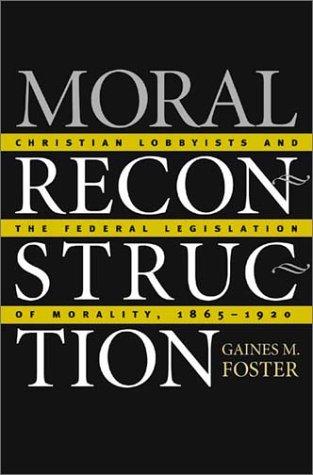
It is in no sense an overstatement to say that Gaines M. Foster's Moral Reconstruction: Christian Lobbyists and the Federal Legislation of Morality, 1865-1920 is a near perfect blend of historical insight and timeliness. Foster's simple book has simple scope: the examination of the rise of the Christian lobby in late nineteenth century America and the moral legislation it pursued. He makes clear, however, from the first sentence of the introduction that this is not intended to be a purely academic exercise. The rise of the Christian right in the late 1970s has made matters of the origins and precedents of religious lobbying and moral legislation issues of extreme importance for contemporary American moral polity. Foster convincingly suggests that the strongest, most germane parallel to the modern movement for moral reform is the late nineteenth century campaign to revise the moral character of the nation. The rise of the Christian lobby was more than merely a political shift or, as the lobbyists undoubtedly believed, an awakening of the American moral conscious in the face of some novel evil. It was a dramatic cultural and philosophical shift away from antebellum theories of states' rights, personal liberty, and moral suasion into new concepts of nationalism and corporate social responsibility. In this, and countless other nuances of Foster's book, there are striking ideological parallels to more recent impulses in American politics. In the interest of brevity, however, there are two points from Foster's work which stand out as especially noteworthy for reflection.

One of the most striking features of the Christian lobby, which Foster deliberately emphasizes in his narrative, was that even in its successes it understood and respected (or at least conceded to accept) the Constitutional limits of the federal government. There is little debate any longer about whether or not the federal government has some role in structuring national morality. As Foster will admit in his conclusion, few people object to the federal government having a hand in, for example, protecting children from the sexual advances of adults. In truth, most Americans probably do not even think of this in terms of the government legislating morality, though that is certainly what is occurring. As desensitized to the concept as modern Americans are, the idea that the government should make any universal laws regarding any morality was entirely foreign to early Americans. In fact, the Thirteenth Amendment represented something of a strange and wonderful novelty to nineteenth century Americans. They accepted that slavery was wrong (though some, only after being compelled by force of arms to accept that opinion), but that the government could seize the right to make that qualitative judgment was unusual. The Thirteenth Amendment would prove to be the justifying precedent cited most frequently by moral reformers.

Even with this powerful antecedent, the Christian lobby was forced to respect that most Americans understood the federal government to be restricted to a very small number of jurisdictions: interstate commerce, international treaties, administration of the military, and direct governance of the District of Columbia and the territories. In view of these limitations, the moral reformers were forced to pursue their agenda of national moral legislation within the confines of a traditional view of a limited federal government. They focused their efforts initially on enacting Sunday laws in DC, stricter divorce rules in the territories, prohibition in the military, and the restriction of interstate distribution of obscene materials (e.g. information on birth control). They understood that they could not make adultery illegal, but they did eventually convince the government that it had the power to make transporting a woman across state lines for the purpose of adultery should be. Even when the moral reformers did make their final push to outlaw the production and sale of all intoxicating beverages, Prohibition came with two important concessions to the limits of federal power. First, reformers readily admitted and accepted that Congress could not simply pass a law to achieve prohibition. A constitutional amendment would be necessary, as the Constitution did not give Congress the kind of sweeping moral power to outlaw behavior that the Christian lobby required. Second, in spite of initial attempts to include it, the provision which made possessing and consuming alcohol in one's home was removed from the wording of the amendment. The country was not ready to accept the idea that the government had the right to regulate moral behavior within one's own home. What authority it had, stopped at the domestic threshold. The home was a fortress, even if it was a den of wicked vice.

In addition to recognizing and working within the constitutional limits of the federal government, the history of the moral reformers teaches contemporary reformers and important lesson about the impermanence of moral reform. When the Volstead Act finally took effect, enforcing the Eighteenth Amendment, the reform periodical American Issue triumphantly declared, "The future historian will accord to January 16, 1920 a place second only to that of the advent of the Redeemer." Historians have a funny way of defying predictions. No one would today suggest that the onset of Prohibition in the United States was an event of permanent and global magnitude. Few school children know anything more than a passing quick fact about the Eighteenth Amendment and even less about the myriad moral reforms which preceded it. Even to the most conservative modern critic, the goals of the Christian lobby in the late nineteenth and early twentieth century seem antiquated if not comic. While many still oppose, largely futilely, ready access to abortion, on the most marginal members of society think it ought to be illegal to distribute information about birth control. Boxing, while not America's proudest past time, is legal to stage, promote, record, and distribute. (Imagine what the moral reformers would have thought of the mixed martial arts craze which has gripped the popular imagination.) The film industry not only escaped government content controls, but modern technology has made it possible for anyone and everyone to pipe any number of genuinely obscene pictures onto their computers, televisions, and telephones. Perhaps most notoriously at all, Prohibition was a miserable failure and social drinking (unlike boxing) is among the great American past times. From a historical perspective, efforts at national moral reform appear to have been the most dismal failure. Only a select few reforms from the period persist in any recognizable form: higher age of consent laws, laws against selling cigarettes to minors, and the end of mail delivery on Sundays. In his conclusion, Foster suggests that "the story of moral reconstruction provides no sure lessons to be applied to the renewed debate over legislating morality...but it does provide a historical context." Yet this historical context may in fact be the sure lesson which moral reformers need to learn; history has proved that it will be infinitely easier to repeal moral legislation than it was to pass it. It took the reformers nearly sixty years to enact prohibition through a constitutional amendment and only thirteen years for Americans to collectively regret and reject prohibition through another amendment.

There can be few complaints about Foster's work. Admittedly, it is dry, deeply encyclopedic reading which at times carries with it the uneasy feeling that one is actually just reading the congressional record. This impression is reenforced by the final eighty pages (or one quarter) of the book which is consumed by extensive appendices, notes, and other scholarly apparatus. At the same time, this exhaustive treatment reassures the reader that Moral Reconstruction is among the most well researched treatments of the period and subject that has yet been written. Though not a page turner for the average reader, the book is worth a second glance and more for professionals or dedicated hobbyists interested in grasping the historical context of ongoing movements among Christian especially to legislate a better moral polity for America.

Thursday, October 13, 2011

Government Involvement in Marriage and Its Ironic History

In his book Moral Reconstruction, a history of moral lobbying and legislation between the Civil War and Prohibition, Gaines M. Foster recalls a period at the turn of the century when Christian lobbyists and special interest groups were pressuring the government for stricter laws regarding marriage and divorce. Interestingly, among the measures proposed was an amendment to the Constitution which would explicitly give the federal government power over marriage. In all, forty-two resolutions to give the government power over marriage were introduced to Congress between 1892 and 1920, none of which received so much as a favorable committee report. Given the striking parallels between the moral polity of the period and the current political climate (a secondary purpose of Foster's book), the three reasons given for the widespread failure of reformers to achieve such federal legislation is intriguing:

1) Such legislation met with overwhelming opposition in the South because many southerners feared it would result in federal intervention in state antimiscegenation laws.

2) The American Bar Association and the Interchurch Conference opposed the measures because they preferred state measures to regulate marriage and divorce.

3) Christians could not effectively mobilize support for legislation because there was widespread disagreement about precisely what the Bible said about marriage and divorce.

The obvious, superficial irony is immediately apparent. Unlike contemporary movements to grant the federal government powers over marriage, Christians and southerners were the key to opposing extending federal powers. The role reversal becomes even more pronounced when one considers that the new support for such measures in the South is born out of the desire of southerners to have their peculiar discriminatory marriage laws universalized. In the past, southerners feared for their idiosyncratic conception of a "true" marriage. A look at the history of moral legislation would seem, thankfully, to justify the fears of nineteenth century southerners rather than bolster the aspirations of those in the 21st century. Granting moral power to the federal government tends to have a liberalizing effect on public morality. Which makes almost amusing the fact that so many supposed supporters of "states rights" also support an amendment granting the federal government a new and unprecedented field of power, while their predecessors had the foresight one hundred years ago to oppose federal involvement in marriage consistent with a belief in restricting the power of the federal government.

In the interest of learning from history, it is perhaps time to realize that whether moral legislation fails (as did federal marriage legislation at the turn of the century) or succeeds (as did Prohibition), in the long term the tendency of the federal government is never toward stricter moral codes. If American history is any judge, progressive moral ideologies win the war of attrition, and time is a surer constant than political favor.

Saturday, September 17, 2011

Pat Robertson Encourages Divorce

Here is a striking nod to amoral pragmatism that I never thought I would see from Pat Robertson. With the question recently posed to him on the 700 Club about how to live with a spouse who has Alzheimer's, Robertson responded the man "should divorce her and start all over again" provided the abandoned spouse was medically provided for.

Terry Meeuwsen, Robertson's co-host, asked him about couples' marriage vows to take care of each other "for better or for worse" and "in sickness and in health."

"If you respect that vow, you say 'til death do us part,'" Robertson said during the Tuesday broadcast. "This is a kind of death."


I can only wonder what other kinds of metaphorical "death" Robertson might also use to justify divorce. Other degenerative diseases? Apostasy, a kind of spiritual death? Sitting through one too many episodes of the 700 Club? We may never know just how slippery a slope he has embarked upon.