We hail with joy the Independent Scratchers, whose mission is a purification of politics. It is urged that while the worst elements of a party may secure the nomination of unfit men, nothing but the apathy of the best elements will secure their election. T he independent scratchers propose to defeat those men—and only those—on a ticket who are known to be corrupt. This will force the nomination of honest men, and be an effectual “brake” on machine politics. It has already done effective service, and is destined to play an increasing part in our public affairs.
Showing posts with label politics. Show all posts
Showing posts with label politics. Show all posts
Tuesday, April 16, 2013
Some Standard Wisdom for Purifying Politics
Some of the most interesting and surprising stories in the Christian Standard are in the "Current Topics" section, a kind of miscellany that includes comments on current news, politically charged barbs, and sarcastic quips. Here is a tidbit about one of what have probably been hundreds of failed political reform movements (should we read in this a prediction of how history will treat the Occupy movement?). Whatever its ultimate fate, the editorial staff at the Standard had high hopes for what seems to be a fairly simple proposition:


Wednesday, January 23, 2013
Mitt Romney: A Failed Mormon Prophecy
Well, it's official. Barack Obama has been sworn in for his second term as president, and the news media has parsed all the important issues: eye rolling, lip syncing, and age-appropriate hair. Finally it feels appropriate to share an observation out of Mormon history when it should have none of the sourness of political partisanship (which I try so desperately to avoid).
In the Winter of 1855, with full blown war with the federal government on the not-so-distant horizon, Brigham Young, governor of the Utah Territory and leader of the Latter Day Saints, envisioned a time when America would fall into such a state of disrepair that the people would call on a Mormon to save them:
 If the LDS church's loudest public voice is to be believed, America has reached that precipice. Then why the monumental failure of Mitt Romney to secure the presidency and save America? Could it be that Glenn Beck is wrong and ACORN, radical Islamic militants, and Reform Jews didn't conspire to put a socialist race-warrior into office? Or could he perhaps be right and Satan still holds the world in his thrall, leaving the saints to wait for the nation to get just a little bit worse before their final vindication? Is it possible that the Mormons in general and Brigham Young in particular were not actually gifted with any special ongoing revelation from God?
Let's table all those wonderfully provocative suggestions for the moment and consider another. One year earlier, Brigham Young had delivered a Fourth of July address as part of a series of speeches by prominent Mormons taking America to task for its partisanship and its failure to realize the lofty goals of the American Revolution. Young had his own observations about failures of the US in its highest office and proposed a different set of qualifications for the highest office. Maybe Romney failed to be the great Mormon savior of America because, it turns out, he's not the kind of man Mormon's thought the nation needed and the people deserved:
In the Winter of 1855, with full blown war with the federal government on the not-so-distant horizon, Brigham Young, governor of the Utah Territory and leader of the Latter Day Saints, envisioned a time when America would fall into such a state of disrepair that the people would call on a Mormon to save them:
Brethren and sisters, our friends wish to know our feelings towards the government. I answer, they are first rate, and we will prove it too, as you will see if you only live long enough, for that we shall live to prove it is certain; and when the Constitution of the United States hangs, as it were, upon a single thread, they will have to call for the "Mormon" Elders to save it from utter destruction; and they will step forth and do it.

Let's table all those wonderfully provocative suggestions for the moment and consider another. One year earlier, Brigham Young had delivered a Fourth of July address as part of a series of speeches by prominent Mormons taking America to task for its partisanship and its failure to realize the lofty goals of the American Revolution. Young had his own observations about failures of the US in its highest office and proposed a different set of qualifications for the highest office. Maybe Romney failed to be the great Mormon savior of America because, it turns out, he's not the kind of man Mormon's thought the nation needed and the people deserved:
The people should concentrate their feelings, their influence, and their faith to select the best man they can find to be their President, if he has nothing more to eat than potatoes and salt--a man who will not aspire to become greater than the people who appoint him but be contented to live as they live, be clothed as they are clothed, and in every good thing be one with them.
[A man] capable of communicating to the the understanding of the people according to their capacity, information upon all points pertaining to the just administration of the Government. He should understand what administrative policy would be most beneficial to the nation. He should also have the knowledge and disposition to wisely exercise the appointing power, so far as it is constitutionally within his control, and select only good and capable men for the office. He should not only carry out the legal and just wishes of his constituents, but should be able to enlighten their understanding and correct their judgment. And all good officers in a truly republican administration will constantly labor for the security of the rights of all, irrespective of sect or party.
Tuesday, December 4, 2012
Lipscomb and the Fiscal Cliff
Having heard more than my fill of partisan bickering over the fiscal cliff, I am reminded of the wise words of David Lipscomb:
Sectional party alignments have changed since 1880. The nature of politics has not.
------------------------------------------------------------------------------------
For whatever reason, the above quote reminds me of this much later witticism by T. R. Burnett about the Spanish-American War that I've been meaning to share:
The staple of Northern politics is abuse of the South, of the Democratic party and men. The staple of Southern politics is abuse of the North, and the Republican party and men. Now, if all were to unite in abusing Mexico and its President, or were they to take in Mexico, and with it, all unite in baying the man in the moon, and vent their spite and spleen upon him, they would be just as happy, as free, as wealthy, as they are now in abusing each other.
There is not and never has been any principle involving the moral or material good of the people in politics.
Sectional party alignments have changed since 1880. The nature of politics has not.
------------------------------------------------------------------------------------
For whatever reason, the above quote reminds me of this much later witticism by T. R. Burnett about the Spanish-American War that I've been meaning to share:
Congress has decided to tax beer $2 per barrel, to raise money to fight Spain. Now if Congress will tax Spain in order to raise revenue to fight beer, the thing will be evenly adjusted. Beer is a worse enemy of American than Spain can possibly be.
Tuesday, November 6, 2012
Here’s an Idea, Don't Vote: Violence and Representative Democracy
There's an election today. Have you heard? This will come as a shock to no one who has ever visited this site, but I will not be voting this year. I also didn't vote four years ago. Or four years before that. Or...you get the drift. As a committed old, tried and true Christian anarchist, I have watched the campaign season very closely, the way I might watch a really interesting football game, or a Spike "world's most unbelievable car crashes" marathon. Politics--infinitely more than contact sports and traffic accidents--has proves itself again and again to be irredeemably violent. Beyond that basically standard pacifist complaint, however, I would like to offer three reasons why I, as a Christian, am not voting and, wait for it, why I encourage other Christians not to vote either. If you're not a Christian, you should vote; it'd be a shame if you didn't. (Not nearly as big a shame as it is that you're not a Christian, of course.) In any case...
With this final argument, I will most nearly approach the essential quarrel that Christian anarchism has with government generally and representative democracy specifically. To do this, however, requires an examination both of the nature of the state and the moral implications in our republican form of government. Though less concrete and more nuanced than other pleas to avoid participation in the democratic process, it still serves as the most compelling reason to see voting as immoral rather than merely unnecessary, ineffective, or unimportant.
David Lipscomb states succinctly what later theologians have agonized over with regard to man's original sin: "God would govern and guide man; man would govern the under-creation, and so the whole world would be held under the government of God, man immediately and the under-creation through man. But, man refused to be governed by God...The institution of human government was an act of rebellion and began among those in rebellion against God, with the purpose of superseding the Divine rule with the rule of man." The term en vogue now to discuss man's fall is "autonomy," but the notions are the same. The account of the first sin in Genesis boils down to the belief that humanity knew better than God how to manage its own affairs.
It is not a coincidence that the second sin is murder. Violence follows logically on the heels of rebellion. Eve having usurped the divine prerogative to rule, Cain usurps the divine prerogative to judge. Ignoring the divine approbation showered on Abel, Cain renders his own terminal judgment about his brother and summarily executes him.
It is equally understandable then that civil government should arise both as an attempt to curb the influences of these sins and as their supreme manifestation. On the one hand, civil government exists to give wrest the rights of authority and judgement from the hands of the individual, a transfer of power which is necessary in order for society to function. At the same time, however, civil government exists as the collaborative human expression of that primary impulse toward autonomy. God is no more lawgiver and judge now than in the days after the fall. Instead, humanity set up an alternative lawgiver and judge to stand in the place of God. The state is essentially and inescapably an idol to our own sense of superior self-determination.
It's a truth so inescapable, God Himself might as well have uttered it:
Samuel obeys, and in his subsequent warning to the people he points out that the king will be the source of constant oppression for the people. "And in that day you will cry out because of your king, whom you have chosen for yourselves, but the LORD will not answer you in that day." Samuel, to say nothing of the LORD, recognizes that human governments will always be tied inexorably to violence. Civil government, simply defined, is the ability--granted or assumed--to coerce others to behave in ways they would not otherwise. People pay their taxes because they fear the IRS, not because they have any confidence in the federal government to invest their money wisely. People drive the speed limit to avoid getting a ticket, not because they are opposed in principle to driving more than 25-mph in a school zone. A government which does not have coercive authority--which is a poor euphemism for violence--to enforce its laws instantly collapses.
But, as we've already seen, Christians have no investment in coercing non-Christians to mimic a Christian society. All our efforts to do so have in fact been counterproductive. It shouldn't surprise anyone. There is no government which can function on the principles of the Sermon on the Mount because civil government unavoidably implies violence. A foreign policy which extols "turn the other cheek" and "resist not evil" invites invasion. Imagine, moreover, a candidate running on the economic platform, "Do not lay up for yourselves treasures on earth." (Never mind that the recent rescue of Wall Street, the banks, and big business has proved the biblical adage "Where your treasure is, there your heart will be also.") Our judicial system would grind to an immediate halt if it were to embrace "Judge not, that you be not judged"--without moving over to talk about "he who is without sin." There's no reason to even discuss the golden rule. The fundamental incompatibility of Christianity and civil government should be obvious merely from a liberal exercise of human reason, but Paul does Christians the service of highlighting the dichotomy in Romans when he tells Christians that they must express love and peace and allow the government to be God's unwitting agent for vengeance.
Therein lies the special problem for representative democracy. For Paul, it was simple: Christians and governments were discrete ethical units. The same is not true in a representative democracy. It has been a while since most of us took a high school civics course, and, if yours was anything like mine, it was worthless to begin with. Here is the way our government works. Our nation is too large and unwieldy to have a direct democracy, wherein everyone actually exercises a specific voice in the construction of policy. Instead, through voting and other means of political activism, Americans elect a small representative group of people to construct policy on their behalf. For the non-Christian, the process is simple enough: choose whichever candidate is most likely to achieve the political ends most important to you.
Here is the problem for Christians. By choosing to elect a representative, we make ourselves complicit in everything that is done on our behalf. That's unpleasant to think about and easy to dismiss uncritically, but that is the nature of the American system of government. President Obama has your proxy to act in the executive branch. Maybe you didn't vote for him, and maybe that means you can sleep better at night know that your spotless Christian hands aren't stained with the blood of the people he assassinated by remote control. But unless you make a habit of losing, there is someone who is representing you in the American government, and it is necessary then to come to terms with the fact that government by its very nature behaves in ways forbidden to Christians.
War serves a legitimate function in statecraft, as does, arguably, capital punishment. But the Christ who told Peter to sheath his sword and stepped in front of the Jewish firing squad to save an adulteress models a different behavior, an ethical lifestyle that Christians are obligated to follow. Whoever you vote for, whoever is elected is employed only and entirely in the business of violence, that is in the business of coercing people to do what they would not do if given the choice. Whether it is taxes, speed limits, capital punishment, marriage rights, restrictions on abortion, or a war in Iran (because dying in the Middle East is the new American pastime) is irrelevant. Government is in the business of violence, and our government is in the business of doing violence with the consent of and on behalf of the voting public.
There is a solution, of course, for Christians. If to vote means to insinuate yourself ethically if not personally into the vile business of politics, then don't vote. It's not a matter of apathy or a recognition of futility. Instead, it is an affirmation that you belong to a different kingdom with a different King. Moreover--unlike America which continues to prove both its ambition and ineptitude on this front--our King will one day have everything put into subjection under his feet, without need of my vote or my campaign contributions. This is not a disengagement with the world. It is a proud boast that, in Christ, we have be granted a different mode of engagement with the world. One in which "when reviled, we bless; when persecuted, we endure; when slandered, we entreat." Christians reject, loudly and audaciously, the governing assumption the state that order is born out of violence and community out of coercion. By not voting, we concede the work of evil to the working of evildoers and reserve for ourselves the practice of untainted righteousness.
Perhaps more importantly, when Christians refuse to vote, we protect ourselves from the errors of the Israelites. We forget neither that God is our King nor the deeds He has worked on our behalf. We heed the advice of Solomon to "Trust in the Lord with all your heart, and do not lean on your own understanding." and sing with the psalmist, "It is better to take refuge in the LORD than to trust in princes." There is a stand to take this election more important than opposition to abortion. There is a gospel to preach truer than economic equality of opportunity. That message begins when Christians extricate themselves from the polls and resume their stance as critics from without, voices in the wilderness crying "Repent, the kingdom of heaven is at hand."
If the kingdom of heaven really is at hand, why are we so invested in the politics of the kingdoms of this world?
With this final argument, I will most nearly approach the essential quarrel that Christian anarchism has with government generally and representative democracy specifically. To do this, however, requires an examination both of the nature of the state and the moral implications in our republican form of government. Though less concrete and more nuanced than other pleas to avoid participation in the democratic process, it still serves as the most compelling reason to see voting as immoral rather than merely unnecessary, ineffective, or unimportant.
David Lipscomb states succinctly what later theologians have agonized over with regard to man's original sin: "God would govern and guide man; man would govern the under-creation, and so the whole world would be held under the government of God, man immediately and the under-creation through man. But, man refused to be governed by God...The institution of human government was an act of rebellion and began among those in rebellion against God, with the purpose of superseding the Divine rule with the rule of man." The term en vogue now to discuss man's fall is "autonomy," but the notions are the same. The account of the first sin in Genesis boils down to the belief that humanity knew better than God how to manage its own affairs.
It is not a coincidence that the second sin is murder. Violence follows logically on the heels of rebellion. Eve having usurped the divine prerogative to rule, Cain usurps the divine prerogative to judge. Ignoring the divine approbation showered on Abel, Cain renders his own terminal judgment about his brother and summarily executes him.
It is equally understandable then that civil government should arise both as an attempt to curb the influences of these sins and as their supreme manifestation. On the one hand, civil government exists to give wrest the rights of authority and judgement from the hands of the individual, a transfer of power which is necessary in order for society to function. At the same time, however, civil government exists as the collaborative human expression of that primary impulse toward autonomy. God is no more lawgiver and judge now than in the days after the fall. Instead, humanity set up an alternative lawgiver and judge to stand in the place of God. The state is essentially and inescapably an idol to our own sense of superior self-determination.
It's a truth so inescapable, God Himself might as well have uttered it:
Then all the elders of Israel gathered together and came to Samuel at Ramah and said to him, “Behold, you are old and your sons do not walk in your ways. Now appoint for us a king to judge us like all the nations.” But the thing displeased Samuel when they said, “Give us a king to judge us.” And Samuel prayed to the LORD. And the LORD said to Samuel, “Obey the voice of the people in all that they say to you, for they have not rejected you, but they have rejected me from being king over them. According to all the deeds that they have done, from the day I brought them up out of Egypt even to this day, forsaking me and serving other gods, so they are also doing to you. Now then, obey their voice; only you shall solemnly warn them and show them the ways of the king who shall reign over them.”
Samuel obeys, and in his subsequent warning to the people he points out that the king will be the source of constant oppression for the people. "And in that day you will cry out because of your king, whom you have chosen for yourselves, but the LORD will not answer you in that day." Samuel, to say nothing of the LORD, recognizes that human governments will always be tied inexorably to violence. Civil government, simply defined, is the ability--granted or assumed--to coerce others to behave in ways they would not otherwise. People pay their taxes because they fear the IRS, not because they have any confidence in the federal government to invest their money wisely. People drive the speed limit to avoid getting a ticket, not because they are opposed in principle to driving more than 25-mph in a school zone. A government which does not have coercive authority--which is a poor euphemism for violence--to enforce its laws instantly collapses.
But, as we've already seen, Christians have no investment in coercing non-Christians to mimic a Christian society. All our efforts to do so have in fact been counterproductive. It shouldn't surprise anyone. There is no government which can function on the principles of the Sermon on the Mount because civil government unavoidably implies violence. A foreign policy which extols "turn the other cheek" and "resist not evil" invites invasion. Imagine, moreover, a candidate running on the economic platform, "Do not lay up for yourselves treasures on earth." (Never mind that the recent rescue of Wall Street, the banks, and big business has proved the biblical adage "Where your treasure is, there your heart will be also.") Our judicial system would grind to an immediate halt if it were to embrace "Judge not, that you be not judged"--without moving over to talk about "he who is without sin." There's no reason to even discuss the golden rule. The fundamental incompatibility of Christianity and civil government should be obvious merely from a liberal exercise of human reason, but Paul does Christians the service of highlighting the dichotomy in Romans when he tells Christians that they must express love and peace and allow the government to be God's unwitting agent for vengeance.
Therein lies the special problem for representative democracy. For Paul, it was simple: Christians and governments were discrete ethical units. The same is not true in a representative democracy. It has been a while since most of us took a high school civics course, and, if yours was anything like mine, it was worthless to begin with. Here is the way our government works. Our nation is too large and unwieldy to have a direct democracy, wherein everyone actually exercises a specific voice in the construction of policy. Instead, through voting and other means of political activism, Americans elect a small representative group of people to construct policy on their behalf. For the non-Christian, the process is simple enough: choose whichever candidate is most likely to achieve the political ends most important to you.
Here is the problem for Christians. By choosing to elect a representative, we make ourselves complicit in everything that is done on our behalf. That's unpleasant to think about and easy to dismiss uncritically, but that is the nature of the American system of government. President Obama has your proxy to act in the executive branch. Maybe you didn't vote for him, and maybe that means you can sleep better at night know that your spotless Christian hands aren't stained with the blood of the people he assassinated by remote control. But unless you make a habit of losing, there is someone who is representing you in the American government, and it is necessary then to come to terms with the fact that government by its very nature behaves in ways forbidden to Christians.
War serves a legitimate function in statecraft, as does, arguably, capital punishment. But the Christ who told Peter to sheath his sword and stepped in front of the Jewish firing squad to save an adulteress models a different behavior, an ethical lifestyle that Christians are obligated to follow. Whoever you vote for, whoever is elected is employed only and entirely in the business of violence, that is in the business of coercing people to do what they would not do if given the choice. Whether it is taxes, speed limits, capital punishment, marriage rights, restrictions on abortion, or a war in Iran (because dying in the Middle East is the new American pastime) is irrelevant. Government is in the business of violence, and our government is in the business of doing violence with the consent of and on behalf of the voting public.
There is a solution, of course, for Christians. If to vote means to insinuate yourself ethically if not personally into the vile business of politics, then don't vote. It's not a matter of apathy or a recognition of futility. Instead, it is an affirmation that you belong to a different kingdom with a different King. Moreover--unlike America which continues to prove both its ambition and ineptitude on this front--our King will one day have everything put into subjection under his feet, without need of my vote or my campaign contributions. This is not a disengagement with the world. It is a proud boast that, in Christ, we have be granted a different mode of engagement with the world. One in which "when reviled, we bless; when persecuted, we endure; when slandered, we entreat." Christians reject, loudly and audaciously, the governing assumption the state that order is born out of violence and community out of coercion. By not voting, we concede the work of evil to the working of evildoers and reserve for ourselves the practice of untainted righteousness.
Perhaps more importantly, when Christians refuse to vote, we protect ourselves from the errors of the Israelites. We forget neither that God is our King nor the deeds He has worked on our behalf. We heed the advice of Solomon to "Trust in the Lord with all your heart, and do not lean on your own understanding." and sing with the psalmist, "It is better to take refuge in the LORD than to trust in princes." There is a stand to take this election more important than opposition to abortion. There is a gospel to preach truer than economic equality of opportunity. That message begins when Christians extricate themselves from the polls and resume their stance as critics from without, voices in the wilderness crying "Repent, the kingdom of heaven is at hand."
If the kingdom of heaven really is at hand, why are we so invested in the politics of the kingdoms of this world?
[Reason 1; Reason 2]
Monday, November 5, 2012
Here's an Idea, Don't Vote: Politics and Christian PR
There's an election tomorrow. Have you heard? This will come as a shock to no one who has ever visited this site, but I will not be voting this year. I also didn't vote four years ago. Or four years before that. Or...you get the drift. As a committed old, tried and true Christian anarchist, I have watched the campaign season very closely, the way I might watch a really interesting football game, or a Spike "world's most unbelievable car crashes" marathon. Politics--infinitely more than contact sports and traffic accidents--has proves itself again and again to be irredeemably violent. Beyond that basically standard pacifist complaint, however, I would like to offer three reasons why I, as a Christian, am not voting and, wait for it, why I encourage other Christians not to vote either. If you're not a Christian, you should vote; it'd be a shame if you didn't. (Not nearly as big a shame as it is that you're not a Christian, of course.) In any case...
The following argument will strike many as trivial, which is precisely why I have sandwiched it between what I believe are two more essential points. Nevertheless, having disposed of the notion that Christians are obligated to construct a moral society through legislation, it is important to look at the consequences of continuing to attempt to achieve such political ends. Admittedly there is a real sense in which Scripture acknowledges that that to be a Christian means to open yourself up to ridicule. Paul even accept that the world will always look down on the wisdom of God, ironically labeling it folly. Nevertheless, it is important to distinguish between opening ourselves up to be mocked and causing God to be mocked.
Jesus and Paul agree here on what ought to be a self-evident truth: people are watching Christians and what they see determines what they believe. Christians individually probably are not to keen on the notion that their lives are under a microscope, and why should they be? God is more than fully aware that we all still sin. Christ is the image of the perfect human, not me. Nevertheless, the corporate behavior of Christianity speaks volumes to the world, particularly given how loudly we shout about certain issues. Unfortunately, what we're shouting about isn't meekness, poverty, righteousness, purity, peace, and mercy as in the Beatitudes--which precede the first quote--nor are is the public face of Christianity brotherly love, quiet living, and industriousness as in the passage from 1 Thessalonians. What are the loudest messages about God instead?

And if that seems like an extreme example to you, there are certainly others. Look at the now infamous statements of Richard Mourdock: "Even when life begins in that horrible situation of rape, that is something that God intended to happen." Frankly, I don't find that sentiment all that appalling, not because I agree with it but because I know it represents a large and historic branch of Christian theology. The popular media and the vocal critics of Christianity are less philosophical about it. It is sentiments like these given voice only because they are attached to political power: constitutionally challenged and protected protests or theology spilling into public policy. Meanwhile, I could walk into work tomorrow morning and proudly declare that I believe therapeutic abortion (i.e. abortion to save the life of the mother) is wrong--and I do believe that--and no one would bat an eye. They know that I have no interest in launching Christian ethics into the public sphere and so derision is replaced with apathy.
Meanwhile, regardless of what I believe about abortion--which is made largely irrelevant by my theoretical lack of a uterus--I would hope that when people describe me it is in terms more personal and therefore more sympathetic than the way most people choose to describe Mourdock or the Westboro Baptists. Those groups exist only as their public faces, only insofar as their behavior has consequences on a political scale. Yet when people interacted with Jesus, he specifically rejected any reduction of himself into a political persona. He was a healer of the sick, a feeder of the hungry, and a forgiver of sinners--not to mention a man of indisputably impeccable character himself. Richard Mourdock may very well donate to food drives. He may volunteer at hospitals. He may forgive any and everyone, even rape victims who get abortions. It's irrelevant. He will always be that Christian who thinks God is a rapist and wants to write laws on the basis of that belief.
It is time for Christians to take a long, hard look at just how extensively our involvement in democratic politics has opened us and, much more importantly, God to ceaseless ridicule. By allowing the public presence of the Christian faith to be reduced to its political manifestation--either is moralistic bigotry or socialistic coerced charity--we have transformed God the Father, Son, and Spirit from persons to partisans. There is no rehabilitating Christianity's political image. It is not possible to offer to the world a kinder, gentler, truer Christianity that will make the faith politically palatable. God makes radical ethical demands of His followers, and libertines are never going to be okay with that. God makes radical social justice demands of his followers, and aristocrats are never going to be okay with that. As long as the faith is married to political agendas, it will never be anything more than a caricature of the truth which Jesus came to impart, a revolutionary practical, ethical truth. In the meantime, more people are likely to disassociate with Christianity in favor of some vague notion of "spirituality" because to be in church means to be Richard Mourdock, et. al.
The following argument will strike many as trivial, which is precisely why I have sandwiched it between what I believe are two more essential points. Nevertheless, having disposed of the notion that Christians are obligated to construct a moral society through legislation, it is important to look at the consequences of continuing to attempt to achieve such political ends. Admittedly there is a real sense in which Scripture acknowledges that that to be a Christian means to open yourself up to ridicule. Paul even accept that the world will always look down on the wisdom of God, ironically labeling it folly. Nevertheless, it is important to distinguish between opening ourselves up to be mocked and causing God to be mocked.
You are the light of the world. A city set on a hill cannot be hidden. Nor do people light a lamp and put it under a basket, but on a stand, and it gives light to all in the house. In the same way, let your light shine before others, so that they may see your good works and give glory to your Father who is in heaven.
Aspire to live quietly, and to mind your own affairs, and to work with your hands, as we instructed you, so that you may walk properly before outsiders and be dependent on no one.
Jesus and Paul agree here on what ought to be a self-evident truth: people are watching Christians and what they see determines what they believe. Christians individually probably are not to keen on the notion that their lives are under a microscope, and why should they be? God is more than fully aware that we all still sin. Christ is the image of the perfect human, not me. Nevertheless, the corporate behavior of Christianity speaks volumes to the world, particularly given how loudly we shout about certain issues. Unfortunately, what we're shouting about isn't meekness, poverty, righteousness, purity, peace, and mercy as in the Beatitudes--which precede the first quote--nor are is the public face of Christianity brotherly love, quiet living, and industriousness as in the passage from 1 Thessalonians. What are the loudest messages about God instead?

And if that seems like an extreme example to you, there are certainly others. Look at the now infamous statements of Richard Mourdock: "Even when life begins in that horrible situation of rape, that is something that God intended to happen." Frankly, I don't find that sentiment all that appalling, not because I agree with it but because I know it represents a large and historic branch of Christian theology. The popular media and the vocal critics of Christianity are less philosophical about it. It is sentiments like these given voice only because they are attached to political power: constitutionally challenged and protected protests or theology spilling into public policy. Meanwhile, I could walk into work tomorrow morning and proudly declare that I believe therapeutic abortion (i.e. abortion to save the life of the mother) is wrong--and I do believe that--and no one would bat an eye. They know that I have no interest in launching Christian ethics into the public sphere and so derision is replaced with apathy.
Meanwhile, regardless of what I believe about abortion--which is made largely irrelevant by my theoretical lack of a uterus--I would hope that when people describe me it is in terms more personal and therefore more sympathetic than the way most people choose to describe Mourdock or the Westboro Baptists. Those groups exist only as their public faces, only insofar as their behavior has consequences on a political scale. Yet when people interacted with Jesus, he specifically rejected any reduction of himself into a political persona. He was a healer of the sick, a feeder of the hungry, and a forgiver of sinners--not to mention a man of indisputably impeccable character himself. Richard Mourdock may very well donate to food drives. He may volunteer at hospitals. He may forgive any and everyone, even rape victims who get abortions. It's irrelevant. He will always be that Christian who thinks God is a rapist and wants to write laws on the basis of that belief.
It is time for Christians to take a long, hard look at just how extensively our involvement in democratic politics has opened us and, much more importantly, God to ceaseless ridicule. By allowing the public presence of the Christian faith to be reduced to its political manifestation--either is moralistic bigotry or socialistic coerced charity--we have transformed God the Father, Son, and Spirit from persons to partisans. There is no rehabilitating Christianity's political image. It is not possible to offer to the world a kinder, gentler, truer Christianity that will make the faith politically palatable. God makes radical ethical demands of His followers, and libertines are never going to be okay with that. God makes radical social justice demands of his followers, and aristocrats are never going to be okay with that. As long as the faith is married to political agendas, it will never be anything more than a caricature of the truth which Jesus came to impart, a revolutionary practical, ethical truth. In the meantime, more people are likely to disassociate with Christianity in favor of some vague notion of "spirituality" because to be in church means to be Richard Mourdock, et. al.
[Reason 1; Reason 3]
Friday, November 2, 2012
Beware the News

Eighteenth century politics was remarkably like present politics, in ways more accessible than my oft repeated assertion that all politics is always and essentially mere violence. The Constitutional Convention which gave America the framework for its current form of government was arguably more contentious even than the present political climate. Unsurprisingly, the press entered the fray wholeheartedly and with a clear agenda. Noted patriot David Humphreys sent a letter to soon-to-be-president George Washington the day the Convention adjourned boasting that the press had done its part in preparing the people to accept the judgments of their leaders unquestioningly:
Judicious and well-timed publications have great efficacy in ripening the judgment of men in this quarter of the Continent.
It is crucial to remember, that "freedom of the press" in America never meant the freedom of the press to objectively report the news. It always simply meant freedom of the press to push an agenda different than the state's agenda. Then, as well as now, it is striking how often even this freedom is not exercised. Certainly beware of the somewhat obvious fallacy that "news" and "facts" are in any sense synonymous, but be even more wary of the "judicious and well-timed" stories that align too nearly with the interests of the government, whoever might be running it. In other words, good citizenship--from a secular standpoint--ought to involve having an unripened mind.
Wednesday, October 31, 2012
What Good Are Laws?
Throughout this political season--in addition to not so subtly pushing my Christian anarchist agenda--I have been trying to refer people as often as possible to different periods in the history of American politics in an effort to broaden the scope with which we look at the political process in the US. Today, I'd like to offer this quote, gleaned in passing from an oral history, that gives the political opinions of an early twentieth century resident of Italian Harlem:
What good indeed? It's a remarkably different perspective than, say, what good are the laws of this country if they don't ensure a child's future right to choose his or her own religion without any bias from childhood religiosity.
What good are the laws of this country if a child is given liberty to talk back to his parents?
What good indeed? It's a remarkably different perspective than, say, what good are the laws of this country if they don't ensure a child's future right to choose his or her own religion without any bias from childhood religiosity.
Saturday, October 27, 2012
A Lesson in Political Speech from Sinclair Lewis

The following is a passage from Sinclair Lewis's Elmer Gantry in which the Reverend Elmer Gantry contemplates the KKK and what stance to take on them publicly. With characteristic wit, Lewis gives the reader a picture of the vacuity of the vast majority of public discourse. Whoever can read the following without hearing the clear echos of our current political partisans either hasn't been paying attention (lucky them) or does not have "ears to hear."
The new Ku Klux Klan, an organization of the fathers, younger brothers, and employees of the men who had succeeded and became Rotarians, had just become a political difficulty. Many of the most worthy Methodist and Baptist clergymen supported it and were supported by it; and personally Elmer admired its principle--to keep all foreigners, Jews, Catholics, and negroes in their place, which was no place at all, and let the country be led by native Protestants, like Elmer Gantry.
But he perceived that in the cities there were prominent people, nice people, rich people, even among the Methodists and Baptists, who felt that a man could be a Jew and still an American citizen. It seemed to him more truly American, also a lot safer, to avoid the problem. So everywhere he took a message of reconciliation to the effect:
"Regarding religious, political, and social organizations, I defend the right of every man in our free America to organize with his fellows when and as he pleases, for any purpose he pleases, but I also defend the right of any other free American citizen to demand that such an organization shall not dictate his mode of thought or, so long as it be moral, his mode of conduct."
That pleased both the K. K. K. and the opponents of the K. K. K., and everybody admired Elmer's powers of thought.
[emphasis added]
Tuesday, October 9, 2012
19th Century Messages for 21st Century Political Partisans
As that impending day of doom draws near, I would like to share with those who choose to engage actively in the political process a series of messages from three 19th century political partisans who shared some of the core values that current political activists continue to espouse.
The first political thinker is 19th century Baptist preacher John Leland who had this message which should resonate with contemporary Republicans, particularly those of the Tea Party persuasion.
The second message comes from Jacksonian Democrat John Leland whose thoughts will likely resonate with the contemporary bearers of his party name:
Finally, we look at a speech from a third political activist, the committed abolitionist John Leland. His words should remind both modern political parties that citizenship begins at home:
Naturally, of course, the various political parties will find little to appreciate among the various sources from which these quotes are drawn, but that, unfortunately, seems to be the nature of politics. Everyone must either be all one thing or the other in our quasi-Manichean understanding of politics. At least we can all agree not to cheat, speak falsely of, or scandalize our neighbors, provided of course, we define "neighbor" as narrowly as possible to mean people in our own political party.
The first political thinker is 19th century Baptist preacher John Leland who had this message which should resonate with contemporary Republicans, particularly those of the Tea Party persuasion.
I would as soon give my vote to a wolf to be a shepherd, as to a man, who is always contending for the energy of government, to be a ruler. I conceive our national government to be strong enough, and yet provision is made therein, to counterpoise all the powers that may be abused.
Let the people keep awake, and danger flies. It is not long since the people of these states were becalmed in their spirits: they left government in the hands of their servants, and reclined on the bed of domestic ease; but, thanks to kind Providence, the servants fell out about the loaves and fishes, and contended so loud that they awaked the people from their slumbers. Let the dangers which we have just escaped make us more watchful, with lead, line and lookout. And when our hoary heads shall lie slumbering in death, may our sons and successors take warning, and never forget the inactive folly of their ancestors.
Disdain mean suspicion, but cherish manly jealousy; be always jealous of your liberty, your rights. Nip the first bud of intrusion on your constitution. Be not devoted to men; let measures be your object, and estimate men according to the measures they pursue.
The second message comes from Jacksonian Democrat John Leland whose thoughts will likely resonate with the contemporary bearers of his party name:
Disdain mean suspicion, but cherish manly jealousy; be always jealous of your liberty, your rights. Nip the first bud of intrusion on your constitution. Be not devoted to men; let measures be your object, and estimate men according to the measures they pursue. Never promote men who seek after a state-established religion; it is spiritual tyranny — the worst of despotism. It is turnpiking the way to heaven by human law, in order to establish ministerial gates to collect toll. It converts religion into a principle of state policy, and the gospel into merchandise. Heaven forbids the bans of marriage between church and state; their embraces, therefore, must be unlawful.
Guard against those men who make a great noise about religion, in choosing representatives. It is electioneering intrigue. If they knew the nature and worth of religion, they would not debauch it to such shameful purposes. If pure religion is the criterion to denominate candidates, those who make a noise about it must be rejected; for their wrangle about it proves that they are void of it. Let honesty, talents and quick dispatch, characterize the men of your choice. Such men will have a sympathy with their constituents, and will be willing to come to the light, that their deeds may be examined. Remember that the genuine meaning of republicanism is self-government; if you would, then, be true disciples in your profession, govern yourselves.
Finally, we look at a speech from a third political activist, the committed abolitionist John Leland. His words should remind both modern political parties that citizenship begins at home:
Remember that the genuine meaning of republicanism is self-government; if you would, then, be true disciples in your profession, govern yourselves. The man who has no rule over his unruly passion, is no republican. He who will swear profanely, drink to excess, cheat his neighbor, speak falsely and scandalize his fellow creatures, is no republican, let his profession be what it will. Such republicans, like ferry-men, look one way and row the other. If you are republicans, indeed, you seek the public good. Be looking out, then, for objects of charity. Let the widow and the fatherless meet your kind assistance, and the blessing of him that is ready to perish fall upon you. Let the naked and hungry share your favors; the sick and afflicted, your hospitality; and let the case of poor prisoners and slaves excite your pity and stimulate your prayers.
Naturally, of course, the various political parties will find little to appreciate among the various sources from which these quotes are drawn, but that, unfortunately, seems to be the nature of politics. Everyone must either be all one thing or the other in our quasi-Manichean understanding of politics. At least we can all agree not to cheat, speak falsely of, or scandalize our neighbors, provided of course, we define "neighbor" as narrowly as possible to mean people in our own political party.
Sunday, October 7, 2012
Pulpit Freedom Sunday
There is a fairly simple test of validity for Christian civil disobedience, and Pulpit Freedom Sunday fails it. For those who haven't heard, Pulpit Freedom Sunday is an initiative put together by the Alliance Defending Freedom that has rallied the support of some 1,000 preachers to violate the law today by endorsing political candidates from the pulpit:
It's a worthy enough cause, I suppose, from a secular standpoint, and I certainly sympathize with an interpretation of the First Amendment which ensures legal protection for political speech, even by non-profit employees. After all, Citizens United taught us that corporations are people and money is speech. It would be a travesty of common sense to accept that but reject the notion that preachers are people and sermons are speech. But, being the confirmed old Christian anarchist that I am, whether or not the preachers have a constitutional case is largely academic for me. I am more concerned with whether or not the this instance of lawlessness is permissible by scriptural standards.
The classic biblical justification for civil disobedience, the clear exception to the otherwise ubiquitous insistence on lawful submission to the state--rendering unto Caesar, being subject to governing authorities, honoring the king--is Peter before the high priest. At first blush, this would appear to be a sound justification for Pulpit Freedom. After all, the issues seems to be the high priest telling Peter and the apostles what they can and cannot preach. Surely, however, our interpretation cannot be so anachronistic as to believe that the principle at issue here was one of free speech and the independence of the church from state censorship. Those are not first century concerns.
The real issue, the obvious issue, the issue that has been recognized by countless thorough and even casual exegetes, is that the commands of the ruling authorities directly interfered with the proper exercise of Christianity (if I may--hypocritically and anachronistically--throw that term back onto Peter). This would be the grounds not only for the continued preaching of the apostles throughout Acts in spite of persistent official and unofficial opposition, but it would also be the rationale that made later Christians prefer martyrdom to burning incense for Caesar, made them refuse under threat of torture and death to renounce the faith, and, if I may let my examples be a little more tribalist, has caused countless conscientious objectors to suffer abuse and death at the hands of the state. In each case, what was at stake was not preference or rights but the essence of Christian living. When a conflict arises between the mandates of God and the mandates of the state, Peter makes abundantly clear what would probably have been obvious nonetheless. God takes priority.
The question then becomes whether or not candidate endorsements are essential to the practice of the faith or, to put it another way, whether or not I can be a good Christian without taking sides politically. Obviously, I spend more time wondering whether or not I can be a good Christian if I do partake of the fruit of the tree of the knowledge of Whig and Tory, but even those still hopelessly mired in the belief that there is no conflict between faith and politicking must surely admit that it is possible to be a good Christian without being a good Republican, a good Democrat, a good independent, or even a good citizen if we're defining that as active participation in the democratic process. Or at least I would hope most could admit that. Certainly, I can recognize that there is more than ample room for uncertainty in the realm of civil disobedience, particularly when ethical questions become more slippery than our neat categories of right and wrong can handle. But unless there is someone who would like to argue with me that abstention from politics is a positive sin, then there is no basis on which to believe that something as trivial as the violation of our artificial, contrived rights is grounds to break the law, man's and God's.
 What we have here, the fundamental conflict for the Alliance Defending Freedom (and let it not be lost on anyone the use of "Defense" and "Freedom," those two favorite codewords for mobilizing aggressive, militant behavior) is not between what God commands and what the state commands but between what the state promised and what the state delivered. There's a disconnect, certainly, or at the very least a lack of clarity. In any case, a Christian--or any reasonable person, really--should not be surprised when civil government proves itself inconsistent, self-defeating, and oppressive. That's the nature of the beast and all the more reason to keep it out of our sanctuaries.
Meanwhile, because I abstain from politics I found myself regrettably compelled to abstain from church today as well. I only hope someone, somewhere had a bolder response. Perhaps, in messianic fashion, someone took a whip (figuratively) and drove the peddlers out of God's temple. A politician is certainly no less a robber than a vendor. If turning the holy place into a marketplace is enough to get the Son of God angry, do we assume he'll be any more pleased to see it turned into the Forum?
Pastors are hoping their bold move will prompt the IRS to enforce the 1954 tax code, the so-called Johnson Amendment, which prohibits tax-exempt organizations, such as churches, from making political endorsements. The law states it is illegal for churches that receive tax-exempt status from the federal government to intervene in “any political campaign on behalf of (or in opposition to) any candidate for elective public office.”
Alliance Defending Freedom, which is holding the summit, said it wants the IRS to press the matter so it can be decided in court. The group believes the law violates the First Amendment by “muzzling” preachers.
“The purpose is to make sure that the pastor -- and not the IRS -- decides what is said from the pulpit,” Erik Stanley, senior legal counsel for the group, told FoxNews.com. “It is a head-on constitutional challenge.”
It's a worthy enough cause, I suppose, from a secular standpoint, and I certainly sympathize with an interpretation of the First Amendment which ensures legal protection for political speech, even by non-profit employees. After all, Citizens United taught us that corporations are people and money is speech. It would be a travesty of common sense to accept that but reject the notion that preachers are people and sermons are speech. But, being the confirmed old Christian anarchist that I am, whether or not the preachers have a constitutional case is largely academic for me. I am more concerned with whether or not the this instance of lawlessness is permissible by scriptural standards.
The classic biblical justification for civil disobedience, the clear exception to the otherwise ubiquitous insistence on lawful submission to the state--rendering unto Caesar, being subject to governing authorities, honoring the king--is Peter before the high priest. At first blush, this would appear to be a sound justification for Pulpit Freedom. After all, the issues seems to be the high priest telling Peter and the apostles what they can and cannot preach. Surely, however, our interpretation cannot be so anachronistic as to believe that the principle at issue here was one of free speech and the independence of the church from state censorship. Those are not first century concerns.
The real issue, the obvious issue, the issue that has been recognized by countless thorough and even casual exegetes, is that the commands of the ruling authorities directly interfered with the proper exercise of Christianity (if I may--hypocritically and anachronistically--throw that term back onto Peter). This would be the grounds not only for the continued preaching of the apostles throughout Acts in spite of persistent official and unofficial opposition, but it would also be the rationale that made later Christians prefer martyrdom to burning incense for Caesar, made them refuse under threat of torture and death to renounce the faith, and, if I may let my examples be a little more tribalist, has caused countless conscientious objectors to suffer abuse and death at the hands of the state. In each case, what was at stake was not preference or rights but the essence of Christian living. When a conflict arises between the mandates of God and the mandates of the state, Peter makes abundantly clear what would probably have been obvious nonetheless. God takes priority.
The question then becomes whether or not candidate endorsements are essential to the practice of the faith or, to put it another way, whether or not I can be a good Christian without taking sides politically. Obviously, I spend more time wondering whether or not I can be a good Christian if I do partake of the fruit of the tree of the knowledge of Whig and Tory, but even those still hopelessly mired in the belief that there is no conflict between faith and politicking must surely admit that it is possible to be a good Christian without being a good Republican, a good Democrat, a good independent, or even a good citizen if we're defining that as active participation in the democratic process. Or at least I would hope most could admit that. Certainly, I can recognize that there is more than ample room for uncertainty in the realm of civil disobedience, particularly when ethical questions become more slippery than our neat categories of right and wrong can handle. But unless there is someone who would like to argue with me that abstention from politics is a positive sin, then there is no basis on which to believe that something as trivial as the violation of our artificial, contrived rights is grounds to break the law, man's and God's.

Meanwhile, because I abstain from politics I found myself regrettably compelled to abstain from church today as well. I only hope someone, somewhere had a bolder response. Perhaps, in messianic fashion, someone took a whip (figuratively) and drove the peddlers out of God's temple. A politician is certainly no less a robber than a vendor. If turning the holy place into a marketplace is enough to get the Son of God angry, do we assume he'll be any more pleased to see it turned into the Forum?
Tuesday, August 28, 2012
The Wisdom of Ann Stoler
In the epilogue of Ann Stoler's Carnal Knowledge and Imperial Power (a book which is absolutely not on my recommended reading list for anyone except specialists in colonial studies...which I am decidedly not) there is an intriguing reflect on the function of classification in politics. Stoler is speaking directly about colonial systems of power, and specifically about the Dutch Indies, but her observations have a broader application, one that has been touched on here with reference to Vernard Eller and Roger Hines.
In other words, the appropriation of difference for the purpose of classifying social groups is an exercise in political laziness. It "gloms," to steal Eller's language, large and diverse bodies into manageable subheadings so that the government can do just that, manage them. White, black, Hispanic. Gay, straight. 99%, job creators. Eller would say none of that categories correspond to any reality and, in fact, function to distort it. Stoler would seem to agree, as she recounts the way the concept of race was constructed in colonial contexts (where, interestingly, European could be so broad as to include the Japanese and Arabs).
While for Eller the problem is an ethical one, the inability to construct a classless and therefore just society as God desires, Stoler's account has a more detached air. She passes no judgment--being a historian and not, like Eller, a theologian--but only presents the grim, unnerving picture of the way the state has evolved to take the path of least resistance between reality as it is and reality as the state would construct it. More unnerving still for me was the realization that our democratic system distinguishes itself from the Dutch system of Stoler's work in that rather than a hegemonic few deciding the sociological categories and directing the state on those grounds, Americans participate in the grouping of themselves into arbitrary categories and allow themselves to be berated, pressured, and educated into conforming to those categories. Every time Americans vote, march, speak, protest, or perform any civic act in the framework of a sociological taxonomy and conforming to the expectations of that taxonomy they remove a conceptual roadblock to the power of the state to mold reality.
[T]axonomies demand more than specification and detail. As Jim Scott too notes, "seeing like a state" may encourage just the opposite--that its agents master not sociological fine print but broad simplified sociological generalizations. Taxonomic states may encourage state agents to pay less attention to detail than to sorting codes. Psychologists convincingly argue that taxonomies reduce cognitive expense. Colonial administrators seemed to treat them as technologies that reduced political expense as well. In the Indies, social categories that were "easy to think" pared down what colonial recruits and residents thought they needed to master. Sociological shorthands lessened how much of certain kinds of information one needed to operate and how much one needed to know.
In other words, the appropriation of difference for the purpose of classifying social groups is an exercise in political laziness. It "gloms," to steal Eller's language, large and diverse bodies into manageable subheadings so that the government can do just that, manage them. White, black, Hispanic. Gay, straight. 99%, job creators. Eller would say none of that categories correspond to any reality and, in fact, function to distort it. Stoler would seem to agree, as she recounts the way the concept of race was constructed in colonial contexts (where, interestingly, European could be so broad as to include the Japanese and Arabs).
While for Eller the problem is an ethical one, the inability to construct a classless and therefore just society as God desires, Stoler's account has a more detached air. She passes no judgment--being a historian and not, like Eller, a theologian--but only presents the grim, unnerving picture of the way the state has evolved to take the path of least resistance between reality as it is and reality as the state would construct it. More unnerving still for me was the realization that our democratic system distinguishes itself from the Dutch system of Stoler's work in that rather than a hegemonic few deciding the sociological categories and directing the state on those grounds, Americans participate in the grouping of themselves into arbitrary categories and allow themselves to be berated, pressured, and educated into conforming to those categories. Every time Americans vote, march, speak, protest, or perform any civic act in the framework of a sociological taxonomy and conforming to the expectations of that taxonomy they remove a conceptual roadblock to the power of the state to mold reality.
Monday, August 20, 2012
The Politics of Gun Control
I read Blake Zeff's recent article on gun control and found myself unexpectedly impressed. The piece begins with this simple premise:
And he proceeds from there to discuss not so much the "why" of gun control, which becomes so immediately repetitive in the wake of so many recent shootings, but the "how." Taking his cues from the movement to legalize same-sex marriage, he explores how gun control advocates need to be willing to invest financially in the cause and to take control of how the debate is framed. Both are pragmatic suggestions and both have worked very well for the same-sex marriage movement. It is an interesting exploration of the technology of politics.

Zeff also attempts to locate the major obstacle that gun control will face that same-sex marriage will not. For him, this is the established opposition represented symbolically (and fiscally) by the NRA. Now, I am skeptical that opposition movements to same-sex marriage can really be described as "relatively weak and poorly organized," except in places where it likely would have made no difference to begin with, but the political might of the NRA does make for a substantial hurdle to overcome.
Zeff does not, however, note a more crucial difference between the two movements. The press for same-sex marriage was, fundamentally, an attempt to expand a set of rights (as we conceive of them). Gun control, for whatever its merits may be, is an attempt to narrow a set of rights. It is critical to note that I am not saying that owning an assault weapon ought to be a right. For that matter, I am not saying getting married should be either. In simple pragmatic terms, however, where same-sex marriage has been permitted, people have been allowed to do something legally that they could not previously. Were gun control enacted, something that people could once do legally would no longer be licit.
You can frame the position as a libertarian one, as Zeff does. You can cite statistics about gun violence. You can appeal to examples of European nations with little to no gun crimes. You can reframe the parameters of the debate, restructure the narrative as much as you want. At the end of the day, Americans have a deeply ingrained cultural aversion to abridging rights. One need only look at Prohibition, that most dramatic of all prohibitive laws, and note that it took nearly one hundred years of temperance movements to see Prohibition amended to the Constitution and only thirteen years of spotty or non-existent enforcement to see it repealed. Once Americans have a taste of something or even the knowledge of the potential to taste of something, telling them they can't have it violates a spirit that permeates our society.
Zeff notes that the statistical data which shows a small majority of Americans in favor of at least some form of gun control is rendered pragmatically meaningless when the question of who will be motivated to translate those positions into votes. it is my suspicion that many people who will never own an assault rifle, even people who will never own a gun, when the time comes to decide whether or not to restrict a activity they have no intention of participating in, they will react viscerally and decisively. The Enlightenment sense of entitlement, of rights, is more essential to American culture even than Christian morality. To overturn it will require a more herculean effort even than the marginal gains that have been made toward legalizing same-sex marriage.
That is not to say it can't be done. It obviously can be. Americans have, from time to time and with varying degrees of permanence, broached new frontiers of government restriction of behavior. It is not typical, but it is possible. What's more, it is not even my intention to argue against trying to achieve gun control. While I recognize that pressing gun restrictions, even to the point that we already have, is antithetical to the spirit of those founders who drafted and supported the Bill of Rights, I also don't owe them any particular loyalty. I'd be happier in an America with fewer guns. Or no guns, since in my experience they exist primarily for sport hunting and violence directed at people--aggressive and defensive, licit and illicit.
All of that is beside the point. The point is that Zeff, while making an interesting and likely constructive argument for the mechanics of achieving gun control, fails to accurately grasp the problem of his parallel to same-sex marriage. This is not like knowing how to grow cucumbers and using that to learn how to grow squash. This is like knowing how to grow cucumbers and trying to use that to learn how to ungrow them. It's a whole different ball game.
There's a reason that nothing's happening to improve gun safety in America despite the mass shootings that now occur so regularly: No one in power is scared of the gun control movement.
And he proceeds from there to discuss not so much the "why" of gun control, which becomes so immediately repetitive in the wake of so many recent shootings, but the "how." Taking his cues from the movement to legalize same-sex marriage, he explores how gun control advocates need to be willing to invest financially in the cause and to take control of how the debate is framed. Both are pragmatic suggestions and both have worked very well for the same-sex marriage movement. It is an interesting exploration of the technology of politics.

Zeff also attempts to locate the major obstacle that gun control will face that same-sex marriage will not. For him, this is the established opposition represented symbolically (and fiscally) by the NRA. Now, I am skeptical that opposition movements to same-sex marriage can really be described as "relatively weak and poorly organized," except in places where it likely would have made no difference to begin with, but the political might of the NRA does make for a substantial hurdle to overcome.
Zeff does not, however, note a more crucial difference between the two movements. The press for same-sex marriage was, fundamentally, an attempt to expand a set of rights (as we conceive of them). Gun control, for whatever its merits may be, is an attempt to narrow a set of rights. It is critical to note that I am not saying that owning an assault weapon ought to be a right. For that matter, I am not saying getting married should be either. In simple pragmatic terms, however, where same-sex marriage has been permitted, people have been allowed to do something legally that they could not previously. Were gun control enacted, something that people could once do legally would no longer be licit.
You can frame the position as a libertarian one, as Zeff does. You can cite statistics about gun violence. You can appeal to examples of European nations with little to no gun crimes. You can reframe the parameters of the debate, restructure the narrative as much as you want. At the end of the day, Americans have a deeply ingrained cultural aversion to abridging rights. One need only look at Prohibition, that most dramatic of all prohibitive laws, and note that it took nearly one hundred years of temperance movements to see Prohibition amended to the Constitution and only thirteen years of spotty or non-existent enforcement to see it repealed. Once Americans have a taste of something or even the knowledge of the potential to taste of something, telling them they can't have it violates a spirit that permeates our society.
Zeff notes that the statistical data which shows a small majority of Americans in favor of at least some form of gun control is rendered pragmatically meaningless when the question of who will be motivated to translate those positions into votes. it is my suspicion that many people who will never own an assault rifle, even people who will never own a gun, when the time comes to decide whether or not to restrict a activity they have no intention of participating in, they will react viscerally and decisively. The Enlightenment sense of entitlement, of rights, is more essential to American culture even than Christian morality. To overturn it will require a more herculean effort even than the marginal gains that have been made toward legalizing same-sex marriage.
That is not to say it can't be done. It obviously can be. Americans have, from time to time and with varying degrees of permanence, broached new frontiers of government restriction of behavior. It is not typical, but it is possible. What's more, it is not even my intention to argue against trying to achieve gun control. While I recognize that pressing gun restrictions, even to the point that we already have, is antithetical to the spirit of those founders who drafted and supported the Bill of Rights, I also don't owe them any particular loyalty. I'd be happier in an America with fewer guns. Or no guns, since in my experience they exist primarily for sport hunting and violence directed at people--aggressive and defensive, licit and illicit.
All of that is beside the point. The point is that Zeff, while making an interesting and likely constructive argument for the mechanics of achieving gun control, fails to accurately grasp the problem of his parallel to same-sex marriage. This is not like knowing how to grow cucumbers and using that to learn how to grow squash. This is like knowing how to grow cucumbers and trying to use that to learn how to ungrow them. It's a whole different ball game.
Wednesday, August 15, 2012
John Lathrop on Peace and War
Here are some thoughts from John Lathrop's sermon "Peace and War," which, all in all, was intriguing from a historical standpoint and dreadful from a moral one. It starts out promising (provided you ignore the full title):
If only he didn't go on to reduce peace to a political objective, confusing it with the mere state of mutual non-aggression between the militarizes of respective bodies politic.
As a side note, he spent a curious amount of time in 1811 decrying civil wars and ensuring his listeners that such a spectacle is unlikely to ever happen in the United States. "We hope...that the opposite parties [in our country] will not wantonly provoke and irritate each other." Oops.
The principal happiness which we are made capable of enjoying, will be found in a state of peace with God, and peace with all mankind. It ought therefore to be the principal business of our life, to cultivate peace; that peace which Jesus preached, which his disciples preached, and which is inseparable from the religion we profess. Blessed, said he, who is in a peculiar sense, the author of peace--"Blessed are the peace makers for they shall be called the children of God."
It should be the business of the ministers of religion, in all possible ways, to promote peace. The Holy Bible is full of exhortations to this purpose. "If it be possible," saith the apostle Paul, "as much as lieth in you, live peaceably with all men!"
If only he didn't go on to reduce peace to a political objective, confusing it with the mere state of mutual non-aggression between the militarizes of respective bodies politic.
Our particular attention is called to the blessings which are to be found in a state of peace in the nation to which we belong; and peace with the other nations of the earth. Nothing is more to be deprecated than civil dissension.
As a side note, he spent a curious amount of time in 1811 decrying civil wars and ensuring his listeners that such a spectacle is unlikely to ever happen in the United States. "We hope...that the opposite parties [in our country] will not wantonly provoke and irritate each other." Oops.
Thursday, July 5, 2012
Destroying Obamacare, the American Way
I happened to be on the road this past Tuesday--all day in a compact car filled with all my earthly treasures--and managed, from time to time, to pick up bits of NPR and conservative talk radio, depending on what city I was passing through. It happened that in the Metroplex I tuned in to the Ben Ferguson show, only the regular host was out for the holiday. Faux-Ferguson, unsurprisingly, was in a tizzy about the much discussed recent Supreme Court decision regarding health care. The overwhelming boredom of a long road trip compelled me to listen.
Faux-Ferguson was of the opinion that, once Mitt Romney is elected president, he needs to sign an executive order voiding the decision of the court. He seemed to understand the unprecedented and unfounded nature of this action, suggesting that what America really needed was a "constitutional crisis." After all, in his opinion, the action of the court had been unprecedented and unfounded. He was of the opinion that anyone who read the Constitution would understand that judicial review as it is now practiced is beyond the scope and power of the judiciary.
What he could not do, is point out where the Constitution contravenes what I learned in kindergarten: that two wrongs don't make a right. Thankfully, a caller phoned in and suggested that very fact to him, implying that just as the Constitution didn't envision a tyrannical court, it didn't intend for an imperial presidency. The caller insisted that what Republicans needed to focus on now, to get rid of Obamacare, is electing a majority in both houses of Congress and a Republican president.
Faux-Ferguson pointed out that even with the legislative repeal of Obamacare, the legal precedent of taxing inactivity has been set and will need to be overturned. And he's right, but there is a perfectly legitimate constitutional mechanism for achieving this without falling into the blatant hypocrisy of a so-called "consistent constitutionalist" suggesting that the actions of a single man can unilaterally overturn the actions of an entirely equal branch of government.
If the talk jockey would spend less time shouting at his dissenting listeners "have you read what the Constitution says about the court" and move on to the history of the court, he might make some headway and realize that the court's size is not fixed. It has changed at least a half a dozen times over the course of history, both expanding and shrinking. No less a revered Democratic figure than Franklin Roosevelt made a valiant attempt to stack the court with justices in order to ensure his legislative achievements would stand. With a little determination, modern Republicans might succeed where he failed.
Certainly the eradication of Obamacare requires the election of Republican majorities in Congress and a Republican president. From there, the constitutional course is for the new Congress to pass legislation expanding the size of the court from nine to eleven justices, for the new president to nominate two strict constructionists to the bench, for the new Congress to speed there approval, and for Republican states to find new grounds on which to bring suit once again.
Sure, it's an arduous process, but Faux-Ferguson and other Republicans need to understand that this is precisely the beauty of the Constitution. With all the whining about how slowly the wheels of progress turn in Washington, it is important to realize that the USA was founded with deliberate safeguards to insulate government from the hot will of the masses. It is just as dangerous to have a president who is willing and able to sign unilateral orders on the basis of public opinion as it would be elect justices by popular vote for short terms or to directly elect Senators (oops). The point is that each branch of government always has recourse to correct the errors of the other, but these correction require, and ought to require, a tremendous exertion of political effort. It is this political inertia that actually prevents the government standstill that would inevitably result from conflicting branches of government entering a cycle of political power-brokering and one-upsmanship.
Imagine if all the branches of government thought like Faux-Ferguson's president. Romney would sign an executive order voiding the courts decision, then the court would unanimously strike down this move, then the legislature would move to impeach the court, but the court would have itself acquitted. Ad infinitum. What a wonderful world that would be. At least for talk show hosts.
As always, the preceding were my thoughts as a politlcal observer and not a political participant. They were not intended to endorse a particular course of action, whether that be the repeal or the implementation of the Affordable Care Act. It was simply an attempt to bring historical observations to bear on the present situation and to encourage an internal consistency by the parties as they discuss the way forward. The Kingdom will come in its own time and in its appointed way whether the government penalizes citizens for not buying health care or not.
Faux-Ferguson was of the opinion that, once Mitt Romney is elected president, he needs to sign an executive order voiding the decision of the court. He seemed to understand the unprecedented and unfounded nature of this action, suggesting that what America really needed was a "constitutional crisis." After all, in his opinion, the action of the court had been unprecedented and unfounded. He was of the opinion that anyone who read the Constitution would understand that judicial review as it is now practiced is beyond the scope and power of the judiciary.
What he could not do, is point out where the Constitution contravenes what I learned in kindergarten: that two wrongs don't make a right. Thankfully, a caller phoned in and suggested that very fact to him, implying that just as the Constitution didn't envision a tyrannical court, it didn't intend for an imperial presidency. The caller insisted that what Republicans needed to focus on now, to get rid of Obamacare, is electing a majority in both houses of Congress and a Republican president.
Faux-Ferguson pointed out that even with the legislative repeal of Obamacare, the legal precedent of taxing inactivity has been set and will need to be overturned. And he's right, but there is a perfectly legitimate constitutional mechanism for achieving this without falling into the blatant hypocrisy of a so-called "consistent constitutionalist" suggesting that the actions of a single man can unilaterally overturn the actions of an entirely equal branch of government.
If the talk jockey would spend less time shouting at his dissenting listeners "have you read what the Constitution says about the court" and move on to the history of the court, he might make some headway and realize that the court's size is not fixed. It has changed at least a half a dozen times over the course of history, both expanding and shrinking. No less a revered Democratic figure than Franklin Roosevelt made a valiant attempt to stack the court with justices in order to ensure his legislative achievements would stand. With a little determination, modern Republicans might succeed where he failed.
Certainly the eradication of Obamacare requires the election of Republican majorities in Congress and a Republican president. From there, the constitutional course is for the new Congress to pass legislation expanding the size of the court from nine to eleven justices, for the new president to nominate two strict constructionists to the bench, for the new Congress to speed there approval, and for Republican states to find new grounds on which to bring suit once again.
Sure, it's an arduous process, but Faux-Ferguson and other Republicans need to understand that this is precisely the beauty of the Constitution. With all the whining about how slowly the wheels of progress turn in Washington, it is important to realize that the USA was founded with deliberate safeguards to insulate government from the hot will of the masses. It is just as dangerous to have a president who is willing and able to sign unilateral orders on the basis of public opinion as it would be elect justices by popular vote for short terms or to directly elect Senators (oops). The point is that each branch of government always has recourse to correct the errors of the other, but these correction require, and ought to require, a tremendous exertion of political effort. It is this political inertia that actually prevents the government standstill that would inevitably result from conflicting branches of government entering a cycle of political power-brokering and one-upsmanship.
Imagine if all the branches of government thought like Faux-Ferguson's president. Romney would sign an executive order voiding the courts decision, then the court would unanimously strike down this move, then the legislature would move to impeach the court, but the court would have itself acquitted. Ad infinitum. What a wonderful world that would be. At least for talk show hosts.
As always, the preceding were my thoughts as a politlcal observer and not a political participant. They were not intended to endorse a particular course of action, whether that be the repeal or the implementation of the Affordable Care Act. It was simply an attempt to bring historical observations to bear on the present situation and to encourage an internal consistency by the parties as they discuss the way forward. The Kingdom will come in its own time and in its appointed way whether the government penalizes citizens for not buying health care or not.
Thursday, June 14, 2012
The Wisdom of Theodore Roosevelt
Quoted in Edmund Morris' Theodore Rex, consider Roosevelt's thoughts on the role of the presidency given in response to a report who suggested he work to nationalize the American rail system:
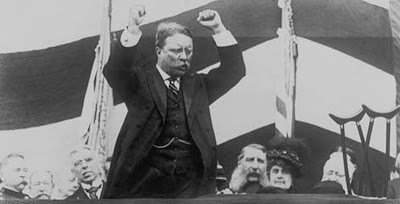
Here is the thing you must bear in mind. I do not represent public opinion. I represent the public. There is a wide difference between the two, between the real interests of the public and the public's opinion of these interests. I must represent not the excited opinion of the West but the real interests of the whole people.

Sunday, May 6, 2012
An Anarchist Manifesto

------------------------------------------------------------------------
Below, I would like to offer a summary and adaptation of Vernard Eller's twelve "basic principles of Christian Anarchy," which he adapted and expanded from Jacques Ellul. Admittedly, I have some reservations about some of Eller's points, and what follows will often gloss over or actively change those aspects in an effort to give a depiction of anarchism which I think more nearly aligns with the Christian ethos. Additionally, it warrants mention that I by no means believe that these twelve represent the best or even most basic aspects of Christian anarchism. There are principles which I would include that Eller did not. There are omissions that I would have made, even omissions of points with which I wholeheartedly agree, simply because I do not think they are basic or essential to anarchism. With all those disclaimers having been made, however, what Eller offers in this list from Christian Anarchy is a collection of important statements and clarifications about the shape of anarchism particularly suited as an apology for those facing uninformed criticisms about what it is to be a Christian anarchist.
- In Christian anarchism, the separation from and eventual dissolution of human governments is not an end in itself. It is only ever endorsed and pursued with the aim of making room for and anticipating the ultimate and absolute reign of God.
- Christian anarchists are not concerned with commending anarchism as a political system superior to contemporary power structures. As a rejection of humanly devised political systems, it would be hypocritical to propose political anarchism as an alternative to traditional hierarchical systems.
- Christian anarchism does not even suffer from the delusion that anarchism is viable for secular society. It admits that human structures are a necessary (or at least efficient) means for ordering a humanist world.
- As such, Christian anarchism sees no particular threat in the existence of human structures of power. The danger is only in accepting the legitimacy of their claims to power and mistaking for real the illusory authority they purport to possess.
- The problem with human structures of power is not that they are "of the devil" necessarily, but that they are human. Just as humans are invariable sinful so to are the governments they construct for themselves. Just as humans are only redeemable in dying to themselves and being reborn to God, so anarchists look for an eschatological death of human powers and the fulfillment of the divine Kingdom.
- Just because all structures of power are equally human (and therefore necessarily sinful) does not meant that all structures of power are equally evil, at least not teleologically. In recognizing that the the United States government is not righteous and inevitably corrupts whoever participates in it, anarchists are not prevented from appreciating moral distinctions between the USA and Nazi Germany or Stalinist Russia. It is possible to be aware of and even grateful for human governments that are less overtly atrocious than others without endorsing, participating in, or falling at the feet of any human government.
- The purpose of Christian anarchism is not to actively attempt to unseat or overthrow human governments, even as their dissolution is earnestly anticipated. As already mentioned, Christian anarchism is not intended to be an alternative political system and recognizes that pure, political anarchism is untenable as a large scale social system. Since it would be impossible for humanity to implement anything but a human government, it would be hypocritical to attempt by human effort to replace world governments with anything else. What's more, the very notion of actively overthrowing a human government implies an appropriation of the very coercive and sinful means that mark human governments as incompatible with the Christian religion. "To undertake a fight against evil on its own terms (to pit power against power) is the first step in becoming the evil one opposes."
- This unwillingness to attempt forcibly to overthrow human governments does not translate into apathy toward their evils or silence about their injustices. "[Christ] challenges every attempt to validate the political realm and rejects its authority because it does not conform to the will of God." Christian anarchism is not retiring simply because it refuses to incite political revolution.
- Just as it is not silent about the evil of government, it is not apathetic about the injustices in society. Anarchists are not so lost in the eschatological vision of a God who is going to "settle things in the end anyway" that it lacks the grounds for social engagement. In truth, it is the eschatological vision of a legitimate power structure and the church's proleptic experience of that reality on which the social ethic is grounded. Anarchists seek to be like Jeremiah's exiles in Babylon, to "seek the welfare of the city where I have sent you into exile, and pray to the Lord on its behalf." Such a social conscience cannot, however, be construed as an endorsement of the legitimacy of Babylon.
- Christian anarchists are not ignorant or afraid of politics, not if they are responsible Christians. Anarchists are always willing to engage with human governments, but always as outsiders, always true to their critique of finite structures of power, and always aware of the ethical dangers involved in political contact.
- Christian anarchism is active but not activist, clearly and definitely engaged in the world without any false pretension about the scope of human ability or goodness. It is eschatological rather than utopian, recognizing that the human mind is incapable of independently conceiving of what a perfect society might look like. It is narrowly rather than broadly focused, thoroughly skeptical of any suggestion that changes at the top might invoke a systemic reformation of society. Finally it is realistic rather than dramatic; because it is not interested in selling a partisan vision of the world in an effort to provoke action from one end of the spectrum or the other it has the benefit of being able to candidly assess what is and is not in the scope of human ability.
- Christian anarchism is committed to the Christian notion of freedom which is distinct from the political notion of autonomy. Governments, and all human structures of power, cannot give you either, though it is common in the prevailing rhetoric to hear the latter promised under the name of the former. Christian anarchism, on the other hand, rejects the stress on autonomy characteristic of secular, political anarchism of all stripes in favor of the Christian notion of freedom, the freedom to pursue God and to attempt to enact His will free from any artificial and exterior constraints. It is, in essence, the freedom from the second master of humanistic politics and the recognition that in trying to serve both, Christians are wont to emphasize that which appears nearer rather than the God who seems distant.
Saturday, April 21, 2012
Regarding Cyborgs and Demagogues

EVER since the late eighteenth century and particularly since the Jacksonian era, American political history has been colored in part by the campaign opportunism of the "demagogue," the professional "man of the people." With considerable histrionic variety and always noisily, he has sought to whip up and intensify the emotions, the prejudices and the passions, of the voting public. And not infrequently his tactics have won out over his more sedate rivals in the political arena.
What would this definition and this evaluation of demagoguery look like if applied disinterestedly to the American political climate today? Who would be labeled a demagogue? Who would be considered among the demagogue's sedate rivals? I cannot help but immediately call to mind the rhetoric which dominates the most popular media of every stripe regarding Mitt Romney, the cold, detached, disengaged, mechanical, affluent robot. In a bygone era, when "gentlemen of birth, wealth, and education, not the "lower orders," monopolized elective office" and when "a government office was a prerogative of the "upper" classes, not a paying job to be sought by flattering the voters," the epithets attached to Romney's name would have been quite different. In fact, in many respect with regard to his person, he is something a relic, a nostalgic throwback to a period in American political history when office was sought by men of leisure who did not need public positions to afford them all the privileges of rank and power.
That is not to say that he would make a good president. It isn't even an attempt to call into question Barack Obama's credentials simply by virtue of his mass appeal and demonizing of affluence. (After all, Luthin formed his definition of a demagogue with no less storied of a figure in mind than Andrew Jackson.) History will evaluate Obama. He may be deemed a good president--as so many political scientists and Norwegians seem to have decided in haste--or a bad one--as so many radio talk show hosts decided just as hastily. It is even possible, though anathema to most, that he may just be an average president, more historically noteworthy for the color of his skin than the contours of his policy. Regardless, the purpose here is to suggest that whatever history has to say about Obama's qualities as a president, it is safe to declare now that he is one of presidential history's greatest demagogues. With Luthin's criteria of mass appeal, self-deprecation in service of populism, impassioned rhetoric, and antagonism toward affluence, Obama is set to ascend into the pantheon of American political demagogues alongside Andrew Jackson and William Jennings Bryan.
This coming election may very well give Americans a chance to evaluate and make decisions about what they want from their most powerful politicians. Will Americans choose the "hopelessly disengaged" plutocrat, who is channeling the Old World notions of a successful business man, a Cincinnatus, who will set aside his wealth and his leisure in service of his country? Would they rather have the young, attractive political superstar, who knows just what to say to whip the masses into a frenzy against the oppressive elites? It will be interesting to see how America's self-discovery and self-determination play out on the national stage (much as it has been interesting to watch Republican self-discovery and self-determination play out on a smaller scale as Romney is pitted against lesser demagogues like Santorum and Gingrich). This election, however it ends up, will be one more chapter in the ongoing saga of America's waxing and waning love affair with her demagogues.
___________________________________________________________
As usual, when I comment on politics, I feel compelled to add this disclaimer: I am not in any way attempting to endorse any candidate nor do I intend to encourage Christian participation in politics in any way. The above is offered merely in an attempt to bring the past to bear on the present, which is the purpose of history. It is my firm and longstanding belief that Christians have an ethical obligation to abstain from participation in politics.
Saturday, March 17, 2012
Myth of the Founding Fathers: Illusions of Innocence

The authors' purpose in Illusions of Innocence is simple yet fundamental: to examine how primitivism functioned in American society throughout history. While the focus is on the seventeenth through nineteenth centuries, they do not shy away from stepping beyond their stated scope into the twentieth century. Primitivism may be loosely defined as the belief in a sacred, universal primordium which stands outside of time and outside of human influence and to which it is imperative that humanity return. The authors identify two ways in which primitivism has functioned. On the one hand, the primordium can in judgment of the present and act as a guard against any attempts to universalize the particulars of a given culture. In American political thought, this can be typified in Jefferson and the belief that there is a fundamental, natural man who has essential, unalienable rights which transcend time and culture. On the other hand, a group may claim to have definitively captured the primordium, thus identifying their own particular features with universal, sacred truth. Again using American political thought, there is the belief that because America has first and best recognized and enshrined those natural, fundamental rights of man America therefore has the right to impose its representation of those values on other cultures (making the world safe for Democracy). In short, one either believed that the primordium could not be recovered and everyone should therefore be free to approximate it as each saw fit or believed instead that the primordium had been recovered and everyone should be compelled to conform to it.
For early American political theorists--the likes of Jefferson, Adams, and Paine--the primordium which provided the sacred tool for ordering the present was man in his natural state, straight from the hand of the "God of Nature." For the Puritans, the primordium was the covenanted nation of Israel. For most indigenous American religious groups, it was the early church. While Americans often disagreed on precisely what the sacred primitive moment outside of history was, depending on where their allegiances lay, they all agreed that there was such a primordium to be sought after with varying degrees of success. Hughes and Allen cite Sidney E. Mead's The Lively Experiment to summarize the three characteristic assumptions of American religion: "the idea of a pure and normative beginnings to which return was possible; the idea that the intervening history was largely that of aberrations and corruptions which was better ignored; and the idea of building anew in the American wilderness on the true and ancient foundations."
In the recent American political climate, a new (or at least revitalized) primordium has been identified and seized upon by Americans, particularly Republicans. Ron Paul says, "One thing is clear: The Founding Fathers never intended a nation where citizens would pay nearly half of everything they earn to the government." Newt Gingrich muses, "I think Jefferson or George Washington would have rather strongly discouraged you from growing marijuana and their techniques with dealing with it would have been rather more violent than our current government." Michelle Bachmann humorously insists, "Well if you look at one of our Founding Fathers, John Quincy Adams...He tirelessly worked throughout his life to make sure that we did in fact one day eradicate slavery." Appeals to the founding fathers and the Constitution--which, like the Bible, is assumed to be self-interpreting--have exploded onto the political scene as Republicans seek to root and therefore legitimate their beliefs in a mythic, sacred past.
What's more, it is working, and why shouldn't it? Primitivism has always had a tremendous rhetorical effect for Americans because we share in a cultural assumption of exceptionalism, a belief that we stand outside of and in judgment of the profane history and culture of the world. The Puritans founded a fresh and efficient government on primitivist pleas. The Disciples created the fifth largest American denomination of their time in a single generation on the basis of a restoration of the primordium. The South seceded from the Union with primitivism at the heart of its identity. It should be unsurprising then that contemporary politicians should seize on the sacred founders of American civil religion--so eerily analogous to the apostles in the Christian religion--who stand in judgment of our present apostasy. Republicans, thankfully, have seen "the normative beginnings to which return was possible," have identified that "the intervening history was largely that of aberrations and corruptions which was better ignored," and are selling to the public "the idea of building anew...on the true and ancient foundations."
The parallels between the way the founding fathers have been seized upon as a sacred American ideal and the way primitivism has constantly manifest in American religion ought to be immediately striking. This only heighten the irony, then, when Hughes and Allen quote from Carl L. Becker's Heavenly City, in which Becker offers a criticism of the Enlightenment thinkers whose thought undergirds the Revolutionary experiment. The same criticism which Becker levels against the founders (among others) has an obvious and direct application to those who marshal their memory to their cause today:
...they are deceiving us, these philosopher-historians...But we can easily forgive them for that, since they are, even more effectively deceiving themselves. They do not know that...[what] they are looking for is just their own image, that the principles they are bound to find are the very one they start with. That is the trick they play on the dead.
Of course, Becker is entirely correct. They do deceive themselves more thoroughly than anyone else. This is precisely the reason why the frequent appeals to history on the part of their opponents fall on deaf ears. Just like Disciples and Mormons and Puritans before them, history has no currency in the founding fathers zeal because the founding fathers stand apart from history, as do their modern proponents who have recaptured their values. The ideology which has been discovered in the fathers is an ideology which is immune to the criticism of reason or history; it is the critic of reason and history. It doesn't matter if in a strictly academic sense John Quincy Adams is not a founding father. Insofar as he is representative of the primordial spirit of the fathers, the invocation of his name is appropriate. It doesn't matter that Jefferson and Washington (and other tobacco lords) probably would not have worked for the violent suppression of marijuana growers in actuality because the ideology they have become synonymous with would be amenable to such action in the present context. Ironically, with the same primordium in mind, Ron Paul can ignore history and context and the changes each have wrought in the way government must operate and make the historically defensible assertion that the founding fathers never conceived of income taxes in their present form.
The purpose here is not to climb up on a high horse to point and laugh at the ignorant Republicans with their primordial myth. It certainly isn't do endorse the Democrats as an alternative. (Like David Lipscomb, I foolishly believe I stand outside of such political partisanship.) In fact, the Democrats have an equal and opposite myth of progress in which they universalize a particular vision of the future rather than of the sacred past to which all reasonable, humane people must attain. While the route is more circumspect, they too--like most Americans--find their way back to grounding this formative myth in a primordium of human rights (intrinsic and apart from the circumstantial trappings of history). Instead, the purpose is to identify, and in doing so hopefully mitigate, the impact of defining myths in our culture. It is to help to reform the appropriate questions, distancing ourselves from the all to easy "Is that really what the founding fathers thought" and getting to the more basic "Should we even care what the founding fathers thought?"
To be sure Hughes and Allen do not want to assert that there are no universals or that they are totally inaccessible, though surely there is no small number of academics today who would agree with one or the other of those premises. Instead, the ongoing purpose of their work and the intent of this reflection on the founding father hysteria is to provide "checks and balances" against too nearly identifying any one person or groups ideology with the universal. Here, perhaps, we have Roger Williams as a model with whom we may critically interact:
For Williams, the radical finitude of human existence, entailing inevitable failures in understanding and action, makes restoration of necessity an open-ended concept. The absolute, universal ideal existed for Williams without question. But the gap between the universal and the particular, between the absolute and the finite, was so great that it precluded any one-on-one identification of the particular with the universal...the best one could do was approximate the universal, an approximation that occurred only through a diligent search for truth.
Wednesday, March 14, 2012
Lawmakers Resort to Schoolyard Antics
Throwing caution to the wind--not to mention principle and process--several lawmakers have decided that the most effective political tool is sarcasm. A number of female lawmakers around the country have been proposing facetious bills in what is best described as a legislative effort to prove "anything you can do, I can do better:"
The fact that the public trust in their various elected officials and their confidence in the ability of government to be efficient and productive are at startling lows does not seem to bother these lawmakers. When asked why she would waste congressional time by proposing legislation which she herself admits is repugnant simply because other lawmakers are wasting congressional time by proposing legislation she finds repugnant, Turner responded, "Because my mama always taught me that two wrongs do make a right." Or, at least, what else could she say?
Democratic Ohio state Sen. Nina Turner is the third female lawmaker to introduce a bill that would limit men's access to Viagra and other erectile dysfunction drugs to make a statement about the dozens of anti-abortion bills that have passed statehouses around the country over the last year...Turner's bill would mandate that men seeking Viagra be "tested for heart problems, receive counseling about possible side effects and receive information about 'pursuing celibacy as a viable lifestyle choice.'"
Turner said on MSNBC Monday that the bill is about showing "men as much love in the reproductive health arena as they have shown us over the years. My Senate Bill 307 is all about the love and making sure we look out for men's sexual health."
The fact that the public trust in their various elected officials and their confidence in the ability of government to be efficient and productive are at startling lows does not seem to bother these lawmakers. When asked why she would waste congressional time by proposing legislation which she herself admits is repugnant simply because other lawmakers are wasting congressional time by proposing legislation she finds repugnant, Turner responded, "Because my mama always taught me that two wrongs do make a right." Or, at least, what else could she say?
Saturday, January 28, 2012
Conservatives, Racists, and Journalists Are Idiots
Sensationalist titles are a journalistic standby, and my years as an editor on my high school paper taught me that they can be used liberally, provided the sensationalism goes no further than the title. So, when I saw an article in a news feed entitled "Low IQ & Conservative Beliefs Linked to Prejudice," I expected to find the impression given in the admittedly engaging title quickly qualified. It's obvious, of course, what the catchy headline is trying to insinuate: conservatives are racists and idiots. After all, the actual phrasing--which indicates that racists are idiots and conservatives--is not nearly as interesting. Clearly the purpose is to draw in conservatives who are indignant at the idea that they could be branded idiots and racists and draw in liberals who are hoping that their deepest held beliefs about conservatives will be vindicated. The truth, of course, which we should all know from the outset is that conservatives and liberals are both idiots (a fact reenforced in the very act of buying into the title and clicking on the article).
To my disappointment (and, I admit, shock) the article gives every appearance of holding to the sensational idea, however, that there is a substantial and meaningful correlation between having a low IQ and being a conservative, being a racist and being a conservative. The writers hit you with gems like "Low-intelligence adults tend to gravitate toward socially conservative ideologies, the study found" and "Polling data and social and political science research do show that prejudice is more common in those who hold right-wing ideals that those of other political persuasions." The article is more than halfway finished before the writers throw poor, dumb conservatives a bone:
Even here, however, it is clear that the intelligent conservative is like a tall woman (an example the article actually uses), the exception not the rule. And so the writers plug euphemistically on, insisting, "Nonetheless, there is reason to believe that strict right-wing ideology might appeal to those who have trouble grasping the complexity of the world." Only in their final thoughts, do the writers think to mention that the study results show a correlative rather than causative connection between the three variables. A professor at the University of Virginia, who was in no way involved in the study, is brought in to play devil's advocate and present a more reasoned analysis of the data:
Go figure. There may be a chance, however slight, that in actuality extreme political ideologies of all forms attract their own special kinds of idiots. Why not lead with that wonderful tidbit, or even just a token teaser that there are some who interpret the findings differently? It is just the tried-and-true liberal media bias, famed in song and story and Republican debate rant? Is it just bad journalism, an unfortunate ignorance on the part of the writer about how the article will be perceived? I don't pretend to know. I also don't know whether or not the average reader of either political persuasion will be clever enough to see from the start how slanted the presentation of the study is, though I would hope so. What I do know, or at least suspect, is that is a correlation between low IQ and believing that dumb people are primarily the residents of one political faction.
To my disappointment (and, I admit, shock) the article gives every appearance of holding to the sensational idea, however, that there is a substantial and meaningful correlation between having a low IQ and being a conservative, being a racist and being a conservative. The writers hit you with gems like "Low-intelligence adults tend to gravitate toward socially conservative ideologies, the study found" and "Polling data and social and political science research do show that prejudice is more common in those who hold right-wing ideals that those of other political persuasions." The article is more than halfway finished before the writers throw poor, dumb conservatives a bone:
Hodson was quick to note that the despite the link found between low intelligence and social conservatism, the researchers aren't implying that all liberals are brilliant and all conservatives stupid. The research is a study of averages over large groups, he said.
"There are multiple examples of very bright conservatives and not-so-bright liberals, and many examples of very principled conservatives and very intolerant liberals," Hodson said.
Even here, however, it is clear that the intelligent conservative is like a tall woman (an example the article actually uses), the exception not the rule. And so the writers plug euphemistically on, insisting, "Nonetheless, there is reason to believe that strict right-wing ideology might appeal to those who have trouble grasping the complexity of the world." Only in their final thoughts, do the writers think to mention that the study results show a correlative rather than causative connection between the three variables. A professor at the University of Virginia, who was in no way involved in the study, is brought in to play devil's advocate and present a more reasoned analysis of the data:
The researchers controlled for factors such as education and socioeconomic status, making their case stronger, Nosek said. But there are other possible explanations that fit the data. For example, Nosek said, a study of left-wing liberals with stereotypically naïve views like "every kid is a genius in his or her own way," might find that people who hold these attitudes are also less bright. In other words, it might not be a particular ideology that is linked to stupidity, but extremist views in general.
"My speculation is that it's not as simple as their model presents it," Nosek said. "I think that lower cognitive capacity can lead to multiple simple ways to represent the world, and one of those can be embodied in a right-wing ideology where 'People I don't know are threats' and 'The world is a dangerous place'. ... Another simple way would be to just assume everybody is wonderful."
Go figure. There may be a chance, however slight, that in actuality extreme political ideologies of all forms attract their own special kinds of idiots. Why not lead with that wonderful tidbit, or even just a token teaser that there are some who interpret the findings differently? It is just the tried-and-true liberal media bias, famed in song and story and Republican debate rant? Is it just bad journalism, an unfortunate ignorance on the part of the writer about how the article will be perceived? I don't pretend to know. I also don't know whether or not the average reader of either political persuasion will be clever enough to see from the start how slanted the presentation of the study is, though I would hope so. What I do know, or at least suspect, is that is a correlation between low IQ and believing that dumb people are primarily the residents of one political faction.
Subscribe to:
Posts (Atom)