Showing posts with label children. Show all posts

Tuesday, April 23, 2013

Some Standard Wisdom for Converting Blacks

Less than a month into this series, I already feel the need to sound the reminder that in quoting some of these articles, my intent is not to endorse or make light of or even to stand in judgment of some of the darker sides of late nineteenth century thought. This warrants particular restatement with the following article by J. W. Crenshaw. It would be easy to read the below and assume either that my intent is racist or callous or anarchonistically judgmental. It is none of these. Instead, the following article sounds, among other things, a pair of themes that I have tried to reiterate here in various ways. The first is the need to complicate the narrative of the Civil War that we all learned in school: the North invaded the South to free the slaves and give blacks their rights. Historians have almost entirely abandoned this carefully constructed fiction, but the public still casts the Civil War in these terms, failing to see the stark racism and paternalism that dominated in the North no less than the South. The other is the sinister overtones that education often takes on in the hands of progressives. It's a message that has ongoing merit.

Even if neither of these themes were present, however, the following is important to read both for those in the Stone-Campbell Movement because it is part of our collective history the consequences of which we continue to live with in the de facto racial segregation of our churches and for Americans in general who need to be forced to read chapters of our history which serve neither to glorify US nationalism or to provide the starting point in a narrative of national redemption. What follows in "Difficulties in Christianizing the Colored Race" is precisely the shades of grey that we all need to grapple with in the formation of our historical consciousness.

As to what the future of the colored race of America is to be, socially, politically or religiously, we do not believe any one can conjecture with any degree of accuracy. Naturally superstitious and with their race prejudices to contend with, we approach them more from a sense of Christian duty than from any hope of achieving grand results. To succeed in our mission work among them we must agree upon some decided policy. If properly approached, we do not believe that there is a better missionary field in the world.

Experience has proven that we can not reach them through the preaching of white men. The colored leaders now, excepting a few, are ignorant and superstitious. In what direction, then, does hope lie? Certainly not in this shouting generation. The hope and the only hope, speaking from experience, is in the children. And when we educate a few colored men, as we have been doing for this work, we must not measure their success by converts made. The children, who are just learning to read, are the ones most benefited. Those whom we send out must be impressed with the importance of continuing to sound into the ears of the auditors that Christianity is something more than shouting the clothes off in the first part of the night, and serving Satan the balance of the night. We need to select young men of good character to educate them for this work. There are brethren among us who have the means to help build such a school as we need for this purpose. With the plain gospel plea that we have, if loving liberal hearts, could be interested in this work, in the next generation many of the difficulties that now so hinder our progress could be surmounted, and thousands of this unfortunate race could be Christianized.

Brethren, this is a question worthy of the attention of every Christian.

Saturday, March 16, 2013

A Southern Nation of Speechifiers: Heyrman and Eastman in Conversation

University of Chicago Press
Christine Leigh Heyrman’s Southern Cross makes a wonderful companion piece to Carolyn Eastman’s A Nation of Speechifiers. More precisely, Heyrman preemptively corrects a historical oversight in Eastman’s much more recent work. Both authors are concerned with identifying the relationships of nonelites to structures of power in the early national period. Both argue that the changes which took place after the turn of the century were not the rosy picture of democratization which has been the academic orthodoxy for politics, society, and religion for some time. Both excellently demonstrate their cases. Yet, while Heyrman treats her subject comprehensively within her limits, Eastman claims a broader scope than she is ultimately able to encompass.

In Nation of Speechifiers, Eastman argues that far from a great triumph of democratization that once dominated thinking on Jacksonian politics or even the perpetual repression of nonelites that has dominated some feminist and minority histories, the period immediately after the Revolution was one of profound cultural negotiation in which nonelites were able to seize access to public participation in limited but meaningful ways. She looks at politics, education, voluntary associations, trade organizations, publishing, and professional oratory to see the ways that women, children, and racial minorities had a public voice prior to 1810. After that, however, culture shifted as the nation solidified. A war won, a peaceful party transition, and a new vision of suffrage for white men all functioned to close the previously permeable borders of public participation and exclude nonelites.

Yet Eastman glaringly omits religion as an arena in which women, children, and racial minorities had a public voice, a curious oversight particularly in view of Eastman’s stress on oratory as a means of public power. The omission might have made a good avenue for further research had not Heyrman perfectly tackled the question more than a decade earlier. Heyrman takes the same period Eastman considers, treats the same nonelites that Eastman does, but focuses narrowly on religion in the South. The conclusions she draws are largely the same. A newly formed (at least in the South) evangelicalism is initially open to the public voice and at least informal authority of women, children, and racial minorities. After the turn of the century, however, Heyrman exhaustively and convincingly traces the restriction of power into the hands of older white males. She concludes, much as Eastman does, by attacking facile notions of democratization by asking the question democratization for whom.

Eastman’s omission of religion—and of the South and transmontane America almost in their entirety—clearly could have been corrected by reading Heyrman, and the failure to do so borders on inexcusable. Yet readers of Heyrman can benefit from consulting Eastman as well. Heyrman explains the changes in evangelicalism largely as evangelistic necessities. “To put the matter bluntly, evangelicals could not rest content with a religion that was the faith of women, children, and slaves” (193). Growth required appeasing and then appealing to white men, in whose hands all temporal power rested. Eastman suggests there is something more at work in the culture at large here. Eastman’s exclusion of the South from her study may throw this observation into doubt for the arena of Heryman’s work, but nevertheless the question must be raised whether or not evangelistic necessity adequately explains the need for a more male-oriented, “traditional” religious structure. Even if it does, do the broader cultural changes charted by Eastman explain what is driving this evangelistic need? In Heyrman, essentially, evangelicals hit a glass ceiling above which a movement of women could no longer ascend. The early nineteenth century as the period of transition is incidental; it is just when the need for change outweighed the inertia of convention. Eastman’s work suggests there is something more happening in the period.

Both books are supremely readable, and Heyrman in particular has a literary flourish rarely seen among historians. Though my interests and preferences tend toward Heyrman's work, I confidently recommend either for general reading. Eastman's more theoretical framework may scare off non-academics, but anyone who has even a hobbyists interest in the period will be more than amply rewarded by putting in the effort to understand her argument. Together, these two works give a picture of early national American democracy that will challenge the narrative taught in most colleges not to long ago and still, consequently, taught in most grade schools.

Wednesday, February 20, 2013

Dorothy Day, the Woman

Being myself both anti-abortion and anti-war, both a complementarian and an environmentalist, you might think that I would realize that others, like myself, do not fall neatly into the media constructed left-right continuum of social and political thought. Nevertheless, I still found myself going into The Long Loneliness with the assumption that Dorothy Day, hero of the radical left, must be a rabid feminist of the latest type. Of course, as a historian, I should have realized the anachronism of assuming that a woman who came of age just as so-called first wave feminists were making strides toward legal equality could not be expected to share the concerns of so-called second wave feminists who would begin to blur the distinctions between equality and uniformity in the 1960s. Especially since Day's book was published in 1952. (For all I know, she went on to mirror the changing landscape of feminist thought, but that is a topic for another study.) Whatever my misconceptions and miscalculations, I was pleasantly surprised to read Day's own reflections on her womanhood, not because they necessarily paralleled or reinforced my own thoughts on gender but simply because she represented a strong, thoughtful, articulate woman who was, nonetheless, still a woman and saw herself as distinct from--dare I say complementary to--man.

I was lonely, deadly lonely. And I was to find out then, as I found out so many times, over and over again, that women especially are social beings, who are not content with just husband and family, but must have a community, a group, an exchange with others. A child is not enough. A husband and children, no matter how busy one may be kept by them, are not enough. Young and old, even in the busiest years of our lives, we women especially are victims of the long loneliness. Men may go away and become desert Fathers, but there were no desert mothers. Even the anchoresses led rather sociable lives, with bookbinding and spiritual counseling, even if they did have to stay in one place.

That observation was inoffensive enough, but she would make others that might not sit quite so well as she pitted her own womanhood against the work she wanted to do:

I am quite ready to concede now that men are the single-minded, the pure of heart, in these movements. Women by their very nature are more materialistic, thinking of the home, the children, and of all things needful to them, especially love. And in their constant searching after it, they go against their own best interests. So, I say, I do not really know myself as I was then. I do not know how sincere I was in my love of the poor and my desire to serve them. I know that I was in favor of works of mercy as we know them, regarding the drives for food and clothing for strikers in the light of justice, and an aid in furthering the revolution. But I was bent on following journalist’s side of the work. I wanted the privileges of the woman and the work of the man, without following the work of the woman. I wanted to go on picket lines, to go to jail, to write, to influence others and so make my mark on the world. How much ambition and how much self-seeking there was in all this!

In that struggle, she did not always choose what the "woman" in her desired. Perhaps, as I think some feminists would argue, this was her overcoming the gender norms foisted upon her by a misogynistic society. Perhaps, as I would suggest, this is merely the sacrifice of self that makes Day's life so profound. Reflecting on her conversion, which precipitated her divorce, she wrote:

I saw the film Grapes of Wrath at this time and the picture of that valiant woman, the vigorous mother, the heart of the home, the loved one, appealed to me strongly. Yet men are terrified of momism and women in turn want a shoulder to lean on. That conflict was in me. A woman does not feel whole without a man. And for a woman who had known the joys of marriage, yes, it was hard. It was years before I awakened without that longing for a face pressed against my breast, an arm about my shoulder. The sense of loss was there. It was a price I had paid.

It was not all so dreadfully serious, and one anecdote caught my attention precisely for how typically human it was. It reminded of the kind of casual, unreflective assumptions about gender that you hear every day walking through the mall or rattled off in casual conversation around the office. Here she explains to a friend precisely how she sees a mutual acquaintance from her feminine perspective:

“I tell you, I do like him. I like him very much. But why do I have to go into raptures about him? Do you want me to fall in love with him? But that is just it—the only thing I do not like about him is that he always is raving about women—kissing his hand to them, going down on his knees to them and saying ‘Ah, how I love them, and how they have wrecked my life!’ Women don’t like such a man. He is too easy to get. They prefer a more aloof type so that if he does make love them they can flatter themselves that there is some rare quality in them which made him succumb.”

And yet, sixty years later, guys like that still exist. Go figure.

Wednesday, February 6, 2013

Dorothy Day, the Child

Unsurprisingly, Dorothy Day began life as a child. Equally unsurprisingly, when she looked back on her childhood she found both profound truths and glimpses of her future self. This is perhaps a great act of anachronism--one which would be by no means unique to her--in which we project back onto a past of infinite possibilities the notion of fate which comes from hindsight and the wisdom which comes from distance. Even if that is true, even if to the smallest degree, it does not thereby negate the value of this self-reflection, this turning to the past to explain the present and to extract from its eventualities eternal truths. After all, Christ pointed often to children for just such a reason, either to validate this human instinct or because he knew that through it we might more easily grasp that which he taught us. It was to those like "little children" that truth had been revealed, not the wise, whom Jesus must rebuke and remind that out of the mouths of babes came true praise. To the those who would become children, the kingdom of heaven belongs. So when Day looks back on her childhood in search of kernels of truth, she may indulge a human impulse but she also practices a Christian virtue.

What she finds is both the seeds of simple faith and the onset of our most basic sins:

We did not search for God when we were children. We took Him for granted. We were at some time taught to say our evening prayers, “Now I lay me,” and “Bless my father and mother.” This done, we prayed no more unless a thunderstorm made us hide our heads under the covers and propitiate the Deity by promising to be good.

Very early we had a sense of right and wrong, good and evil. My conscience was very active. There were ethical concepts and religious concepts. To steal cucumbers from Miss Lynch’s garden on Cropsey Avenue was wrong. It was also wrong to take money from my mother, without her knowledge, for a soda. What a sense of property rights we had as children! Mine and yours! It begins in us as infants. “This is mine.” When we are very young just taking makes it mine. Possession is nine points of the law. As infants squabbling in the nursery we were strong in that possessive sense. In the nursery might made right. We had not reached the age of reason. But at the age of four I knew it was wrong to steal.

She also remember with what innocence and clarity she first learned about poverty and became disillusioned with the way it is approached in supposedly Christian society. Her words are both a testament to the obviousness of our shortcomings and to the wisdom and impressionability of our youth:

Children look at things very directly and simply. I did not see anyone taking off his coat and giving it to the poor. I didn’t see anyone having a banquet and calling in the lame, the halt and the blind. And those who were doing it, like the Salvation Army, did not appeal to me. I wanted, though I did not know it then, a synthesis. I wanted life and I wanted the abundant life. I wanted it for others too. I did not want just the few, the missionary-minded people like the Salvation Army, to be kind to the poor, as the poor. I wanted everyone to be kind. I wanted every home to be open to the lame, the halt and the blind, the way it had been after the San Francisco earthquake. Only then did people really live, really love their brothers. In such love was the abundant life and I did not have the slightest idea how to find it.

Wednesday, October 31, 2012

What Good Are Laws?

Throughout this political season--in addition to not so subtly pushing my Christian anarchist agenda--I have been trying to refer people as often as possible to different periods in the history of American politics in an effort to broaden the scope with which we look at the political process in the US. Today, I'd like to offer this quote, gleaned in passing from an oral history, that gives the political opinions of an early twentieth century resident of Italian Harlem:

What good are the laws of this country if a child is given liberty to talk back to his parents?

What good indeed? It's a remarkably different perspective than, say, what good are the laws of this country if they don't ensure a child's future right to choose his or her own religion without any bias from childhood religiosity.

Monday, July 16, 2012

Couple Sues Eleven Year Old Baseball Prodigy

In case you weren't paying attention, the litigiousness of our society has reached unintentional self-deprecating proportions:

A New Jersey woman who was struck in the face with a baseball at a Little League game is suing the young catcher who threw it.

Elizabeth Lloyd is seeking more than $150,000 in damages to cover medical costs stemming from the incident at a Manchester Little League game two years ago. She's also seeking an undefined amount for pain and suffering.

Lloyd was sitting at a picnic table near a fenced-in bullpen when she was hit with the ball.

Catcher Matthew Migliaccio was 11 years old at the time and was warming up a pitcher.

The wife is claiming that the errant ball was actually thrown at her intentionally and constitutes assault. She also insists that the whole exercise of warming up was an "inappropriate...sporting activity," in spite of the fact that it took place in a fenced-in bullpen. The husband, putting the absurd cherry on this cake, complains of the loss of "services, society and consortium" from his wife and is holding the child personally responsible.

There's a whole litany of crazy here that could be addressed. Like that I was unaware that it is even possible to sue an eleven year old. Or how about the parents of the catcher's misdirected anger at Little League for not helping with their legal fees. Or that someone would send threatening letters to a child. Or the unnerving reality that a society exists--and persists--on the planet where something like this can happen.

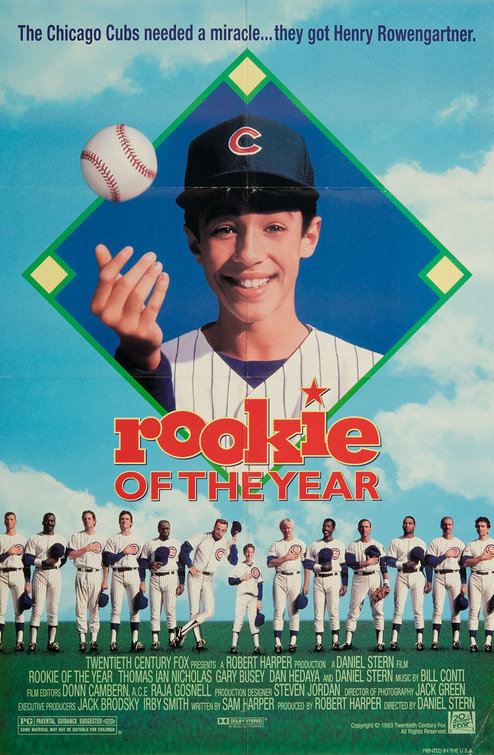
But the question my wife and I just keep coming back to: how hard can an eleven year old really throw? I mean, c'mon folks. Really? Really? If I were standing two feet from an eleven year old and he threw a ball at my face as hard as he could, I don't think it would cause $150,000 and two years worth of damage. (It certainly wouldn't prevent me from providing "services, society and consortium" for my wife.) It wasn't even the pitcher throwing heat--do eleven year olds throw heat? It was a catcher warming up the pitcher at some reasonable distance from a picnic table. If there is even a shred of truth to the allegations from this woman, then the parents should just take out a loan and settle. It won't matter. This kid has a multimillion dollar Major League deal waiting just around the corner for him. Can you say, "Henry Rowengartner?"

Saturday, June 9, 2012

What's Wrong With Spanking in Public Schools?

Due to a recent interest in public views about child rearing, and particularly with innovative new disciplinary methods, I recently came across a USA Today editorial opposing corporal punishment in public schools. It ought to go without saying that I have a profound dislike for corporal punishment of any kind applied to anyone. Not being a parent myself, by the grace of God, I stop short of presenting this dislike as a conviction, but--as an ardent opponent of violence properly understood and in all its forms--the prospect of hitting a child in a way which is typically logically unconnected to the offense being corrected is repugnant to me. In addition to being nonsensical and to the multiplicity of more taxing but more benign forms of discipline that could function as alternatives, corporal punishment teaches that violence is an appropriate corrective, an ethical and pragmatic fallacy that has far-reaching personal, political, and global consequences when children inevitably undergo the metamorphosis into citizens.

Yet, with all that being said, something about this article immediately rubbed me the wrong way. It wasn't even the pathetic and predictable public declamation of everyone's favorite ideologically backward whipping boy, the South, in the second sentence. It also wasn't the specious attempt by the writer to make an entire system culpable in the excessive of a few extreme incidents. It wasn't even the shameless way the bugaboo of racism was conjured. Okay, so maybe it was all those things--as good points poorly argued are a pet peeve of mine--but not first and not most. This is what really troubled me:

When children are struck by school personnel, they learn a couple of lessons, neither of them good: One is that it's OK for non-parental authority figures to hit them. Another is that violence is an acceptable response to bad behavior.

Why should that bother me? After all, that sounds very much like my primary objection to the corporal punishment of children. Here's the problem: both of those "bad" lessons are true lessons which will serve children in our society. After all, I wonder if the writer is aware that the police, the most prominent domestic "non-parental authority figures," still employ force as a means of social control, even in the thirty one states and over one hundred foreign countries that have disallowed corporal punishment in schools. We may think ourselves civilized in America because we don't cane vandals or maim thieves, but our civil servants still strike, mace, wrestle, and electrocute suspected criminals for refusing to comply with official directives. As for violence acting as "an acceptable response to bad behavior," the continuing presence of capital punishment domestically and military action internationally prove that violence is still very prominent in our culture as a means for suppressing unacceptable behavior.

Perhaps the editorial writer and the enlightened residents of the Northeast would like it if all of that weren't true, if there were no violent action by the police, no armed conflict internationally, and no capital punishment. As a matter of fact, I'd like those things. But saying that for children to learn that the world is controlled by means of violence is a bad lesson is disingenuous. It is perhaps the most basically true lesson they can learn in school. If they'd like, opponents of corporal punishment can change the way the world works so that the life lessons they admit corporal punishment teaches are no longer true. If, however, the idea is to alter education in an attempt to rework the world order into their ideological image...well, wouldn't that be shocking.

Saturday, June 2, 2012

Unorthodox Teen Discipline Prompts Criticism


In a story surprising equally for the unapologetic ingenuity of its protagonist and the gross oversensitivity it uncovers in the general public, ABC reports that one woman has taken her fight against inappropriate social media behavior deep into enemy territory:

At first, it might seem like your typical case of modern parental discipline: A Texas mom has prohibited her 12-year-old daughter from using the photo-sharing site Instagram after she caught the girl posting a photo of herself holding an unopened bottle of vodka with a caption that read “I sure wish I could drink this.”

But it’s what ReShonda Tate Billingsley did next that has people buzzing: Billinglsey, a prominent Houston-area author, had her daughter post a new picture of herself to Instagram earlier this month holding a sign reading, “Since I want to post photos of me holding liquor, I am obviously not ready for social media and will be taking a hiatus until I learn what I should (and) should not post. Bye-bye.”

Billingsley then posted the same photo – in which only the lower half of her daughter’s face was visible – to her own personal Facebook page and it has since gone viral. It has seen 11,000 shares from Facebook alone, not to mention attention from various media outlets.

It was a clever move on the part of Billingsley and effective, apparently so much so that the daughter begged for a spanking as an alternative. What I love about this, particularly when compared to corporal punishment, is there is a logical relationship between the "crime" and the "punishment." Most obviously, if children abuse social media, they should have their access to social media restricted. Moreover, with the theoretically limitless reach of online behavior, the act of forcing her daughter to own up to her mistakes is equally essential. When I committed some indiscretion against someone, some public act of bad behavior, as a child, I was required to apologize to all those who were effected by said behavior. As Instagram was the arena of her malfeasance, then it is appropriate that she should own up to her mistakes through in the same place.

For some reason, however, the "public shaming" has apparently made Billingsley the target of serious criticism. Aside from the presumptuousness of child-rearing professionals and the public at large meddling in other people's parenting in ways they would never permit in their own families, the real problem with this is the labeling of the second picture as the embarrassment rather than the first. It is precisely this misconception that Billingsley's choice of discipline can serve to correct. The shameful act is not and should not be taking public responsibility for one's actions and accepting the consequences of them, as Billingsley made her daughter do. It is the careless and deeply inappropriate act of a twelve year old announcing to the world how much she would love to be able to drink hard liquor. When the child's aberrant behavior ceases to shock and the act of publicly taking responsibility offends, it becomes clear that the world is hopelessly confused about what is truly shameful.

And just so that we can all gain a little perspective, let's all take a look at this mother in Mexico City who also employed an unorthodox punishment:

A mother in Mexico has been arrested on suspicion of gouging out the eyes of her 5-year-old son during a ceremony...The mother is believed to have removed the eyes with her bare hands because the boy refused to close them during the ceremony, police told a news conference.

Monday, May 7, 2012

Priest Single-Handedly Boosts Birth Rate

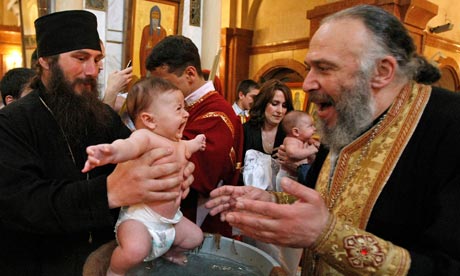
Here is an odd, touching, wonderful story about a prelate who, ironically, takes the imperative to "be fruitful and multiply" very personally. In addition to having perhaps the most adorable picture of a baptism as accompaniment, the Atlanta Journal Constitution reports:

The patriarch of the Georgian Orthodox Church presided over the baptism of hundreds of babies in a Tbilisi cathedral on Sunday as part of an effort credited with helping raise the birth rate in this former Soviet nation.

Patriarch Ilia II has promised to become the godfather of all babies born into Orthodox Christian families who already have two or more children. Since he began the mass baptisms in 2008, he has gained nearly 11,000 godchildren.

Georgian President Mikhail Saakashvili has said the patriarch deserves much of the credit for the rising birth rate, which in 2010 was 25 percent higher than in 2005. The number of abortions also declined by nearly 50 percent over the same five-year period.

Parents of the 400 babies baptized by an array of priests Sunday said the patriarch was instrumental in their decision to have a third or fourth child.

Saturday, September 10, 2011

The Wisdom of J. C. Ryle: An Appendix

While J. C. Ryle's The Duty of Parents interested me primarily as a corrective for modern trends in child-rearing, I was surprised to find myself engaged and inspired by other quotes in his work which often had nothing to do with raising children. So, in addition to some extra quotes on children that did not make it into the previous post, I would like to share a few other quotes from Ryle's work that I found interesting.

More advice on raising children:

A true Christian must be no slave to fashion, if he would train his child for heaven. He must not be content to do things merely because they are the custom of the world; to teach them and instruct them in certain ways, merely because it is usual; to allow them to read books of a questionable sort, merely because everybody else reads them; to let them form habits of a doubtful tendency, merely because they are the habits of the day. He must train with an eye to his children’s souls. He must not be ashamed to hear his training called singular and strange. What if it is? The time is short, — the fashion of this world passeth away. He that has trained his children for heaven, rather than for earth, — for God, rather than for man, — he is the parent that will be called wise at last.


Never listen to those who tell you your children are good, and well brought up, and can be trusted.


Fathers and mothers, you may take your children to be baptized, and have them enrolled in the ranks of Christ’s Church; — you may get godly sponsors to answer for them, and help you by their prayers; — you may send them to the best of schools, and give them Bibles and Prayer Books, and fill them with head knowledge but if all this time there is no regular training at home, I tell you plainly, I fear it will go hard in the end with your children’s souls. Home is the place where habits are formed; — home is the place where the foundations of character are laid; — home gives the bias to our tastes, and likings, and opinions. See then, I pray you, that there be careful training at home.


On human nature:

Believe me, we are not made for entire independence, — we are not fit for it.


No created being was ever meant to be idle. Service and work is the appointed portion of every creature of God.


...there is an alphabet to be mastered in every kind of knowledge...


The active moving mind is a hard mark for the devil to shoot at.


On Christian practice:

Prayer is the simplest means that man can use in coming to God. It is within reach of all, — the sick, the aged, the infirm, the paralytic, the blind, the poor, the unlearned, — all can pray. It avails you nothing to plead want of memory, and want of learning, and want of books, and want of scholarship in this matter. So long as you have a tongue to tell your soul’s state, you may and ought to pray.


Strive rather to be a living epistle of Christ, such as your families can read, and that plainly too.


And still more:

The Bible tells us that God has an elect people, — a family in this world. All poor sinners who have been convinced of sin, and fled to Jesus for peace, make up that family.


Children have ever been the bow from which the sharpest arrows have pierced man’s heart. Children have mixed the bitterest cups that man has ever had to drink. Children have caused the saddest tears that man has ever had to shed.

Wednesday, September 7, 2011

The Wisdom of J. C. Ryle

An incident recently brought to my attention has reignited my interest in a 19th century child-rearing manual that I had set aside for more challenging reading. When I heard about the family who had taken a contemporary manual and applied its teachings to the terminal detriment of their adopted daughter, I began to see in a new light the restrained, even-handed suggestions of Anglican bishop J. C. Ryle. In The Duties of Parents, Ryle offers seventeen suggestions for raising a Christian child that have a timeless quality to them. While his theology, apparent in some of his advice, takes a decidedly Calvinistic bent which may not sit well with everyone (myself included), the pedagogy Ryle outlines has the benefit of transcending the modern tendencies to polarize to the extremes of permissiveness or, in the case of the family in the news, cruelty. So, I offer these seventeen training tips now (with the full knowledge that I am someone without children of my own) both in the form of quotations from Ryle and my own translation of his advice into a modern idiom.


1. Left to his own devices, your child will screw up with tremendous acuity. You must actively train a child in what is right or he will incline toward what is wrong.

Remember children are born with a decided bias towards evil, and therefore if you let them choose for themselves, they are certain to choose wrong. The mother cannot tell what her tender infant may grow up to be, — tall or short, weak or strong, wise or foolish he may be any of these things or not, — it is all uncertain. But one thing the mother can say with certainty: he will have a corrupt and sinful heart… for pity’s sake, give him not up to his own wayward tastes and inclinations. It must not be his likings and wishes that are consulted. He knows not yet what is good for his mind and soul, any more than what is good for his body. You do not let him decide what he shall eat, and what he shall drink, and how he shall be clothed. Be consistent, and deal with his mind in like manner.


2. Raise your child with a love and affection that is both genuine and apparent.

Love is one grand secret of successful training. Anger and harshness may frighten, but they will not persuade the child that you are right; and if he sees you often out of temper, you will soon cease to have his respect… Try hard to keep up a hold on your child’s affections. It is a dangerous thing to make your children afraid of you. Anything is almost better than reserve and constraint between your child and yourself; and this will come in with fear. Fear puts an end to openness of manner; — fear leads to concealment; — fear sows the seed of much hypocrisy, and leads to many a lie.


3. Remember that you are the greatest pedagogical force in your child’s life. Embrace that reality.

We depend, in a vast measure, on those who bring us up. We get from them a colour, a taste, a bias which cling to us more or less all our lives. We catch the language of our nurses and mothers, and learn to speak it almost insensibly, and unquestionably we catch something of their manners, ways, and mind at the same time.


4. Don't let momentary concerns cause you to lose sight of eternal ones. A child's soul is in your charge no less than his body.

Precious, no doubt, are these little ones in your eyes; but if you love them, think often of their souls. No interest should weigh with you so much as their eternal interests. No part of them should be so dear to you as that part which will never die. The world, with all its glory, shall pass away; the hills shall melt; the heavens shall be wrapped together as a scroll; the sun shall cease to shine. But the spirit which dwells in those little creatures, whom you love so well, shall outlive them all, and whether in happiness or misery (to speak as a man) will depend on you.


5. Begin to teach a child the Scriptures even while he is young. Let them be the bedrock of his developing character.

See that they read [the Bible] regularly. Train them to regard it as their soul’s daily food, — as a thing essential to their soul’s daily health. I know well you can not make this anything more than a form; but there is no telling the amount of sin which a mere form may indirectly restrain. See that they read it all. You need not shrink from bringing any doctrine before them. You need not fancy that the leading doctrines of Christianity are things which children cannot understand. Children understand far more of the Bible than we are apt to suppose.


6. Teach a child to pray, and thereby to confer actively and personally with God.

Prayer is one great secret of spiritual prosperity. When there is much private communion with God, your soul will grow like the grass after rain; when there is little, all will be at a standstill, you will barely keep your soul alive. Show me a growing Christian, a going forward Christian, a strong Christian, a flourishing Christian, and sure am I, he is one that speaks often with his Lord.


7. Instill in a child the value of being a regular participant in the life of the Christian community. He should know that to be a part of God's family and to participate in its formal life is a blessing not a chore.

Tell them of the duty and privilege of going to the house of God, and joining in the prayers of the congregation. Tell them that wherever the Lord’s people are gathered together, there the Lord Jesus is present in an especial manner, and that those who absent themselves must expect, like the Apostle Thomas, to miss a blessing.


8. Teach your child to have faith in your instruction, and give him no reason to doubt that trust.

...you should train them up to believe what you say. You should try to make them feel confidence in your judgment, and respect your opinions, as better than their own. You should accustom them to think that, when you say a thing is bad for them, it must be bad, and when you say it is good for them, it must be good; that your knowledge, in short, is better than their own, and that they may rely implicitly on your word. Teach them to feel that what they know not now, they will probably know hereafter, and to be satisfied there is a reason and a needs-be for everything you require them to do...No doubt it is absurd to make a mystery of everything you do, and there are many things which it is well to explain to children, in order that they may see that they are reasonable and wise. But to bring them up with the idea that they must take nothing on trust, that they, with their weak and imperfect understandings, must have the "why" and the "wherefore" made clear to them at every step they take, — this is indeed a fearful mistake, and likely to have the worst effect on their minds.


9. Ensure that your child knows the virtue of obedience, because a habit of disobedience spills over into unexpected and dangerous quarters.

Teach them to obey while young, or else they will be fretting against God all their lives long, and wear themselves out with the vain idea of being independent of His control. Reader, this hint is only too much needed. You will see many in this day who allow their children to choose and think for themselves long before they are able, and even make excuses for their disobedience, as if it were a thing not to be blamed. To my eyes, a parent always yielding, and a child always having its own way, are a most painful sight.


10. Make sure your child always speaks the truth not merely that he doesn't lie.

Try to keep this continually before your children’s minds. Press upon them at all times, that less than the truth is a lie; that evasion, excuse-making, and exaggeration are all halfway houses towards what is false, and ought to be avoided. Encourage them in any circumstances to be straightforward, and, whatever it may cost them, to speak the truth.


11. Do not give much time to idleness, even though your child's idleness may be convenient for you.

Reader, I ask you to set these things before the minds of your children. Teach them the value of time, and try to make them learn the habit of using it well. It pains me to see children idling over what they have in hand, whatever it may be. I love to see them active and industrious, and giving their whole heart to all they do; giving their whole heart to lessons, when they have to learn; — giving their whole heart even to their amusements, when they go to play. But if you love them well, let idleness be counted a sin in your family.


12. Avoid over-indulgence. It is an easier and deadlier trap to fall into than small excesses in austerity.

It is natural to be tender and affectionate towards your own flesh and blood, and it is the excess of this very tenderness and affection which you have to fear. Take heed that it does not make you blind to your children’s faults, and deaf to all advice about them. Take heed lest it make you overlook bad conduct, rather than have the pain of inflicting punishment and correction...Do not, I pray you, make your children idols...


13. God has a family over which He is the Father. He is the ultimate model for righteous parenting.

Now, reader, notwithstanding all these things, did you ever hear of a single child of God who thought his Father did not treat him wisely? No, I am sure you never did. God’s children would always tell you, in the long run, it was a blessed thing they did not have their own way, and that God had done far better for them than they could have done for themselves. Yes! And they could tell you, too, that God’s dealings had provided more happiness for them than they ever would have obtained themselves, and that His way, however dark at times, was the way of pleasantness and the path of peace. I ask you to lay to heart the lesson which God’s dealings with His people is meant to teach you. Fear not to withhold from your child anything you think will do him harm, whatever his own wishes may be. This is God’s plan. Hesitate not to lay on him commands, of which he may not at present see the wisdom, and to guide him in ways which may not now seem reasonable to his mind. This is God’s plan. Shrink not from chastising and correcting him whenever you see his soul’s health requires it, however painful it may be to your feelings; and remember medicines for the mind must not be rejected because they are bitter. This is God’s plan. And be not afraid, above all, that such a plan of training will make your child unhappy. I warn you against this delusion. Depend on it, there is no surer road to unhappiness than always having our own way...Reader, be not wiser than God; — train your children as He trains His.


14. Your child is watching you, and no matter what you say, he will learn first and best from what you do.

Instruction, and advice, and commands will profit little, unless they are backed up by the pattern of your own life. Your children will never believe you are in earnest, and really wish them to obey you, so long as your actions contradict your counsel. Archbishop Tillotson made a wise remark when he said, "To give children good instruction, and a bad example, is but beckoning to them with the head to show them the way to heaven, while we take them by the hand and lead them in the way to hell." ...Fathers and mothers, do not forget that children learn more by the eye than they do by the ear. No school will make such deep marks on character as home. The best of schoolmasters will not imprint on their minds as much as they will pick up at your fireside. Imitation is a far stronger principle with children than memory. What they see has a much stronger effect on their minds than what they are told.


15. In raising your child, never underestimate the pervasive power of sin.

You must not expect to find your children’s minds a sheet of pure white paper, and to have no trouble if you only use right means. I warn you plainly you will find no such thing. It is painful to see how much corruption and evil there is in a young child’s heart, and how soon it begins to bear fruit. Violent tempers, self- will, pride, envy, sullenness, passion, idleness, selfishness, deceit, cunning, falsehood, hypocrisy, a terrible aptness to learn what is bad, a painful slowness to learn what is good, a readiness to pretend anything in order to gain their own ends, — all these things, or some of them, you must be prepared to see, even in your own flesh and blood. In little ways they will creep out at a very early age; it is almost startling to observe how naturally they seem to spring up. Children require no schooling to learn to sin.


16. Do not be discouraged when your efforts at first appear fruitless. There is no way to know how a proper raising will carry on even after you are gone.

You may not see with your own eyes the result of careful training, but you know not what blessed fruits may not spring from it, long after you are dead and gone. It is not God’s way to give everything at once...Many children, I doubt not, shall rise up in the day of judgment, and bless their parents for good training, who never gave any signs of having profited by it during their parents’ lives.


17. Entreat God constantly on behalf of your children. Do not delude yourself into thinking that you are up to the challenge of raising them on your own.

The Lord is far more willing to hear than we to pray.

Thursday, June 2, 2011

Breaking News: Liberals Run the Media

In a new revelation that should shock absolutely no one, Ben Shapiro is claiming that liberals run the media. Sure, it's been a stock accusation by conservatives for years now, but Shapiro says he has proof: the liberals themselves admitting it with glee. In a newly released book, Primetime Propaganda: The True Hollywood Story of How the Left Took Over Your TV, Shapiro breaks down the content of dozens of interviews with the minds behind Friends, House, Happy Days, Rosanne, M*A*S*H, and more. They gladly admit not only that they actively pushed a progressive social and political agenda in their TV shows but that they delight in the fact that conservatives are ostracized and discriminated against in Hollywood. Here are some snippets of what Shapiro claims to have gotten out of his interviews:

In one video, "Friends" co-creator Marta Kauffman says that when she cast Candace Gingrich-Jones, half-sister of Republican former House Speaker Newt Gingrich, as the minister of a lesbian wedding, "There was a bit of [a middle finger] in it to the right wing."

Kauffman also acknowledges she "put together a staff of mostly liberal people," which is another major point of Shapiro's book: that conservatives aren't welcome in Hollywood.

Maybe that's because they're "idiots" and have "medieval minds." At least that's what "Soap" and "Golden Girls" creator Susan Harris thinks of TV's conservative critics.

However, the ranks of dumb right-wingers has dwindled, according to Harris, whose video has her saying: "At least, you know, we put Obama in office, and so people, I think, are getting — have gotten — a little bit smarter."

...an additional video has Di Bona, who also created "America's Funniest Home Videos," becoming remarkably blunt about his approval of a lack of political diversity in Hollywood. When Shapiro asks what he thinks of conservative critics who say everyone in Hollywood is liberal, Di Bona responds: "I think it's probably accurate, and I'm happy about it."


Even more interesting than the obvious revelations that shows like Friends or M*A*S*H have an agenda are accusations that shows with a wide viewing audience among conservatives are also secretly trying to push a liberal agenda. The most obvious example of this:

Shapiro released two videos Tuesday, one featuring "COPS" creator John Langley saying he's partial to segments where white people are the criminals...


I know a lot of people who are very restrictive about what their children watch on TV. I have always understood it, but I admit that it always made me sort of uneasy. At the same time, I wonder to what degree the liberality of my own parents TV watching habits has affected my worldview. I suppose at the very least it merits consideration to what degree we want to allow ourselves and our children to be subtly indoctrinated by people who have an admitted agenda in their programming. After all, according to Shapiro, not even Sesame Street is above reproach. It's a good thing I was raised on Mr. Rogers.