Sunday, January 22, 2012

Late Breaking News

Dr. Richard Oster, HST professor of New Testament, recently unveiled a blog he calls "Seven Subversive Letters." Based upon research and ideas for a manuscript he has sent off to a publisher, the blog looks at Revelation 1-3.

So says a bulletin which, through a mail mix-up, only very recently reached me. The blog, which began in September, might have saved me a great deal of work, as it treats much of the same material I did. Without intending to in any way implicate him in my interpretations, I received much of my perspective on Revelation from Oster. For those who are interested, both in Revelation and the sociocultural context of the New Testament (which is Oster's specialty), the blog appears to be regularly updated.

Thursday, January 19, 2012

Christ, Jain, and Mutual Forgiveness

The previous conversation between Jain and Christian thought focused almost entirely on the negative aspects of Jain's approach to the material world as it related to the transcendent and life's ultimate destiny. As a counter balance, the question of forgiveness and particularly the universal stress on mutual forgiveness offers a delightful point of overlap between Christianity and Jain. The Jain focus on forgiveness is an extension of the goal of practitioners to be at harmony with other living beings. There is a semi-liturgical rite known as the Vandana Formula in which a member of the Jain laity approaches a monk and has the following interchange:

Layperson: I wish to reverence you, ascetic who suffers with equanimity, with
intense concentration.
Monk: So be it.
Layperson: You will have passed the day auspiciously with little disturbance.
Monk: Yes
Layperson: You make spiritual progress
Monk: And you also.
Layperson: I wish to ask pardon for transgressions.
Monk: I ask for it too.
Layperson: I must confess, ascetic who suffers with equanimity, for lack of
respect and day-to-day transgressions of the mind, speech, or body;
through anger, pride, deceit, or greed; false behavior and neglect of the
Teaching; and whatever offense I have committed I here confess, repudiate
and repent of it and set aside my past deeds.

This ritual ought to resonate strongly with Christians, particularly as it so nearly resembles the practice of some traditions with regard to confession. There is a clear sense of the inequality of the two people with regard to spiritual progress, and at the same time they meet on the level playing field of their mutual inadequacy. The laity ask for forgiveness and the monk responds "I ask for it too." There is no illusion that one can come to the other for forgiveness, and yet there is spiritual power in the act of seeking it from one another.

The Vandana Formula is by no means peculiar in Jain. In the Kalpasutra, the teachings of Mahavira once again speak to this central place of mutual forbearance and forgiveness among practitioners of Jain. In this text, it arises in the context of a yearly retreat for monks and nuns. Knowing that such a congregation will ultimately give rise to conflict, Mahavira gave the ascetics the following advice:

If, during the retreat, among monks or nuns occurs a quarrel or dispute or dissension, the young monk should ask forgiveness of the superior, and the superior of the young monk. They should forgive and ask forgiveness, appease and be appeased, and converse without restraint.

It is almost too easy to find parallel concepts in Christianity. Jesus' hyperbolic reply to Peter that we ought to forgive one another seventy times seven times springs immediately to mind, as does the command in the Sermon on the Mount to seek forgiveness before making a gift to God. More interesting than merely an emphasis on forgiveness, however, is the parallel idea that exists in both religions that mutual forgiveness is not ultimately about our ability to expiate one another's sins. There is something else going on in each. For Jain, the forgiveness is an attempt to live at harmony with other living beings, to be released from the burden of the illusion of guilt and the corruption of anger. In Christianity, we forgive not because our forgiveness is somehow necessary in order to free one another from sin but because we serve a God who forgives. It is ultimately Christians' own attempt at harmony, but not necessarily with one another (though that is a penultimate goal) but with a God who is overflowing with forgiveness.

The unfortunate truth, I suspect, is that both Jain and Christianity suffer from the same flaw: confession and mutual forgiveness are more readily found in their holy texts than in the lives of modern practitioners.

Episcopals are at it again

In an ongoing effort to tie up courts with lawsuits among believers, the Episcopal Church (USA) has won yet another court battle which affirms the national hierarchy's rights to the property of local congregations who have voted to split from the denomination. It is, once again, a proud day for Christianity.

Wednesday, January 18, 2012

#300

In keeping with time honored tradition, this three hundredth post commemorates the great quotes that have appeared here over the last hundred entries. Below are my personal top ten notable quotables, though you are welcome and encouraged to disagree.

10) The last hundred posts began with one of my first comparative series, this one examining points of contact between Christianity and absurdism. As a near rabid fan of Albert Camus, it was difficult to select only one quote. Nevertheless, here is a thought of his from The Absurd and Science:

And here are the trees and I know their gnarled surface, water and I feel its taste. These scents of grass and stars at night, certain evenings when the heart relaxes -how shall I negate this world whose power and strength I feel? Yet all the knowledge on earth will give me nothing to assure me that this world is mine. You describe it to me and you teach me to classify it. You enumerate its laws and in my thirst for knowledge I admit that they are true. You take apart its mechanisms and my hope increases. At the final stage you teach me that this wondrous and multicolored universe can be reduced to the atom and that the atom itself can be reduced to the electron. All this is good and I wait for you to continue. But you tell me of an invisible planetary system in which electrons gravitate around a nucleus. You explain this world to me with an image. I realize then that you have been reduced to poetry: I shall never know. Have I the time to become indignant? You have already changed theories. So that science that was to teach me everything ends up in a hypothesis, that lucidity founders in metaphor, that uncertainty is resolved in a work of art. What need had I of so many efforts? The soft lines of these hills and the hand of evening on this troubled heart teach me much more. I have returned to my beginning. I realize that if through science I can seize phenomena and enumerate them, I cannot, for all that, apprehend the world.

9) More recently, we find ourselves int he midst of a comparative examination of Christianity and Jain. While there are still many great quotes yet to come in this series, the following excellent excerpt could have easily been from any number of Byzantine Christian mystics but is in fact a saying of Mahavira, posted in Christ, Jain, and the Material World:

...there is no analogy whereby to know the transcendent; its essence is without form; there is no condition of the unconditioned. There is no sound, no color, no smell, no taste, not touch--nothing of that kind. Thus I say.

8) The past hundred posts has seen an unusual output of advice to parents, including from such notable figures as Stephen Prothero and the inimitable David Bentley Hart. Still, none left quite the impression as J. C. Ryle, who proved that some child-rearing wisdom is timeless. While there is much to commend the meat of his teaching, the most memorable quote came from The Wisdom of J. C. Ryle: An Appendix:

Never listen to those who tell you your children are good, and well brought up, and can be trusted.

7) I find the news deeply frustrating, as so many of us do. No story has so grated against my sensibilities for the last hundred posts than has the unceremonious dismissal of Joe Paterno. Still, the best quote here has come from the relatively minor Rep. Brad Drake, with this profoundly nonsensical, self-defeating comment posted in the Oct. 19th edition of In Other News:

I have no desire to humanely respect those that are inhumane.

6) I never seem to be lacking in pithy, inspirational thoughts from great pacifists. Last time around it was J. W. McGarvey. This time, let me offer one from J. D. Tant in The Wisdom of J. D. Tant:

I would as soon risk my chance of heaven to die drunk in a bawdy house as to die on the battlefield, with murder in my heart, trying to kill my fellow man.

5) Without a doubt, the past six months in the United States has been completely dominated by the American electoral process. More important than anything the candidates might be saying is this sentiment from Stephen Prothero offered in Knowledge and Franchise:

Few Americans are able to challenge claims made by politicians or pundits about Islam’s place in the war on terrorism or what the Bible says about homosexuality. This ignorance imperils our public life, putting citizens in the thrall of talking heads and effectively transferring power from the third estate (the people) to the fourth (the press).

4) Pope Benedict XVI has done more shocking things this year than kissing an imam. In addition to renewing the Catholic Church's stand against capital punishment, he had this to say about the Christian use of war in history, in Pope Shocks World by Doing the Right Thing:

"As a Christian I want to say at this point: yes, it is true, in the course of history, force has also been used in the name of the Christian faith," he said in his address to the delegations in an Assisi basilica.

"We acknowledge it with great shame. But it is utterly clear that this was an abuse of the Christian faith, one that evidently contradicts its true nature."

3) In a post which happened to coincide with the tenth anniversary of the World Trade Center attacks which launched the world headlong into two prolonged multinational wars, I shared a Tentative Description of a Dinner Given to Promote the Impeachment of President Eisenhower, a poem by Lawrence Ferlinghetti:

And after it became obvious that the strange rain would never stop and that Old Soldiers never drown and that roses in the rain had forgotten the word for bloom and that perverted pollen blown on sunless seas was eaten by irradiated fish who spawned up cloudleaf streams and fell on our dinnerplates

And after it became obvious that the President was doing everything in his power to make the world safe for nationalism his brilliant military mind never realized that nationalism itself was the idiotic superstition which would blow up the world

...The President himself came in

Took one look around and said

We Resign

2) On an anniversary which personally touched me a little more dearly, On the Anniversary of David Lipscomb's Death, I shared these thoughts of Price Billingsley on the great man who was so influential in his own day and continues to touch the hearts and minds of Christians who read his works:

I then got my first sight of the dear old Brother Lipscomb dead. I was amazed to see how fine looking and tall he was when straightened out in the casket. I saw him when he was dying, and a more abject object of decaying senility I never before beheld - body and soul distraught in the parting! But did I pity him? I pitied myself for not being as ready to die as he!

1) The recent past has had more than its fair share of high profile deaths, from entertainment stars like Elizabeth Taylor and Harry Morgan, to intellectual celebrities like Christopher Hitchens. The more important loss for many, however, was a completely overlooked Bible professor at a small Arkansas university. Before offering my own eulogy concurrent with his memorial service, I shared this quote from Amelia Burr on the day of his passing:

Because I have loved life, I shall have no sorrow to die.

Here's looking forward to another eventful hundred posts with even more memorable thoughts to share in the months to come.

Saturday, January 14, 2012

Obama Brings Rape into the 21st Century

And gets a gold star from me for doing it. After more than eighty years of the federal government inadequately defining "rape," the Obama administration has updated the definition. Under the old understanding, rape was the "carnal knowledge of a female, forcibly and against her will." The new and improved definition is much more expansive:

Penetration, no matter how slight, of the vagina or anus with any body part or object, or oral penetration by a sex organ of another person, without the consent of the victim.

Why is this better? The most glaringly obvious improvement is that the FBI now recognizes that men can be the victims of rape, which has been one of the most dastardly oversights in the decades old dispute over equal rights for the sexes. By removing the specification that a rape victim must be "female," the government finally acknowledges what should have been self-evident all along: it is possible to sexually violate a male. Additionally, the new definition expands rape to include the variety of sexual acts which, in our perverse excellence, we have perfected in modern times, including object rape, vaginal or anal penetration with body parts other than the penis, and forced fellatio.

It is important to remember, however, that this change does not affect penal codes--state or federal--in anyway, though thankfully most already included the full range of offenses in their rape and sexual assault laws. It does, however, bring the statistical analysis of rape into the 21st century, which is an important step. Many state and local organizations use the official rape statistics put out by the FBI to assign funds and other resources to rape prevention and awareness programs as well as victims' services. The greatest victory, however, may still be the moral one. It is encouraging to know that our government is still nimble enough to change patently absurd conceptions of crime, even if it takes eighty-five years to do it.

Friday, January 13, 2012

"Answers" Given in JoePa Firing

Finally, in the wake of an angry town hall meeting, the powers-that-be in the Joe Paterno firing have offered (what they considered to be) answers to the pressing questions on our minds:

According to the statement, after Paterno announced Nov. 9 he would retire at the conclusion of the 2011 season, the board decided that "given the nature of the serious allegations ... and the extraordinary circumstances then facing the University, ... Paterno could not be expected to continue to effectively perform his duties and that it was in the best interests of the University to make an immediate change in his status."

"Therefore, the Board acted to remove Coach Paterno from his position as Head Football Coach effective as of that date," read the statement issued by board chairman Steve Garban and vice chairman John Surma.

Let's pretend for a moment that the above is even a defensible cause for dismissal. The "answer" is still unsatisfying on so many levels. Why did you dismiss him over the phone? Why have you consciously distanced yourself from his image? Why is Joe Paterno merchandise no longer being sold by Penn State retailers? Also--and we can stop our pretending now--what on earth would make anyone think that an interim would "effectively perform his duties" any better than Joe Paterno could, especially since the authorities specifically said that Paterno was not an object of the investigation? It seems we are destined to be less and less satisfied the more and more information we get.

Thursday, January 12, 2012

Compelling Morality: Our Redundant History


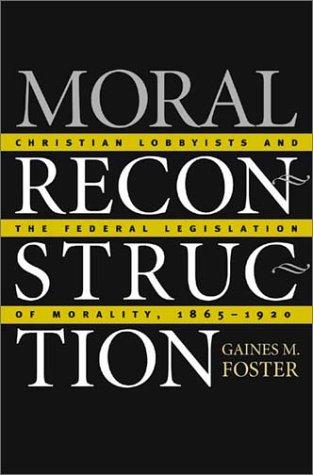
It is in no sense an overstatement to say that Gaines M. Foster's Moral Reconstruction: Christian Lobbyists and the Federal Legislation of Morality, 1865-1920 is a near perfect blend of historical insight and timeliness. Foster's simple book has simple scope: the examination of the rise of the Christian lobby in late nineteenth century America and the moral legislation it pursued. He makes clear, however, from the first sentence of the introduction that this is not intended to be a purely academic exercise. The rise of the Christian right in the late 1970s has made matters of the origins and precedents of religious lobbying and moral legislation issues of extreme importance for contemporary American moral polity. Foster convincingly suggests that the strongest, most germane parallel to the modern movement for moral reform is the late nineteenth century campaign to revise the moral character of the nation. The rise of the Christian lobby was more than merely a political shift or, as the lobbyists undoubtedly believed, an awakening of the American moral conscious in the face of some novel evil. It was a dramatic cultural and philosophical shift away from antebellum theories of states' rights, personal liberty, and moral suasion into new concepts of nationalism and corporate social responsibility. In this, and countless other nuances of Foster's book, there are striking ideological parallels to more recent impulses in American politics. In the interest of brevity, however, there are two points from Foster's work which stand out as especially noteworthy for reflection.

One of the most striking features of the Christian lobby, which Foster deliberately emphasizes in his narrative, was that even in its successes it understood and respected (or at least conceded to accept) the Constitutional limits of the federal government. There is little debate any longer about whether or not the federal government has some role in structuring national morality. As Foster will admit in his conclusion, few people object to the federal government having a hand in, for example, protecting children from the sexual advances of adults. In truth, most Americans probably do not even think of this in terms of the government legislating morality, though that is certainly what is occurring. As desensitized to the concept as modern Americans are, the idea that the government should make any universal laws regarding any morality was entirely foreign to early Americans. In fact, the Thirteenth Amendment represented something of a strange and wonderful novelty to nineteenth century Americans. They accepted that slavery was wrong (though some, only after being compelled by force of arms to accept that opinion), but that the government could seize the right to make that qualitative judgment was unusual. The Thirteenth Amendment would prove to be the justifying precedent cited most frequently by moral reformers.

Even with this powerful antecedent, the Christian lobby was forced to respect that most Americans understood the federal government to be restricted to a very small number of jurisdictions: interstate commerce, international treaties, administration of the military, and direct governance of the District of Columbia and the territories. In view of these limitations, the moral reformers were forced to pursue their agenda of national moral legislation within the confines of a traditional view of a limited federal government. They focused their efforts initially on enacting Sunday laws in DC, stricter divorce rules in the territories, prohibition in the military, and the restriction of interstate distribution of obscene materials (e.g. information on birth control). They understood that they could not make adultery illegal, but they did eventually convince the government that it had the power to make transporting a woman across state lines for the purpose of adultery should be. Even when the moral reformers did make their final push to outlaw the production and sale of all intoxicating beverages, Prohibition came with two important concessions to the limits of federal power. First, reformers readily admitted and accepted that Congress could not simply pass a law to achieve prohibition. A constitutional amendment would be necessary, as the Constitution did not give Congress the kind of sweeping moral power to outlaw behavior that the Christian lobby required. Second, in spite of initial attempts to include it, the provision which made possessing and consuming alcohol in one's home was removed from the wording of the amendment. The country was not ready to accept the idea that the government had the right to regulate moral behavior within one's own home. What authority it had, stopped at the domestic threshold. The home was a fortress, even if it was a den of wicked vice.

In addition to recognizing and working within the constitutional limits of the federal government, the history of the moral reformers teaches contemporary reformers and important lesson about the impermanence of moral reform. When the Volstead Act finally took effect, enforcing the Eighteenth Amendment, the reform periodical American Issue triumphantly declared, "The future historian will accord to January 16, 1920 a place second only to that of the advent of the Redeemer." Historians have a funny way of defying predictions. No one would today suggest that the onset of Prohibition in the United States was an event of permanent and global magnitude. Few school children know anything more than a passing quick fact about the Eighteenth Amendment and even less about the myriad moral reforms which preceded it. Even to the most conservative modern critic, the goals of the Christian lobby in the late nineteenth and early twentieth century seem antiquated if not comic. While many still oppose, largely futilely, ready access to abortion, on the most marginal members of society think it ought to be illegal to distribute information about birth control. Boxing, while not America's proudest past time, is legal to stage, promote, record, and distribute. (Imagine what the moral reformers would have thought of the mixed martial arts craze which has gripped the popular imagination.) The film industry not only escaped government content controls, but modern technology has made it possible for anyone and everyone to pipe any number of genuinely obscene pictures onto their computers, televisions, and telephones. Perhaps most notoriously at all, Prohibition was a miserable failure and social drinking (unlike boxing) is among the great American past times. From a historical perspective, efforts at national moral reform appear to have been the most dismal failure. Only a select few reforms from the period persist in any recognizable form: higher age of consent laws, laws against selling cigarettes to minors, and the end of mail delivery on Sundays. In his conclusion, Foster suggests that "the story of moral reconstruction provides no sure lessons to be applied to the renewed debate over legislating morality...but it does provide a historical context." Yet this historical context may in fact be the sure lesson which moral reformers need to learn; history has proved that it will be infinitely easier to repeal moral legislation than it was to pass it. It took the reformers nearly sixty years to enact prohibition through a constitutional amendment and only thirteen years for Americans to collectively regret and reject prohibition through another amendment.

There can be few complaints about Foster's work. Admittedly, it is dry, deeply encyclopedic reading which at times carries with it the uneasy feeling that one is actually just reading the congressional record. This impression is reenforced by the final eighty pages (or one quarter) of the book which is consumed by extensive appendices, notes, and other scholarly apparatus. At the same time, this exhaustive treatment reassures the reader that Moral Reconstruction is among the most well researched treatments of the period and subject that has yet been written. Though not a page turner for the average reader, the book is worth a second glance and more for professionals or dedicated hobbyists interested in grasping the historical context of ongoing movements among Christian especially to legislate a better moral polity for America.