Showing posts with label United States of America. Show all posts

Wednesday, January 23, 2013

Mitt Romney: A Failed Mormon Prophecy

Well, it's official. Barack Obama has been sworn in for his second term as president, and the news media has parsed all the important issues: eye rolling, lip syncing, and age-appropriate hair. Finally it feels appropriate to share an observation out of Mormon history when it should have none of the sourness of political partisanship (which I try so desperately to avoid).

In the Winter of 1855, with full blown war with the federal government on the not-so-distant horizon, Brigham Young, governor of the Utah Territory and leader of the Latter Day Saints, envisioned a time when America would fall into such a state of disrepair that the people would call on a Mormon to save them:

Brethren and sisters, our friends wish to know our feelings towards the government. I answer, they are first rate, and we will prove it too, as you will see if you only live long enough, for that we shall live to prove it is certain; and when the Constitution of the United States hangs, as it were, upon a single thread, they will have to call for the "Mormon" Elders to save it from utter destruction; and they will step forth and do it.

If the LDS church's loudest public voice is to be believed, America has reached that precipice. Then why the monumental failure of Mitt Romney to secure the presidency and save America? Could it be that Glenn Beck is wrong and ACORN, radical Islamic militants, and Reform Jews didn't conspire to put a socialist race-warrior into office? Or could he perhaps be right and Satan still holds the world in his thrall, leaving the saints to wait for the nation to get just a little bit worse before their final vindication? Is it possible that the Mormons in general and Brigham Young in particular were not actually gifted with any special ongoing revelation from God?

Let's table all those wonderfully provocative suggestions for the moment and consider another. One year earlier, Brigham Young had delivered a Fourth of July address as part of a series of speeches by prominent Mormons taking America to task for its partisanship and its failure to realize the lofty goals of the American Revolution. Young had his own observations about failures of the US in its highest office and proposed a different set of qualifications for the highest office. Maybe Romney failed to be the great Mormon savior of America because, it turns out, he's not the kind of man Mormon's thought the nation needed and the people deserved:

The people should concentrate their feelings, their influence, and their faith to select the best man they can find to be their President, if he has nothing more to eat than potatoes and salt--a man who will not aspire to become greater than the people who appoint him but be contented to live as they live, be clothed as they are clothed, and in every good thing be one with them.

[A man] capable of communicating to the the understanding of the people according to their capacity, information upon all points pertaining to the just administration of the Government. He should understand what administrative policy would be most beneficial to the nation. He should also have the knowledge and disposition to wisely exercise the appointing power, so far as it is constitutionally within his control, and select only good and capable men for the office. He should not only carry out the legal and just wishes of his constituents, but should be able to enlighten their understanding and correct their judgment. And all good officers in a truly republican administration will constantly labor for the security of the rights of all, irrespective of sect or party.

Tuesday, September 25, 2012

The Wisdom of Harry Stout

In the course of an article about the rhetorical world of the Federalist clergy, Harry Stout offers this delightful observation (which I have deliberately decontextualized so that you might take it however you like):

America is a disproving ground of logic.

Monday, August 20, 2012

The Politics of Gun Control

I read Blake Zeff's recent article on gun control and found myself unexpectedly impressed. The piece begins with this simple premise:

There's a reason that nothing's happening to improve gun safety in America despite the mass shootings that now occur so regularly: No one in power is scared of the gun control movement.

And he proceeds from there to discuss not so much the "why" of gun control, which becomes so immediately repetitive in the wake of so many recent shootings, but the "how." Taking his cues from the movement to legalize same-sex marriage, he explores how gun control advocates need to be willing to invest financially in the cause and to take control of how the debate is framed. Both are pragmatic suggestions and both have worked very well for the same-sex marriage movement. It is an interesting exploration of the technology of politics.


Zeff also attempts to locate the major obstacle that gun control will face that same-sex marriage will not. For him, this is the established opposition represented symbolically (and fiscally) by the NRA. Now, I am skeptical that opposition movements to same-sex marriage can really be described as "relatively weak and poorly organized," except in places where it likely would have made no difference to begin with, but the political might of the NRA does make for a substantial hurdle to overcome.

Zeff does not, however, note a more crucial difference between the two movements. The press for same-sex marriage was, fundamentally, an attempt to expand a set of rights (as we conceive of them). Gun control, for whatever its merits may be, is an attempt to narrow a set of rights. It is critical to note that I am not saying that owning an assault weapon ought to be a right. For that matter, I am not saying getting married should be either. In simple pragmatic terms, however, where same-sex marriage has been permitted, people have been allowed to do something legally that they could not previously. Were gun control enacted, something that people could once do legally would no longer be licit.

You can frame the position as a libertarian one, as Zeff does. You can cite statistics about gun violence. You can appeal to examples of European nations with little to no gun crimes. You can reframe the parameters of the debate, restructure the narrative as much as you want. At the end of the day, Americans have a deeply ingrained cultural aversion to abridging rights. One need only look at Prohibition, that most dramatic of all prohibitive laws, and note that it took nearly one hundred years of temperance movements to see Prohibition amended to the Constitution and only thirteen years of spotty or non-existent enforcement to see it repealed. Once Americans have a taste of something or even the knowledge of the potential to taste of something, telling them they can't have it violates a spirit that permeates our society.

Zeff notes that the statistical data which shows a small majority of Americans in favor of at least some form of gun control is rendered pragmatically meaningless when the question of who will be motivated to translate those positions into votes. it is my suspicion that many people who will never own an assault rifle, even people who will never own a gun, when the time comes to decide whether or not to restrict a activity they have no intention of participating in, they will react viscerally and decisively. The Enlightenment sense of entitlement, of rights, is more essential to American culture even than Christian morality. To overturn it will require a more herculean effort even than the marginal gains that have been made toward legalizing same-sex marriage.

That is not to say it can't be done. It obviously can be. Americans have, from time to time and with varying degrees of permanence, broached new frontiers of government restriction of behavior. It is not typical, but it is possible. What's more, it is not even my intention to argue against trying to achieve gun control. While I recognize that pressing gun restrictions, even to the point that we already have, is antithetical to the spirit of those founders who drafted and supported the Bill of Rights, I also don't owe them any particular loyalty. I'd be happier in an America with fewer guns. Or no guns, since in my experience they exist primarily for sport hunting and violence directed at people--aggressive and defensive, licit and illicit.

All of that is beside the point. The point is that Zeff, while making an interesting and likely constructive argument for the mechanics of achieving gun control, fails to accurately grasp the problem of his parallel to same-sex marriage. This is not like knowing how to grow cucumbers and using that to learn how to grow squash. This is like knowing how to grow cucumbers and trying to use that to learn how to ungrow them. It's a whole different ball game.

Sunday, April 29, 2012

Let's Talk about Sex

I recently watched the 2009 documentary Let's Talk About Sex. The stated purpose of the film is to examine adolescent sexuality and to try to understand alarming trends in American culture, such as rates of teen pregnancy and teen STD contraction significantly above that of any other "developed" Western nation. In truth, the documentary is a forthright apology for comprehensive sex education in schools and a frank criticism of abstinence-only education as an alternative. Everything else which is discussed is done so more-or-less as a footnote. This is not intended as a criticism; the filmmakers do very little to hide this motivating intention. Why should they? The nature of sex education is a matter of intense debate because it has real and dramatic consequences. When we realize that 7% of all women in America will become pregnant before they turn twenty and that, of those pregnancy that might otherwise be carried to term, 30% will end in elective abortion, it is hard to imagine anyone not concerned. The documentary rightly concludes that everyone wants the same thing: fewer teen STDs, fewer teen pregnancies, and fewer teen abortions.

To that end, the documentary offers at least three suggestions which, though by no means novel, warrant constant reiteration until they come to fruition:

  • Comprehensive sex education in schools:  The film cites studies which have shown there to be no correlation between abstinence only education and decreased rates of pregnancy or STDs.  While this alone is not enough to commend comprehensive sex education, it is hard not to look over to Western Europe with the remarkably low rates of teen pregnancy and STDs and wonder what our public education system is doing wrong.  The government has a legitimate public interest in preventing teen pregnancies and STDs, and the filmmakers rightly point out that the health hazard created by (or at least correlated with) teen ignorance costs the government multiple billions of dollars annually.
  • Greater involvement and candor from the religious community: Sex education is not simply a public health concern.  It is a moral and existential concern as well, and because of that it is imperative that the faith community take an active role in educating America's youth about sex.  At its most compelling, the film displays ministers earnestly seeking to balance moral truth with the pressing needs of adolescents in their congregations.  One commenter rightly points out that there was a time when the church was engaged meaningfully on social issues in a way not so readily reduced into the kind of moralizing which is only profitable for an audience to whom it is not applicable.  Preachers preach hellfire and abstinence, parents nudge their young children into purity pledges, and adolescents are swept along in ignorance.  The church needs to stop teaching teen classes on Song of Solomon and then washing their hands of their youth.
  • Parent centered solutions:  The church is not and should not be the most directly formative influence on an adolescent's life, and the state infinitely less so.  A great deal of the blame for the culture surrounding sex and particularly adolescent sex in America falls on parents.  Particularly guilty are those multitudes of parents who deflect responsibility onto the schools and churches, refusing to bring the issue of sex into the home except for a single, awkward, trite "birds and the bees" talk at the onset of puberty.  Surely parents haven't forgotten adolescence; surely they remember that sex is not something their teenagers think about once at thirteen, make a decision about, and then are never troubled again.  Sex pervades society, and even if it didn't, sex would still dominate the hormone addled mind of teenagers.  If parents really cared about their teen, cared more than they care about their comfort, they would be engaged regularly and openly.
While I wholeheartedly embrace the above as legitimate steps to be taken to mitigate the fall out from inevitable teen sex, there are problems with the way they are often presented and with the way the documentary presents them.  One of the reasons the issue has become so charged and why people who agree on the ends cannot unite on any common means is because people from both sides have too thoroughly draped their solutions with their peculiar ideologies.  It is no wonder that comprehensive sex education smacks of libertinism much in the same way that abstinence only sex education smacks of fideism.  Correctives are needed:

  • The public interest is a health interest: The state does have a legitimate interest in educating teenagers about sex, but the legitimacy of that interest does not legitimize the state offering up a normative ideology through the education system.  The very fact that comprehensive sex education is being used for this ought to raise deafening alarms in the Orwellian corners of our brain.  Comprehensive sex education needs to be comprehensive only in terms of its factual, scientific information and only as far as is prudent for preventing unwanted pregnancies and STDs.  Teach teens about diseases: how they are contracted, how they are treated, and how they are prevented.  Teach teens about pregnancy: how it happens and how it is prevented.  Demonstrate contraceptive use, offer resources for obtaining those contraceptives, discuss issues of consent (e.g. what constitutes "date rape"), and the importance of being assertive in demanding that you and your partner practice safe sex.  The legitimate concerns of the state end there, but for some reason that hasn't stopped some programs from tacitly or even explicitly passing qualitative judgements on sexual behavior.  They want to teach an ideology that homosexuality is good, that sexual experimentation is good, that anything is good provided it is done safely and consensually.  The documentary shows over and over sex education material that uses terms like "good," "healthy," "beautiful," and "fun."  The state should not be making those qualitative determinations.  Their job is to define what is legal; it falls to others to debate what is good.
  • The church does not need to abandon ideology:  The church, unlike the state, has a duty to make qualitative and moral judgments, and it is not the place of the government to restrict or direct those judgments.  Unfortunately, however, most of the churches that were shown actively participating in rigorous sex education were churches of a unabashedly liberal bent.  This leaning showed through clearly in the way they approached sex education, and the viewer might get the impression that the only way a church could be involved in sex education in a way that would please the filmmakers would be if they were conferring divine approbation on the secular sex agenda.  This need not be the case, however.  Churches, even conservative churches, can legitimately engage in rigorous and thorough sex education while continuing to make the argument that premarital sex is a moral evil and promoting heteronormative sexual ethics.  It is the ridiculously shallow "sex is bad if you do it before your married" line, coupled with vacuous purity ceremonies, that has made the church culpable in the crisis of teen sexuality, particularly the startling number of devout teens engaging in para-intercourse sex acts with impunity because "technically" they are still virgins.  A comprehensive, faith based sex education plan can make great strides in alleviating not only social, but moral and existential ills.  Begin with the truth that human sexuality, like everything else, is God-created, wonderful in its appropriate context, and devastating when improperly employed.  Acknowledge the intensity of temptation and the universality of human frailty.  Create an environment of accountability that minimizes shame and maximizes the edifying value of confession.  Most importantly, make the commitment ongoing.  Youth ministers and their congregations need to be thinking about sex as often as their teens are and devoting a proportionate amount of time and energy to their sex-related efforts.  Just because a church is seriously committed to sex education does not mean that they need to adopt the value judgements of liberal sexual ethics.
  • It isn't enough just to shift the blame to parents:  Everyone knows that parents need to be more involved.  The government has said it.  The churches have said it.  Even many parents, often hypocritically, have said it.  But just as parents are too often guilty of shifting the responsibility onto schools and churches, society seems largely uninterested in actually equipping and encouraging parents to talk to their children about sex education.  It is time that schools and churches made a greater effort to ensure that parents had both the tools and the motivation to be active in the sex education of their teens.  The documentary made a positive exhibition of a number of very progressive parents (e.g. parents who gave their teens condoms for their birthdays, who let their teens' significant others spend the night, who joked around the dinner table about their teens' sex life) but what was most striking is that many of the parents on display were just as ignorant as their teens.  They didn't know the statistics about sex or the myths that were floating around among teenagers.  There are some parents, paradoxically (and we shift out of the documentary and into personal experience here), who aren't even entirely sure of the mechanics of sex, pregnancy, and STDs.  Parents would benefit from programs offered by schools and churches specifically designed to educate parents about adolescent sex issues and about how to talk to teens about sex.  Small, interactive gatherings with teachers, counselors, and members of the clergy have significant advantages over whatever thirty year old "How to talk to your kids about sex" book that a parent might buy off Amazon.
Whatever its obvious biases and deficiencies--particularly in terms of proposing concrete, unifying solutions--Let's Talk About Sex is a documentary worth watching.  It is probably one even worth watching with teens, be they your children, your class, your youth groups, or your friends.  The film is informative yet entertaining, remarkably clean given the subject matter, and has tremendous heuristic value.  If nothing else, it can function as a great launching point for the conversations we all ought to have been having all along.  The issue is obviously too pressing for Americans to stick their heads into the sand and hope it goes away.

    Saturday, March 24, 2012

    The Myth of the Founding Fathers: Asking the Right Question

    As already noted, the appeal to the Founding Fathers has reached almost religious proportions in contemporary political rhetoric. Often they are appealed to in order to bolster political philosophies, economic schemes, or specific features of controversial legislation. Just as often, they are marshaled vaguely as political partisans of various stripes radically identify their own idiosyncrasies with the dead revolutionaries in an effort to legitimize not only their politics but themselves as Americans. These attempts are usually met with appropriately graded degrees of incredulity. One feature of the debate about the Founders, however, seems to drawn continual attention on every level of society: what was the faith of the Founders? The question is supposed to provide the answer to the all-important question of whether or not America is a Christian nation. Unfortunately, too few people seem to realize what historians and academics are painfully aware of: the faith of the Founders is irrelevant.

    "The eventual construction of a national identity, or a national culture, involved many factors, but one that contributed almost nothing was the religion practiced by the founding fathers themselves." So says Mark Noll, revealing what ought to have occurred to countless thoughtful people at every level of discourse. The Founders, however broadly you want to construe that category, were not ministers, they were not religious leaders, they were not spokesmen for the nation’s faith. They were political theorists, in their best moments, and more often simply politicians much of the same sort we have today. They never presumed to speak for the nation or even to be representative of it. They meant only to construct a government and then to commend that government to the people for their approval and interpretation.

    It is in this latter role that the real folly of tying the religion of the nation to the religion of the Founders becomes evident. When we examine only the Constitution and the thought of its various authors, we ignore that they did not invest it with its significance or even its authority. Only when referred to the people does the Constitution become representative of and normative for American government. Therefore whether or not the Constitution, and thus the government it defines, is a purely secular one rests not with the authors but with those who interpreted and applied it. In describing his purpose in writing God of Liberty, Thomas Kidd points out, "So much of the popular discussion of faith and the American Founding revolves around the personal faith of the major Founders. This is an interesting topic, but I don't actually think it tells us much about the role that religion played in the larger process of creating the American republic. So I sought to broaden the focus to the level of the public religious principles that helped unite the Patriots. These included religious liberty, the importance of virtue, the dangers of vice, the principle of equality by creation, and the role of Providence in human affairs." These popular religious notions are infinitely more important because their influence on the development of a national identity and control over politics at every level were more direct.

    Yet, as Kidd points out, these common religious notions actually unified Christian and secularist alike: "When you look at these principles, it is easier to understand why people of such sharply differing personal beliefs as Thomas Jefferson and the Baptist evangelist John Leland could cooperate so enthusiastically during the Revolution." If the interest in the faith of Jefferson and Madison is intended to establish whether or not America was founded on Christian principles, the explicit faith of either is largely inconsequential. It takes a person of profound historical ignorance to assume that when Jefferson and others appeal to Nature and Nature's God in an effort to discover the universal principles which ought to govern human relations, their vision of that universal God is Christian. It may be diluted and contorted, but it is not the same vision of a secular "Creator" that they would construct had they been Hindu or Muslim or even Jewish. Jefferson was quite clear that he believed Jesus to be a uniquely qualified revealer of the true nature of the world and ethics. The principles that guided his political thought were the principles of Christianity filtered through the prism of eighteenth century natural theology, even and especially the principle of religious pluralism. Consider the argument of Catherine A. Brekus and W. Clark Gilpin: "Christianity in America is not neatly contained under the steeples of its churches or the governing bodies of its denominations but has, in addition, extended out into other sectors of society. If Americans do not always recognize the Christian influence on their culture, it is because its omnipresence has made it virtually invisible."

    Ultimately, it ought to be clear that the religious thought of the Founding Fathers, while interesting in itself, is not particularly relevant to the question of whether or not America is a Christian nation. There are other more pertinent questions we might ask. What did the people who ratified and applied the Constitution believe about the Christian character of the nation? What distinctively Christian impulses or thought modes governed the apparently construction of an apparently secular Constitution? Of course, as I argued previously, the question of first importance needs to be why do we care at all what eighteenth century Americans thought and, if it is important, what is a responsible way to apply that information? Still, Stephen Prothero comes closest to providing answers about the Christian character of the republic from its outset, doing so in a way that displays a delightful penchant for Christian paradox:

    There is logic not only to President John Adams’s affirmation in the Treaty of Tripoli in 1796 that “the government of the United States of America is not in any sense founded on the Christian religion” but also to the Supreme Court’s 1892 observation that “this is a Christian nation.” In short, the long-standing debate about whether the United States is secular or religious is fundamentally confused. Thanks to the establishment clause, the US government is secular by law; thanks to the free exercise clause, American society is religious by choice. Ever since George Washington put his hand on a Bible and swore to uphold a godless Constitution, the United States has been both staunchly secular and resolutely religious.

    Saturday, March 17, 2012

    Myth of the Founding Fathers: Illusions of Innocence

    It would seem strange to me to "review" a book that is now nearly twenty-five years old, and so I won't try. Still, Illusions of Innocence is a work which demands regular revisiting both as a cogent historical analysis and an insightful critique of American culture. It was in the former capacity that I picked it up recently, planning to reread portions while I waited for a new book to arrive and satisfy my thirst for historical inquiry. Yet, as I flipped through the pages I found myself drawn in by the strong undercurrent of criticism which it offers for America's ongoing self-image. It is, therefore, with regard to how Hughes and Allen's work speaks to contemporary issues that I wish to turn, specifically with what may be said about the recent explosion of interest in the founding fathers.

    The authors' purpose in Illusions of Innocence is simple yet fundamental: to examine how primitivism functioned in American society throughout history. While the focus is on the seventeenth through nineteenth centuries, they do not shy away from stepping beyond their stated scope into the twentieth century. Primitivism may be loosely defined as the belief in a sacred, universal primordium which stands outside of time and outside of human influence and to which it is imperative that humanity return. The authors identify two ways in which primitivism has functioned. On the one hand, the primordium can in judgment of the present and act as a guard against any attempts to universalize the particulars of a given culture. In American political thought, this can be typified in Jefferson and the belief that there is a fundamental, natural man who has essential, unalienable rights which transcend time and culture. On the other hand, a group may claim to have definitively captured the primordium, thus identifying their own particular features with universal, sacred truth. Again using American political thought, there is the belief that because America has first and best recognized and enshrined those natural, fundamental rights of man America therefore has the right to impose its representation of those values on other cultures (making the world safe for Democracy). In short, one either believed that the primordium could not be recovered and everyone should therefore be free to approximate it as each saw fit or believed instead that the primordium had been recovered and everyone should be compelled to conform to it.

    For early American political theorists--the likes of Jefferson, Adams, and Paine--the primordium which provided the sacred tool for ordering the present was man in his natural state, straight from the hand of the "God of Nature." For the Puritans, the primordium was the covenanted nation of Israel. For most indigenous American religious groups, it was the early church. While Americans often disagreed on precisely what the sacred primitive moment outside of history was, depending on where their allegiances lay, they all agreed that there was such a primordium to be sought after with varying degrees of success. Hughes and Allen cite Sidney E. Mead's The Lively Experiment to summarize the three characteristic assumptions of American religion: "the idea of a pure and normative beginnings to which return was possible; the idea that the intervening history was largely that of aberrations and corruptions which was better ignored; and the idea of building anew in the American wilderness on the true and ancient foundations."

    In the recent American political climate, a new (or at least revitalized) primordium has been identified and seized upon by Americans, particularly Republicans. Ron Paul says, "One thing is clear: The Founding Fathers never intended a nation where citizens would pay nearly half of everything they earn to the government." Newt Gingrich muses, "I think Jefferson or George Washington would have rather strongly discouraged you from growing marijuana and their techniques with dealing with it would have been rather more violent than our current government." Michelle Bachmann humorously insists, "Well if you look at one of our Founding Fathers, John Quincy Adams...He tirelessly worked throughout his life to make sure that we did in fact one day eradicate slavery." Appeals to the founding fathers and the Constitution--which, like the Bible, is assumed to be self-interpreting--have exploded onto the political scene as Republicans seek to root and therefore legitimate their beliefs in a mythic, sacred past.

    What's more, it is working, and why shouldn't it? Primitivism has always had a tremendous rhetorical effect for Americans because we share in a cultural assumption of exceptionalism, a belief that we stand outside of and in judgment of the profane history and culture of the world. The Puritans founded a fresh and efficient government on primitivist pleas. The Disciples created the fifth largest American denomination of their time in a single generation on the basis of a restoration of the primordium. The South seceded from the Union with primitivism at the heart of its identity. It should be unsurprising then that contemporary politicians should seize on the sacred founders of American civil religion--so eerily analogous to the apostles in the Christian religion--who stand in judgment of our present apostasy. Republicans, thankfully, have seen "the normative beginnings to which return was possible," have identified that "the intervening history was largely that of aberrations and corruptions which was better ignored," and are selling to the public "the idea of building anew...on the true and ancient foundations."

    The parallels between the way the founding fathers have been seized upon as a sacred American ideal and the way primitivism has constantly manifest in American religion ought to be immediately striking. This only heighten the irony, then, when Hughes and Allen quote from Carl L. Becker's Heavenly City, in which Becker offers a criticism of the Enlightenment thinkers whose thought undergirds the Revolutionary experiment. The same criticism which Becker levels against the founders (among others) has an obvious and direct application to those who marshal their memory to their cause today:

    ...they are deceiving us, these philosopher-historians...But we can easily forgive them for that, since they are, even more effectively deceiving themselves. They do not know that...[what] they are looking for is just their own image, that the principles they are bound to find are the very one they start with. That is the trick they play on the dead.

    Of course, Becker is entirely correct. They do deceive themselves more thoroughly than anyone else. This is precisely the reason why the frequent appeals to history on the part of their opponents fall on deaf ears. Just like Disciples and Mormons and Puritans before them, history has no currency in the founding fathers zeal because the founding fathers stand apart from history, as do their modern proponents who have recaptured their values. The ideology which has been discovered in the fathers is an ideology which is immune to the criticism of reason or history; it is the critic of reason and history. It doesn't matter if in a strictly academic sense John Quincy Adams is not a founding father. Insofar as he is representative of the primordial spirit of the fathers, the invocation of his name is appropriate. It doesn't matter that Jefferson and Washington (and other tobacco lords) probably would not have worked for the violent suppression of marijuana growers in actuality because the ideology they have become synonymous with would be amenable to such action in the present context. Ironically, with the same primordium in mind, Ron Paul can ignore history and context and the changes each have wrought in the way government must operate and make the historically defensible assertion that the founding fathers never conceived of income taxes in their present form.

    The purpose here is not to climb up on a high horse to point and laugh at the ignorant Republicans with their primordial myth. It certainly isn't do endorse the Democrats as an alternative. (Like David Lipscomb, I foolishly believe I stand outside of such political partisanship.) In fact, the Democrats have an equal and opposite myth of progress in which they universalize a particular vision of the future rather than of the sacred past to which all reasonable, humane people must attain. While the route is more circumspect, they too--like most Americans--find their way back to grounding this formative myth in a primordium of human rights (intrinsic and apart from the circumstantial trappings of history). Instead, the purpose is to identify, and in doing so hopefully mitigate, the impact of defining myths in our culture. It is to help to reform the appropriate questions, distancing ourselves from the all to easy "Is that really what the founding fathers thought" and getting to the more basic "Should we even care what the founding fathers thought?"

    To be sure Hughes and Allen do not want to assert that there are no universals or that they are totally inaccessible, though surely there is no small number of academics today who would agree with one or the other of those premises. Instead, the ongoing purpose of their work and the intent of this reflection on the founding father hysteria is to provide "checks and balances" against too nearly identifying any one person or groups ideology with the universal. Here, perhaps, we have Roger Williams as a model with whom we may critically interact:

    For Williams, the radical finitude of human existence, entailing inevitable failures in understanding and action, makes restoration of necessity an open-ended concept. The absolute, universal ideal existed for Williams without question. But the gap between the universal and the particular, between the absolute and the finite, was so great that it precluded any one-on-one identification of the particular with the universal...the best one could do was approximate the universal, an approximation that occurred only through a diligent search for truth.

    Thursday, March 15, 2012

    J. W. McGarvey: On Repentance

    The following is part of an ongoing commentary on J. W. McGarvey's Sermons Delivered in Louisville Kentucky. For an introduction to and table of contents for the series, see Happy Birthday, J. W.
    -------------------------------------------------------------------------

    In all likelihood, the title of McGarvey’s sermon “Conditions of Forgiveness” would have chaffed against many nineteenth century Christians the way that it would grate on modern ears. No one likes the idea, much less the explicit language, of conditional forgiveness. We prefer to think of salvation in terms of “a free gift,” without delving too deeply into how the offering and the reception of that gift might play out practically. In truth, however, McGarvey’s points are not all that radical and are probably less so by modern standards than nineteenth century ones. His three conditions of forgiveness are faith, repentance, and baptism, and he makes very clear that belief that “Jesus is the Messiah, the Son of God” is the bedrock on which the other two rest. He makes clear, both in this sermon and the following sermon (“Faith,” which was treated in the previous entry), that he falls well within the bounds of Protestant sole fide dogma.

    McGarvey insists, nevertheless, that faith must be an active faith. Just as in faith, Enoch walked with God, Noah built his ark, and Abraham uprooted his family, the faith of the Christian must be productive or else, in the words of James, it is dead. In view of this, he launches proudly into what amounts to a month long defense of his belief that faith must manifest itself in practice. Even to an audience of Disciples who must have largely shared his beliefs about the necessary outgrowths of faith, McGarvey admits that nothing is more difficult than translating that belief into action:

    The greatest obstacle to the salvation of men is the obstinacy of the human will. It is not very difficult, in this country particularly, to induce men to believe the Gospel--to plant faith within the soul. Indeed, we may say it is difficult in our blessed land for a man to be an unbeliever. Multitudes of men try to be, and fail; and some women do the same. And even when they think that they have succeeded in persuading themselves that there is no truth in the Gospel or in the Bible, often, when they come to face death, their unbelief vanishes, and they find themselves among the number who believe and tremble. Neither is it very difficult to persuade men to be baptized, when they become penitent believers. I have never yet met with a person, who was a genuine believer and sincerely penitent, that raised any question about being baptized. They are ready to go where they are led.

    The difficulty is to induce them to repent. I have often, in my preaching experience, studied and prayed and reflected and read, to find some way by which I could have more power in inducing people to repent. I would rather have that power than all the other powers and gifts that could be bestowed upon me as a preacher. But we modern preachers need not be discouraged, I think, on account of our weakness here, because we find, on reading the Gospels, that our Saviour experienced the same difficulty. When He was bidding farewell, or about to bid farewell, to Galilee, where the most of His mighty works were done, and upbraided the cities whose people had heard Him most, it was not because they did not believe; it was not because they refused to be baptized by John; but it was because they did not repent. With all the tremendous efforts that He had put forth to bring them to repentance, He had failed. Not surprising, then, that there should be found the same difficulty in the way of modern preachers.

    The same is obviously true in our own day, and McGarvey’s specific critiques of America still ring true. The profession of belief continues to be widespread, and many would argue (though with diminishing success) that it is difficult to be a genuine atheist in American culture. There is an abundance of faith in the States, at least faith defined as a profession of belief. What Americans lack—and what perhaps all Christians have struggled with—is manifesting that belief in practice. Looking at Jesus’ critique of the unrepentant Galileans, McGarvey imagines that much the same criticism will be made of America. That is why he concludes “that this city, and this State, and this country of ours, are the worst places on this broad earth from which to go to hell…Why? Because, if that which has been done in your midst had been done in Sodom, it would have lived.”

    What McGarvey is calling for is not merely proliferation of good works, and any accusation of merit based salvation is either uninformed or malicious. He goes into minute detail, risking the damning accusation of being one who likes “to multiply words,” to explain that good works may be the fruits of repentance and sorrow over sin may be its cause but that the true essence of repentance is a change of disposition. In many ways, his view of repentance mirrors that of his understanding of faith. To come to believe is to shift the mind from confidence in itself about things seen to confidence in God about things unseen. This same transition happens in the will through repentance. It turns from an impulse toward sin to an impulse toward righteousness.

    When we take this understanding of repentance as situated less in behavior than in the will, we begin to find grounds on which to approach understanding in Christian ethical discourse. I am by no means one to shy away from the rigorous and frequent examination of moral behavior, and I as often as not disagree stridently with those around who seem to propound a Christian ethos (particularly when it smacks of jingoism, chauvinism, or militarism of any kind). But Christians need to realize that to repent from one’s sins is not to receive an infallible understanding of right and wrong. It is only to commit oneself to pursuing the right instead of the wrong. I will never stop trying to convince my fellow Christians who are politicians or soldiers that their vocations are incompatible with Christian ethics. I will never stop combating the notion that abortion can be morally justified through appeals to exigent circumstances. This is in no sense an appeal for ethical agnosticism. At the same time, we all need to understand that, just as a faith in a common God does not automatically equal a perfect understanding of that one God, our common repentance from evil does not automatically ensure a perfect and common understanding of what the good is to which our will is now directed.

    Tuesday, January 31, 2012

    Another Blow to the Myth that Secularism is Neutral

    While teachers in religious schools may be sitting on the edge of their seats, Christian counseling students are breathing a sigh of relief today. In part of what is becoming a trend of high-profile legal victories for religious liberty, the 6th District U.S. Court of Appeals has ruled in favor of an Eastern Michigan University student who was dismissed from her program after requesting that a homosexual patient be allowed to be transferred to another counselor.

    Julea Ward, a student in the university’s graduate level counseling program, had only four courses remaining to earn her degree when she enrolled in a one-on-one counseling practicum in 2009. As part of the practicum Ward was assigned a potential client “seeking assistance regarding a sexual relationship that was contrary to her religious convictions,” explained the Alliance Defense Fund (ADF), the legal advocacy group that represented Ward in the case. “Ward recognized the potential conscience issue with the client, and asked her supervisor how to handle the matter.”

    After directing her to turn the client over to another counselor, EMU officials informed Ward that in order to stay in the counseling program she would have to undergo a “remediation” program designed to deal with her unsatisfactory viewpoint regarding homosexual relationships.

    "Remediation" was apparently not pretty, and after undergoing what her attorneys described as an ideology-driven flogging by unsympathetic members of the faculty, Ward was booted from the program. In spite of this, she has won the day, and while I obviously disagree with Christians finding recourse for justice in the legal system, I cannot help but be glad that this basic right of conscience is being preserved in the system. In its report on the ruling, the court issued an important clarification, one which I first encountered in Stephen Prothero's Religious Literacy:

    Surely, for example, the ban on discrimination against clients based on their religion (1) does not require a Muslim counselor to tell a Jewish client that his religious beliefs are correct if the conversation takes a turn in that direction and (2) does not require an atheist counselor to tell a person of faith that there is a God if the client is wrestling with faith-based issues. Tolerance is a two-way street. Otherwise, the rule mandates orthodoxy, not anti-discrimination.

    This critique hits the mark squarely. What the counseling department at Eastern Michigan was insisting on was an adherence to a competing ideology, one which endorses certain behaviors without qualification. The problem is a persistent one in the counseling field, and--in the very few courses in counseling that I have been required to take--I have heard horror stories from professionals who have been turned out of jobs, schools, and professional societies for an unwillingness to compromise their values and encourage patients to engage in behaviors which they believe to be ultimately destructive. This stretches beyond questions of sexuality. One such counselor shared that he had fought most of his career against the prevailing notion that there are times when it is appropriate to counsel a couple to divorce. Taking the biblical prohibition on divorce seriously, he refused to budge and (according to his rendition) has suffered as a result.

    Certainly there are greater challenges being faced by Christians, even here in the religiously comfortable climes of theologically temperate North America. Still, there should be a strong sense of victory here both for Christians and proponents of religious freedom. After all, anti-discrimination has been slowly creeping (though, at times, it feels more like a headlong rush) closer and closer toward positive pluralism as a litmus test for academic, social, and professional acceptability. People have incorrectly confused disapproval with discrimination and have been too quick to infringe on each other's freedom to disagree. Even everyone's government-given right to be an idiot. That means that Christians can take principled stands (with such offensive attendant actions as referring patients to therapists who do not share their moral qualms, thus benefiting both patient and counselor), homosexuals can have left-coast parades in leather thongs, Westboro baptists can ascribe hatred and vindictiveness to God, occupiers can stand up for their incendiary, binary view of society by squatting on public land, and birthers can stack conspiracy theory on conspiracy theory until their house of cards crumbles. If this country is really committed to the kind of blind, non-intrusive freedom it claims to be, then that includes not only your freedom to be a heteroromantic asexual but also Julea Ward's freedom to refer you for treatment elsewhere and the Lutheran Church's freedom to not employ people who, contrary to clear Christian teaching, choose to settle Christian disputes in secular courts.

    Monday, January 23, 2012

    Hart Casts More Pearls Before Swine

    David Bentley Hart has a new article out in the January edition of First Things, so naturally my heart is all a-flutter. My first impulse is obviously to take this brief thousand-or-so word article and compose a voluminous, multi-part series on its many strengths and weaknesses. Since, however, I only just completed one such exercise in shameless intellectual fawning, I will try to condense my reflections on "The Precious Steven Pinker" to a single entry.

    As the title suggests, Hart's article is responding to Steven Pinker's latest effort, The Better Angels of Our Nature: Why Violence Has Declined. At its core, this work is essentially the antithesis of Hart's earlier Atheist Delusions: The Christian Revolution and Its Fashionable Enemies. Pinker's aim is to demonstrate how, contrary to popular perception (and Hart's academic conclusion), the world is actually a safer, less violent place than in dark times past. Further, Pinker wants his readers to believe that the cause of this improvement has been the rise of "reason" and the abatement of religion. Hart deftly identifies three core problems with this assessment.

    1) The Myth of the "Dark Ages"

    Pinker, being himself a psychologist and not a historian, falls all to easily into the common fable in the popular canon of historical myth that there was such a time as the "Dark Ages" when everything was horrible, all the advances of classical civilization were lost, and blind, corrosive faith reigned supreme. In Hart's own words, Pinker's "almost cartoonish" treatment of the Middle Ages consists in him presenting them "as a single historical, geographical, and cultural moment" easily encapsulated in the caricature which dominates vulgar discourse. In truth, the Middle Ages (inappropriately so-called) were a diverse time both of great progress (whatever that may mean) and great tragedy, depending on when, where, and of whom we are speaking.

    [Pinker] says nothing of almshouses, free hospitals, municipal physicians, hospices, the decline of chattel slavery, the Pax Dei and Treuga Dei, and so on. Of the more admirable cultural, intellectual, legal, spiritual, scientific, and social movements of the High Middle Ages, he appears to know nothing. And his understanding of early modernity is little better. His vague remarks on the long-misnamed “Wars of Religion” are tantalizing intimations of a fairly large ignorance.

    It is difficult to write a history of violence without at least some firm grasp of history.

    2) The Myth of the secular "Enlightenment"

    Pinker will make the same error of two dimensional thinking with his reconstruction of the Enlightenment. He sees "not the dark side of the “Enlightenment” and the printing press—“scientific racism,” state absolutism, Jacobinism, the rise of murderous ideologies, and so on—but the nice Enlightenment of “perpetual peace,” the “rights of man,” and so on." There is a greater error that Hart exposes in Pinker's treatment of the Enlightenment, however, and that is the assumption that its positive advances (and there were many) were somehow purely secular. He ignores that many of the ideas of the Enlightenment had their root directly and relevantly in religious, "unreasonable" concepts which preceded them. Pinker acknowledges know sense of continuity, no genetic association between the thought of the "dark ages" and that of the Enlightenment.

    Pinker’s is a story not of continuous moral evolution, but of an irruptive redemptive event. It would not serve his purpose to admit that, in addition to the gradual development of the material conditions that led to modernity, there might also have been the persistent pressure of moral ideas and values that reached back to antique or medieval sources, or that there might have been occasional institutional adumbrations of modern “progress” in the Middle Ages, albeit in a religious guise.

    Polemicists--particularly those who are not historians--make this error in almost every attempt to marshal history to an ideological cause. Consider the ongoing argument in American politics about whether or not the country was founded on Christian ideas. The question should not be--though it too often is--was Benjamin Franklin an agnostic or James Madison a deist? The issue is with the proximate and ultimate cultural sources of ideas such as "perpetual peace" and "the rights of man" which characterize the Enlightenment and encapsulate the core principles of the American experiment.

    3) The Flaw in Comparative Statistics

    Perhaps the most pernicious of Pinker's errors is not historical but statistical. There is an ongoing debate which centers around whether or not to adjust statistics about violence to account for population figures. Pinker is of the school of thought that violence should be measured statistically as a figure of violent deaths per capita. This certainly has an objective reasonableness to it. After all, it would not due to say that the total combined wealth of the United States in the 1920s was ten billion dollars, that it was one hundred billion dollars in the 2000s, ergo people are ten times wealthier now than they were then. That is, however, precisely the problem. Pinker's argument understands human life in the same way that it does money. In truth, we intuitively realize that a single human life has an absolute value which cannot be comparatively reduced. Pinker's statistics leave no room for this distinction.

    But statistical comparisons like that are notoriously vacuous. Population sample sizes can vary by billions, but a single life remains a static sum, so the smaller the sample the larger the percentage each life represents. Obviously, though, a remote Inuit village of one hundred souls where someone gets killed in a fistfight is not twice as violent as a nation of 200 million that exterminates one million of its citizens...In the end, what Pinker calls a “decline of violence” in modernity actually has been, in real body counts, a continual and extravagant increase in violence that has been outstripped by an even more exorbitant demographic explosion.

    Hart points out other flaws in Pinker's statistical methods as well, including the increased life expectancy and decreased infant mortality, each of which Hart believes skews the numbers in support of Pinker's theory.

    The most enjoyable part of Hart's article is certainly his surgical evisceration of Pinker's argument, but Hart concludes on a milder note, praising the stream of Pinker's thought for not succumbing to the crushing weight postmodernism. He waxes poetic, as he so often does, about the beautiful, inviolable faith of those who pretend to be faithless. In truth, the above does not begin to mine the riches which I believe are embedded in all of Hart's prose, but I will leave it to interested parties to read the remainder of the article. It is certainly well worth it.

    Thursday, January 12, 2012

    Compelling Morality: Our Redundant History


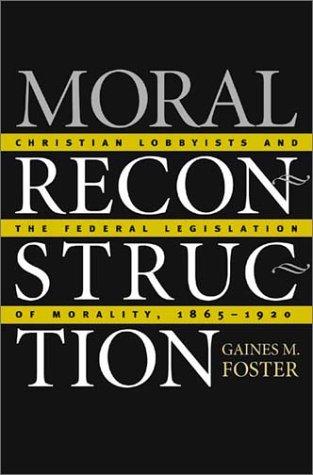
    It is in no sense an overstatement to say that Gaines M. Foster's Moral Reconstruction: Christian Lobbyists and the Federal Legislation of Morality, 1865-1920 is a near perfect blend of historical insight and timeliness. Foster's simple book has simple scope: the examination of the rise of the Christian lobby in late nineteenth century America and the moral legislation it pursued. He makes clear, however, from the first sentence of the introduction that this is not intended to be a purely academic exercise. The rise of the Christian right in the late 1970s has made matters of the origins and precedents of religious lobbying and moral legislation issues of extreme importance for contemporary American moral polity. Foster convincingly suggests that the strongest, most germane parallel to the modern movement for moral reform is the late nineteenth century campaign to revise the moral character of the nation. The rise of the Christian lobby was more than merely a political shift or, as the lobbyists undoubtedly believed, an awakening of the American moral conscious in the face of some novel evil. It was a dramatic cultural and philosophical shift away from antebellum theories of states' rights, personal liberty, and moral suasion into new concepts of nationalism and corporate social responsibility. In this, and countless other nuances of Foster's book, there are striking ideological parallels to more recent impulses in American politics. In the interest of brevity, however, there are two points from Foster's work which stand out as especially noteworthy for reflection.

    One of the most striking features of the Christian lobby, which Foster deliberately emphasizes in his narrative, was that even in its successes it understood and respected (or at least conceded to accept) the Constitutional limits of the federal government. There is little debate any longer about whether or not the federal government has some role in structuring national morality. As Foster will admit in his conclusion, few people object to the federal government having a hand in, for example, protecting children from the sexual advances of adults. In truth, most Americans probably do not even think of this in terms of the government legislating morality, though that is certainly what is occurring. As desensitized to the concept as modern Americans are, the idea that the government should make any universal laws regarding any morality was entirely foreign to early Americans. In fact, the Thirteenth Amendment represented something of a strange and wonderful novelty to nineteenth century Americans. They accepted that slavery was wrong (though some, only after being compelled by force of arms to accept that opinion), but that the government could seize the right to make that qualitative judgment was unusual. The Thirteenth Amendment would prove to be the justifying precedent cited most frequently by moral reformers.

    Even with this powerful antecedent, the Christian lobby was forced to respect that most Americans understood the federal government to be restricted to a very small number of jurisdictions: interstate commerce, international treaties, administration of the military, and direct governance of the District of Columbia and the territories. In view of these limitations, the moral reformers were forced to pursue their agenda of national moral legislation within the confines of a traditional view of a limited federal government. They focused their efforts initially on enacting Sunday laws in DC, stricter divorce rules in the territories, prohibition in the military, and the restriction of interstate distribution of obscene materials (e.g. information on birth control). They understood that they could not make adultery illegal, but they did eventually convince the government that it had the power to make transporting a woman across state lines for the purpose of adultery should be. Even when the moral reformers did make their final push to outlaw the production and sale of all intoxicating beverages, Prohibition came with two important concessions to the limits of federal power. First, reformers readily admitted and accepted that Congress could not simply pass a law to achieve prohibition. A constitutional amendment would be necessary, as the Constitution did not give Congress the kind of sweeping moral power to outlaw behavior that the Christian lobby required. Second, in spite of initial attempts to include it, the provision which made possessing and consuming alcohol in one's home was removed from the wording of the amendment. The country was not ready to accept the idea that the government had the right to regulate moral behavior within one's own home. What authority it had, stopped at the domestic threshold. The home was a fortress, even if it was a den of wicked vice.

    In addition to recognizing and working within the constitutional limits of the federal government, the history of the moral reformers teaches contemporary reformers and important lesson about the impermanence of moral reform. When the Volstead Act finally took effect, enforcing the Eighteenth Amendment, the reform periodical American Issue triumphantly declared, "The future historian will accord to January 16, 1920 a place second only to that of the advent of the Redeemer." Historians have a funny way of defying predictions. No one would today suggest that the onset of Prohibition in the United States was an event of permanent and global magnitude. Few school children know anything more than a passing quick fact about the Eighteenth Amendment and even less about the myriad moral reforms which preceded it. Even to the most conservative modern critic, the goals of the Christian lobby in the late nineteenth and early twentieth century seem antiquated if not comic. While many still oppose, largely futilely, ready access to abortion, on the most marginal members of society think it ought to be illegal to distribute information about birth control. Boxing, while not America's proudest past time, is legal to stage, promote, record, and distribute. (Imagine what the moral reformers would have thought of the mixed martial arts craze which has gripped the popular imagination.) The film industry not only escaped government content controls, but modern technology has made it possible for anyone and everyone to pipe any number of genuinely obscene pictures onto their computers, televisions, and telephones. Perhaps most notoriously at all, Prohibition was a miserable failure and social drinking (unlike boxing) is among the great American past times. From a historical perspective, efforts at national moral reform appear to have been the most dismal failure. Only a select few reforms from the period persist in any recognizable form: higher age of consent laws, laws against selling cigarettes to minors, and the end of mail delivery on Sundays. In his conclusion, Foster suggests that "the story of moral reconstruction provides no sure lessons to be applied to the renewed debate over legislating morality...but it does provide a historical context." Yet this historical context may in fact be the sure lesson which moral reformers need to learn; history has proved that it will be infinitely easier to repeal moral legislation than it was to pass it. It took the reformers nearly sixty years to enact prohibition through a constitutional amendment and only thirteen years for Americans to collectively regret and reject prohibition through another amendment.

    There can be few complaints about Foster's work. Admittedly, it is dry, deeply encyclopedic reading which at times carries with it the uneasy feeling that one is actually just reading the congressional record. This impression is reenforced by the final eighty pages (or one quarter) of the book which is consumed by extensive appendices, notes, and other scholarly apparatus. At the same time, this exhaustive treatment reassures the reader that Moral Reconstruction is among the most well researched treatments of the period and subject that has yet been written. Though not a page turner for the average reader, the book is worth a second glance and more for professionals or dedicated hobbyists interested in grasping the historical context of ongoing movements among Christian especially to legislate a better moral polity for America.

    Tuesday, October 18, 2011

    Blame to Go Around

    A recent USA Today poll shows that more Americans blame the federal government than "Wall Street" for their financial plight, if only marginally more. In fact, while 78% seem willing to ascribe a great deal of the blame to Wall Street, only slightly more, at 87%, believe the government also shoulders much of the blame. While the article focuses on the fact that more than twice as many Americans answered that they blame the federal government more for the bad economy, the more important feature of the polls seems to be that the overwhelming majority of Americans seem to have the good sense to blame both. After all, if there is anything that can match the federal government avarice and malicious self-interest, it is Wall Street. The two are locked in an eternal cosmic game of one-upmanship when it comes to playing free and loose with other people's money.

    What the article seems to be missing, however, is a statistic for the number of people who think that they themselves are to blame for the financial crisis. In fairness, neither the government nor Wall Street are actually sentient, independent entities. They are both collectives of people who do what their constituencies want, be that the voting public or consumers and shareholders. More importantly still, people seem to be ignoring the fact that the American government and American financial institutions learned fiscal responsibility at the feet of the masters, the American public. We're all quick to point out how unconscionable it is for the government to borrow forty cents of every dollar it spends, but we don't seem at all concerned with the countless millions of dollars which the American public has amassed in credit card debt, car loans, mortgages, and students loans. The whole twenty-first century financial paradigm is structured around the maxim that you can get it today and pay for it later. I recently read an article in a waiting room magazine about how revolutionary the introduction of GMAC was because it freed people of the burden of saving up to buy cars and allowed them to purchase on credit. The idea was distasteful to Ford and his antiquated fiscal sensibilities. Now, it is the idea of paying for a car, or much of anything, upfront which is anomalous.

    It is perhaps time for Americans to realize that there is plenty of blame to go around, to accept the brazen hypocrisy of those of us with student loans or credit cards or mortgages attempting to lecture the government or Wall Street about the reckless abandon with which they spend other people's money. It is especially time for Americans to stop wondering about whether or not the financial system is "personally fair to them" and begin to ask whether or not they, the public, are not equally to blame for a government, a financial sector, an entire culture that thrives on fiscal irresponsibility

    Thursday, October 13, 2011

    Government Involvement in Marriage and Its Ironic History

    In his book Moral Reconstruction, a history of moral lobbying and legislation between the Civil War and Prohibition, Gaines M. Foster recalls a period at the turn of the century when Christian lobbyists and special interest groups were pressuring the government for stricter laws regarding marriage and divorce. Interestingly, among the measures proposed was an amendment to the Constitution which would explicitly give the federal government power over marriage. In all, forty-two resolutions to give the government power over marriage were introduced to Congress between 1892 and 1920, none of which received so much as a favorable committee report. Given the striking parallels between the moral polity of the period and the current political climate (a secondary purpose of Foster's book), the three reasons given for the widespread failure of reformers to achieve such federal legislation is intriguing:

    1) Such legislation met with overwhelming opposition in the South because many southerners feared it would result in federal intervention in state antimiscegenation laws.

    2) The American Bar Association and the Interchurch Conference opposed the measures because they preferred state measures to regulate marriage and divorce.

    3) Christians could not effectively mobilize support for legislation because there was widespread disagreement about precisely what the Bible said about marriage and divorce.

    The obvious, superficial irony is immediately apparent. Unlike contemporary movements to grant the federal government powers over marriage, Christians and southerners were the key to opposing extending federal powers. The role reversal becomes even more pronounced when one considers that the new support for such measures in the South is born out of the desire of southerners to have their peculiar discriminatory marriage laws universalized. In the past, southerners feared for their idiosyncratic conception of a "true" marriage. A look at the history of moral legislation would seem, thankfully, to justify the fears of nineteenth century southerners rather than bolster the aspirations of those in the 21st century. Granting moral power to the federal government tends to have a liberalizing effect on public morality. Which makes almost amusing the fact that so many supposed supporters of "states rights" also support an amendment granting the federal government a new and unprecedented field of power, while their predecessors had the foresight one hundred years ago to oppose federal involvement in marriage consistent with a belief in restricting the power of the federal government.

    In the interest of learning from history, it is perhaps time to realize that whether moral legislation fails (as did federal marriage legislation at the turn of the century) or succeeds (as did Prohibition), in the long term the tendency of the federal government is never toward stricter moral codes. If American history is any judge, progressive moral ideologies win the war of attrition, and time is a surer constant than political favor.

    Monday, July 4, 2011

    A Dear John Letter to Uncle Sam

    Dear Sam,

    I don’t know of any easy way to say this, but it’s over between us. I think we have both known it for a long time and just didn’t want to admit it to ourselves. We’ve been growing apart for years and the time has finally come to say goodbye. I would like to say that it’s not you, it’s me, but that wouldn’t be entirely true.

    Sure, I’m young and idealistic; my expectations may not be realistic. I want someone who can keep his promises to me, someone who is always faithful not by happenstance but by nature. I need safety that isn’t transient and superficial, security that doesn’t understand economic crisis or “imminent” threats to “national security.” I need someone who has principles that run deeper than campaign promises and political expediency. I believe that there is someone out there like that. Someone who promises justice and delivers more than a reasonably high rate of accuracy for convictions and executions. Someone who doesn’t confuse liberty with libertinism. Someone who seeks peace through means other than bribery and intimidation. Someone like that.

    As for you, I just don’t feel the same way about you that I did when I was young and naïve. I find that I am no longer willing to stand up and pray to your star spangled god. I am no longer content to sign my name to the roll and wait for you to call on me to rise up and kill, to lie down and die for oil or for land, for a confused notion of right or a vague and misplaced specter of exceptionalism, and certainly not for an innate sense of duty that I neither feel myself nor understand in others.

    I know what you’re going to say. I’m just displaying the ignorance of my youth. Look at the sacrifices you’ve made for me. Look at how much better my life is with you in it. Look at the joy, the freedom, the strength, the protection that you provide. I’m not buying it. You’ve told those lies to others before me and you’ll get still more after me to believe them. But not me. I’ve outgrown you or, perhaps more accurately, outwitted you. I know that for you strength is synonymous with violence. I know that when you say protection you mean from other people just like you, weaker maybe but fundamentally no different. I know that for you freedom includes freedom for you to whore yourself out to every corrupt behavior and ideology that you can rationalize. I won’t buy into the lie that to be a good person, a good citizen, a good Christian means to surrender myself to you wholesale and slip silently into a fog of materialism, militarism, republicanism, pluralism, capitalism, and jingoism.

    So you’ll excuse me if I don’t show up at your birthday party. I’m not sure if I know what there is to celebrate. Of course, you’ll see me around from time to time, and I’ll have things to say to you as a curious bystander might. Any time I come across something that belongs to you, I’ll gladly send it your way, but as far as I’m concerned, you’re welcome to ignore me altogether. I will, of course, be praying for you, but not the way I might pray for a parent or a spouse or even a brother or sister. I’ll pray for you the way a china shop might pray for a bull. With a little luck and divine intervention, you may do as little damage as possible, given what you are.

    Respectfully (but not regretfully),
    The Itinerant Mind

    Saturday, June 4, 2011

    Gay Marriage: It's the American Way

    I have previously voiced my belief that it is patently unamerican that homosexuals are not allowed to marry in this country. I frankly cannot understand why the American government (at the behest of the American people) is involved in sexual ethics at all. It is legal in this country for two men to hold hands, to kiss, to have sexual intercourse, to cohabitate, to adopt children (with a little hoop jumping), to grant each other power of attorney, and to name one another in their wills. If twelve male dwarves wanted to have an orgy in a vat of chocolate pudding, they could do it legally and make the pet parrot watch. We may be disgusted by it (and I may never each chocolate pudding again after concocting that image), but there seems to be a pretty general consensus that our government should not be involved in the sexual behavior of consenting adults. It boggles my mind, in view of all this, that so many Americans would take such a firm stand on whether or not homosexuals can enter into the (unfortunately) public contract of marriage.

    And since we are talking about the "rights" of homosexuals anyway, now seems as good a time as any to share a selection from Ron Paul's Liberty Defined on this very issue:

    Most Americans do not question the requirement to obtain a license to get married. As in just about everything else, this requirement generates unnecessary problems and heated disagreements. If the government was not involved there would be no discussion or controversy over the definition of marriage. Why should the government give permission to two individuals for them to call themselves married? In a free society, something that we do not truly enjoy, all voluntary and consensual agreements would be recognized. If disputes arose, the courts could be involved as in any other civil dispute…

    I’d like to settle the debate by turning it into a First Amendment issue: the right of free speech. Everyone can have his or her own definition of what marriage means, and if an agreement or contract is reached by the participants, it will qualify as a civil contract if desired…

    I personally identify with the dictionary definition of marriage: “The social institution under which a man and woman establish their decision to live together as husband and wife by legal commitments or religious ceremony.” If others who choose a different definition do not impose their standards on anyone else, they have a First Amendment right to their own definition and access to the courts to arbitrate any civil disputes.


    While I do not recall Paul mentioning it, I think it warrants remembering that marriage licences have been used throughout the past century of American history by the government in order to enforce what it believes are acceptable standards for marriages. In times not so long past, the government protected us from the possible catastrophe of marriages between whites and blacks or, worse still, Japanese! The practice is not as distant as we might like to believe. At some point, it might be nice if the people realized that they did not need the government to protect them from the gay menace. If you don't want to marry, befriend, or even break bread with a homosexual, then you are more than welcome not to. In the meantime, if you do not want the government poking around in your private contracts (or your privates in general) then it is the height of hypocrisy to demand that it interfere with the affairs of everyone else.