“We met today for social worship and the elder no being present, the deacon and the brethren would not lead in worship; the sisters went ahead and had singing, prayer and Bible reading. Did we do right? Would it have been right for a sister to have led in the breaking bread?”
In our judgment, you did just right. And if you had added the Lord ’s supper to observances, we should still say you did right. If a company of sisters in a neighborhood in which no brethren lived were to assemble for reading and prayer, what would there be to hinder their observance of the Lord’s supper? And if brethren are present and refuse to lead in the worship, no one can charge that the women usurp authority over them, if they go forward in the performance of duties from which the men shrink. Certainly, such men should never complain because the women outstrip them in zeal and faithfulness.
Tuesday, April 30, 2013
Some Standard Wisdom for the Proactive Church Lady
Having highlighted the seedier side of Stone-Campbell views on the prospects and methods for evangelizing the newly freed slaves, let us turn now to a more egalitarian note. This comes from the Querists' Drawer where Errett and his editorial staff answered questions on belief and practice sent in by readers. Here Errett comes to the defense of some women fed up with their unmotivated fellow congregants.


Friday, April 26, 2013
It's an Arbor Day Miracle: A History of the Tennessee Badlands
 |
| Image by UNC Press |
The Ducktown Basin, Maysilles explains, was a geography that cried out for disaster. The rich copper deposits right on the surface were too tempting for miners to ignore. Transportation deficiencies made the raw materials too expensive to transport off site to smelt. The sulfur content of the rocks was unusually high, creating unusually toxic smelting smoke. The geography of the basin was such that the smoke, once in the air, could not escape and dissipate into the atmosphere. The moist climate of the temperate rainforest meant that the chemicals were constantly being delivered back into the the soil in the form of toxic rain. The resulting concentration of chemicals in the air and water stripped the soil, killed the trees, and launched a legal battle between the state of Georgia and the mining companies that made it all the way to the Supreme Court on multiple occasions.
Intrigued as I was by this untold story and fortunate enough to be going to east Tennessee for a visit, I took the opportunity to drive down to Ducktown and see what remained of the infamous badlands created through ignorance, negligence, and geographical misfortune. The answer: very little. At the Ducktown museum, which commemorates both the mine and the unusual topography it created, the woman behind the desk took me with pride to a satellite photo of the region from some decades ago. She recalled with pride, "The only two man made things you could see from space were the Great Wall of China and the Tennessee Badlands." The nostalgia poured out of her as she remembered a time when, stripped of all flora and fauna, she need not worry about snakes or mosquitoes like her neighbors outside the basin in the lush Tennessee mountain forests. "It's too bad," she told me, "because we just look like everyone else now." Maysilles tells a different story, one of workers who had to have separate car for work and everything else because just by driving into the basin the air would begin to peel away the paint. He shares, perhaps for the first time for modern eyes, the stories of small subsistence farmers who had their land stripped of its fertility and, when they protested, found themselves fired from the mines where they worked to supplement their income. He tells of a single woman who spent years in court seeking damages from the mining companies and won, only to have her settlement reduced to one dollar on appeal. Memory is truly a curious phenomenon, and it is difficult to sort out whose story should take precedence: Maysilles, the outside critic, or the woman at the museum who grew up in Ducktown and whose husband was a mine worker.
In any case, the story does not linger in the confusing days of the Tennessee Badlands. Cooperative ventures by the government and the various industries who have controlled the mining companies over the years have struggled to make the basin green again. These herculean efforts to reforest have been largely rewarded, though not immediately and not without struggle and expense. Driving over the crest and into the basin, we noticed no difference between the forests without and the forests within. The Ducktown Basin is teeming with life again, even snakes and mosquitoes. As the reforestation began to take hold, many in the basin, I suspect the woman at the museum among them, lobbied to have a piece of the badlands preserved as a memorial. It was actually this memorial that I had traveled out to see, a relic of the way the basin had looked when it was an environmental catastrophe and a tourist attraction. Here then, is the arbor day miracle. The reclamation efforts have been so successful, life so insistent on reclaiming the dead basin, that it is a struggle to keep the last little bit of badlands in its pristine, unnatural state. Here it is, as it appeared at the time of my visit, trying to fight off the invasion of trees, but failing so completely that the little saplings are springing up even in the steep slope that terminates in a flooded mineshaft:

Maysilles has given the curious and patient reader a wonderful glimpse into a largely ignored subject. His interest is primarily in the way the legal battle continues to be cited in major environmental cases today. Mine was in the hidden treasure that had been in my backyard all the years I lived in Tennessee but that I had never known about until I left. A law student told me recently that she loved the way Maysilles had made obscure legal principles comprehensible, in ways that even her text books couldn't. Whatever it may be, if something about Ducktown has peaked your curiosity, I highly encourage picking up this book. I also wholeheartedly recommend that anyone in the region make a journey down to Ducktown to explore. The drive is beautiful (no matter what direction you come from), the community is quaint, and the history is engaging.
And if you should stop in and see the precious little old woman at the museum desk, tell her you read about her online and that there are still people fascinated by her community, even if they "just look like everyone else now."
Tuesday, April 23, 2013
Some Standard Wisdom for Converting Blacks
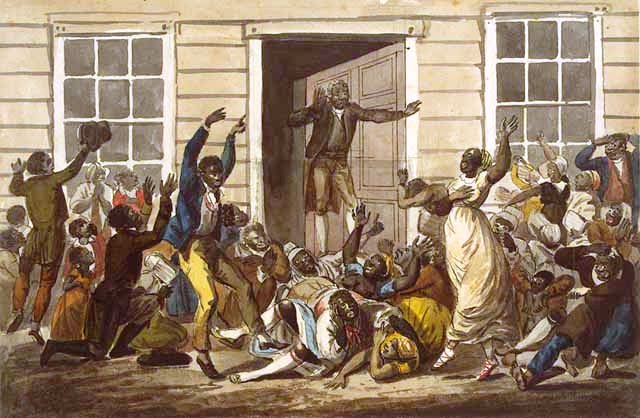 Less than a month into this series, I already feel the need to sound the reminder that in quoting some of these articles, my intent is not to endorse or make light of or even to stand in judgment of some of the darker sides of late nineteenth century thought. This warrants particular restatement with the following article by J. W. Crenshaw. It would be easy to read the below and assume either that my intent is racist or callous or anarchonistically judgmental. It is none of these. Instead, the following article sounds, among other things, a pair of themes that I have tried to reiterate here in various ways. The first is the need to complicate the narrative of the Civil War that we all learned in school: the North invaded the South to free the slaves and give blacks their rights. Historians have almost entirely abandoned this carefully constructed fiction, but the public still casts the Civil War in these terms, failing to see the stark racism and paternalism that dominated in the North no less than the South. The other is the sinister overtones that education often takes on in the hands of progressives. It's a message that has ongoing merit.
Even if neither of these themes were present, however, the following is important to read both for those in the Stone-Campbell Movement because it is part of our collective history the consequences of which we continue to live with in the de facto racial segregation of our churches and for Americans in general who need to be forced to read chapters of our history which serve neither to glorify US nationalism or to provide the starting point in a narrative of national redemption. What follows in "Difficulties in Christianizing the Colored Race" is precisely the shades of grey that we all need to grapple with in the formation of our historical consciousness.
As to what the future of the colored race of America is to be, socially, politically or religiously, we do not believe any one can conjecture with any degree of accuracy. Naturally superstitious and with their race prejudices to contend with, we approach them more from a sense of Christian duty than from any hope of achieving grand results. To succeed in our mission work among them we must agree upon some decided policy. If properly approached, we do not believe that there is a better missionary field in the world.
Experience has proven that we can not reach them through the preaching of white men. The colored leaders now, excepting a few, are ignorant and superstitious. In what direction, then, does hope lie? Certainly not in this shouting generation. The hope and the only hope, speaking from experience, is in the children. And when we educate a few colored men, as we have been doing for this work, we must not measure their success by converts made. The children, who are just learning to read, are the ones most benefited. Those whom we send out must be impressed with the importance of continuing to sound into the ears of the auditors that Christianity is something more than shouting the clothes off in the first part of the night, and serving Satan the balance of the night. We need to select young men of good character to educate them for this work. There are brethren among us who have the means to help build such a school as we need for this purpose. With the plain gospel plea that we have, if loving liberal hearts, could be interested in this work, in the next generation many of the difficulties that now so hinder our progress could be surmounted, and thousands of this unfortunate race could be Christianized.
Brethren, this is a question worthy of the attention of every Christian.
Sunday, April 21, 2013
The Wisdom of J. Gresham Machen
J. Gresham Machen is one of my intellectual heroes and the man at whose metaphorical feet I (like so many others) first learned Greek. Here he is on the anti-intellectualism of his fellow conservatives:
The Church is perishing to-day through the lack of thinking not through an excess of it.
Friday, April 19, 2013
In Other News
| Thanks to the DPLA, images like this are accessible to all! |
In less exciting news, the church institutional continues to disgrace itself on a variety of fronts. The Episcopal Church has won a "victory" in its civil case against itself before the Virginia Supreme Court.
The panel affirmed a lower court’s decision that the 3,000-member congregation, which voted in 2006 to leave the Episcopal Church, did not have the right to keep the sprawling property known as the Falls Church.
The Falls Church property is one of the country’s largest Episcopal churches and is a central landmark in downtown Falls Church.
The breakaway congregation, now called the Falls Church Anglican, has been worshiping in the Bishop O’Connell High School auditorium in Arlington County while it sought to overturn the Fairfax County Circuit Court decision from last year.
On Thursday, the Supreme Court affirmed that the property was rightly given to the mainline denomination but said some of the nearly $3 million in church coffers belongs to the Falls Church Anglican congregation.
I put "victory" in scare quotes because it hardly seems appropriate to call either side victorious when both have so miserably failed the basic standard of Christian charity and forbearance, applied particularly to this situation by Paul in 1 Corinthians 6. "Why not rather suffer wrong? Why not rather be defrauded?" Probably because Paul's churches never had anything like three million dollars in its "church coffers." If it did, maybe Paul wouldn't have been so quick on the draw with that "to have lawsuits at all with one another is already a defeat to you" nonsense.
The Orthodox Church global is having its own struggles. At the end of a long saga that has witnessed significantly more diligence than Catholic handling of sexual misconduct, Bishop Matthias has resigned. The head of the Chicago diocese of the Orthodox Church in America could no longer bear the odium of his sexual misconduct scandal and finally yielded to pressure from above to step down. In a deferential address--a momentary lapse from his conspiratorial theories about a liberal plot to manufacture his ouster--he expressed hope that "my stepping down will end the ordeal, allowing the diocese to move toward healing," and asked "for everyone's forgiveness for my failings, my mistakes and sins." He then graciously offered to forgive everyone else, for what is not entirely clear. Maybe he forgives the woman who misunderstood his "inappropriate words that I thought were being received as humorous." That certainly is the way this sincere apology feels: "I am sorry that my kindness and generosity to this person was viewed with suspicion and ulterior motives." Growing up, when I made apologies like that I got slapped. I suppose being stripped of your diocese is the ecclesiastical equivalent.
In Prague, a much bigger fish has been fried by a much sexier scandal. Metropolitan Krystof, the head of the Orthodox Church in the Czech Republic and Slovakia, has stepped down after scandal broke about his lascivious life. The prelate is alleged to have had an affair with the wife of one of his priest's and of fathering numerous illegitimate children. With all the talk of progress in Europe, it seems they are still very much medieval over there.
Tuesday, April 16, 2013
Some Standard Wisdom for Purifying Politics
Some of the most interesting and surprising stories in the Christian Standard are in the "Current Topics" section, a kind of miscellany that includes comments on current news, politically charged barbs, and sarcastic quips. Here is a tidbit about one of what have probably been hundreds of failed political reform movements (should we read in this a prediction of how history will treat the Occupy movement?). Whatever its ultimate fate, the editorial staff at the Standard had high hopes for what seems to be a fairly simple proposition:
We hail with joy the Independent Scratchers, whose mission is a purification of politics. It is urged that while the worst elements of a party may secure the nomination of unfit men, nothing but the apathy of the best elements will secure their election. T he independent scratchers propose to defeat those men—and only those—on a ticket who are known to be corrupt. This will force the nomination of honest men, and be an effectual “brake” on machine politics. It has already done effective service, and is destined to play an increasing part in our public affairs.
Monday, April 15, 2013
Denying the Holocaust: Albany Teacher Suspended for Teaching Nazism
 |
| The Nazis are stealing your children! |
As part of the 10th grade English persuasive writing assignment, the Albany High students were asked to pretend their teacher is a Nazi government official who must be convinced they believe Jews are the source of Germany's problems: "You must argue that Jews are evil, and use solid rationale from government propaganda to convince me of your loyalty to the Third Reich!"
The teacher is on leave, facing possible termination, because school officials and government leaders were appalled. Said Superintendent Vanden Wyngaard, "You asked a child to support the notion that the Holocaust was justified, that's my struggle. It's an illogical leap for a student to make." Said New York City Councilmen David Greenfield, "The teacher responsible for coming up with and assigning students with this task must be held accountable for attempting to indoctrinate children with anti-Semitic beliefs." Said Director of the Jewish Federation Shelly Shapiro "It's not how you teach about how prejudice has led to genocide."
Well it certainly was not how I was taught that prejudice led to genocide. I learned, "Prejudice leads to genocide. It happened with the Nazis. So don't be prejudiced like the Nazis." And that was it. Something tells me that Shapiro is short-selling the pedagogical value of what is happening here. These students, in addition to learning a valuable lesson in English (because no creative writer has only had to write the perspective of laudable characters with whom everyone agrees), would take away from this assignment a powerful and deep understanding of not merely the tired truism that "prejudice has led to genocide" but an experience of precisely how it led to genocide. It teaches the student, in the most basic way, what it was to be a civilian in Nazi Germany, under a government that flooded the intellectual marketplace with antisemitic propaganda and expected you to learn a new cultural script to mirror it. The applications extend far beyond merely a better grasp of the history of 1930s Germany to a life lesson in the way propaganda continues to be employed and continues to shape the thinking of citizens around the world. Some clever honors student might even have concluded that the consumption of media in contemporary America might be shaping his or her thought in similar ways.
Renowned scholar of religion and American culture Stephen Prothero draws much the same conclusion:
I think it’s Greenfield who is lacking in common sense here. And it's the superintendent who is being illogical.
I suppose it is possible that the teacher is a closet Nazi attempting to reconstruct the Third Reich in Albany. But isn’t it more likely that he or she is trying to teach students about the dangers of propaganda and the horrors of the Holocaust?
Consider the student who felt “horrible” about doing this assignment. Is that really a bad thing? How are high school students today supposed to feel about Nazism and the Holocaust?
Apparently, what they are supposed to feel (and think) is nothing, because the lesson high school teachers are going to take away from this fiasco is to avoid this topic at all costs, lest they risk losing their jobs.
Prothero points to a further dimension of "this fiasco," the special place of the Holocaust in the American imagination. Historian John Fea has pointed out that if the principles espoused here to teaching the Holocaust were universally applied, teachers could no longer teach the thinking of Puritans who killed witches, settlers who killed Native Americans, southerners who kept slaves, nativist who oppressed Catholic immigrants, etc. What a moralistic history we are left with! And an incomplete history at that, a half history. Of course, no one would ever suggest hamstringing historians on those topics because they are not blessed by the kind of special pleading that surrounds the Holocaust. There is no villain like Hitler, no enormity like the Holocaust, and no racism like antisemitism. That, in the end, is the kind of lesson we were taught by the two-dimensional treatment of Nazism in school. No depth, no perspective, because the history of Nazism is alone a truly simple matter in history. It is a lesson against thinking for most students, and it is a tragedy that this teacher should suffer for bringing thought--in the form of an entertaining thought experiment the like of which I never enjoyed in high school or college--back into the subject of Nazism.
I hope the teacher is reinstated, because termination over something so ridiculous is unthinkable. I also hope the teacher is fired, because to take any punishment, even a slap on the wrist, and then return willingly to that environment of educational repression strikes me as a tacit admission that the teacher actually did something wrong. Of course, the teacher is probably sitting at home now worrying about paying bills, working long enough to retire some day, and coping with social ostracism. So what I really hope is that whatever the teacher wants happens. It's a shame that it had to go this far.
Subscribe to:
Posts (Atom)